
Slavery in Dominica
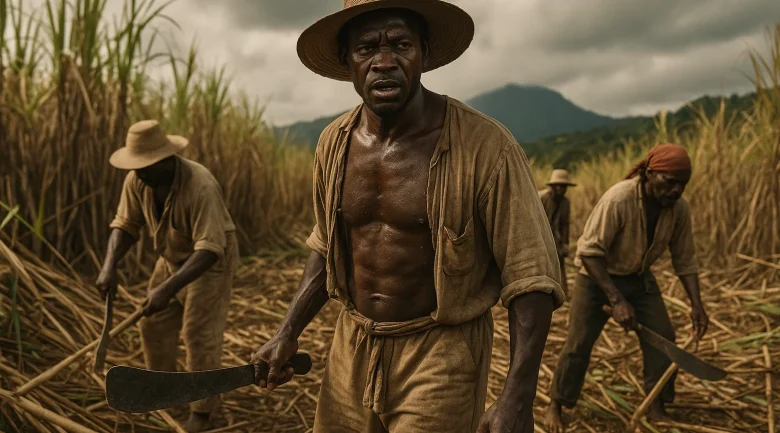
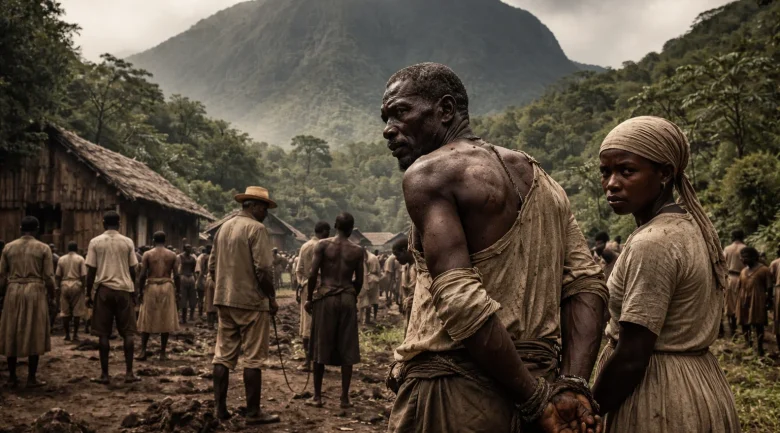
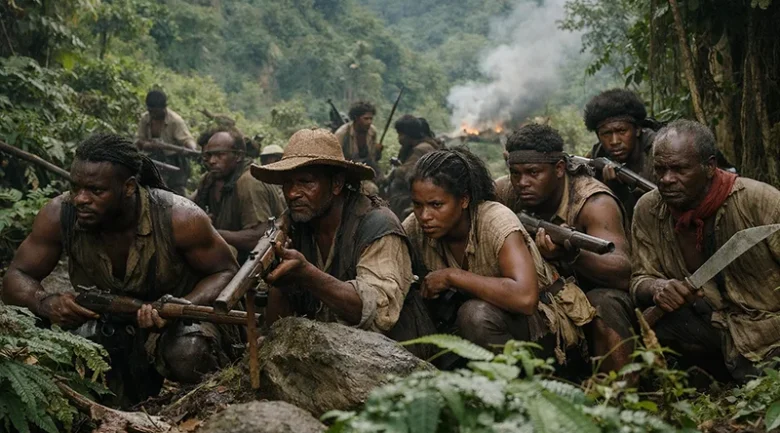
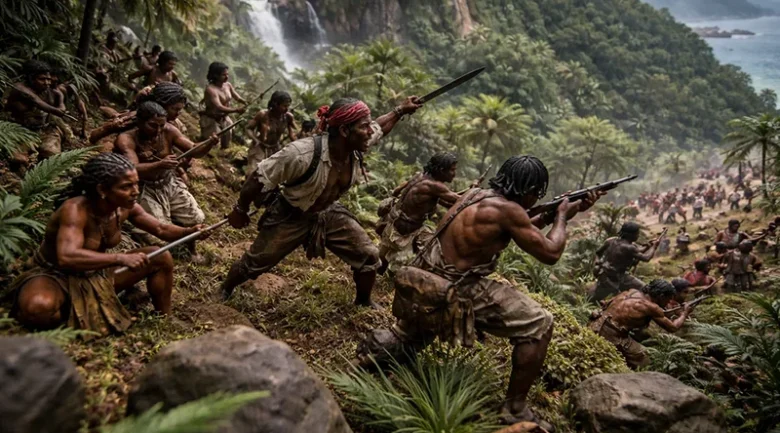
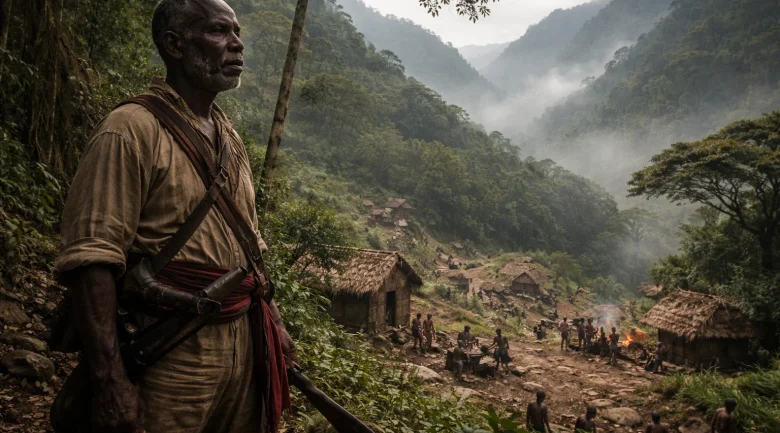
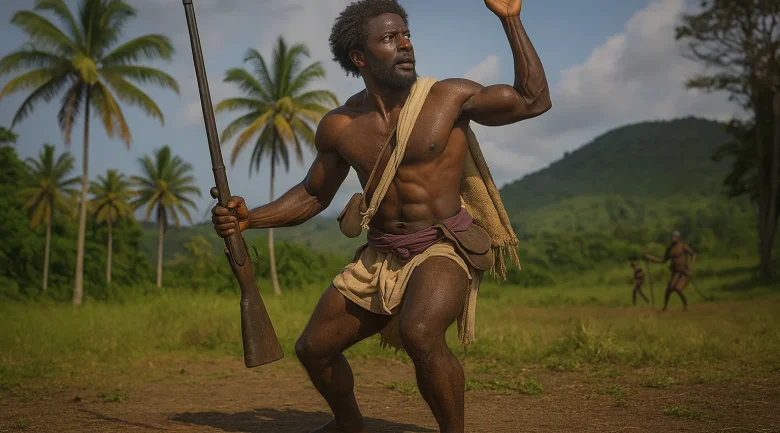
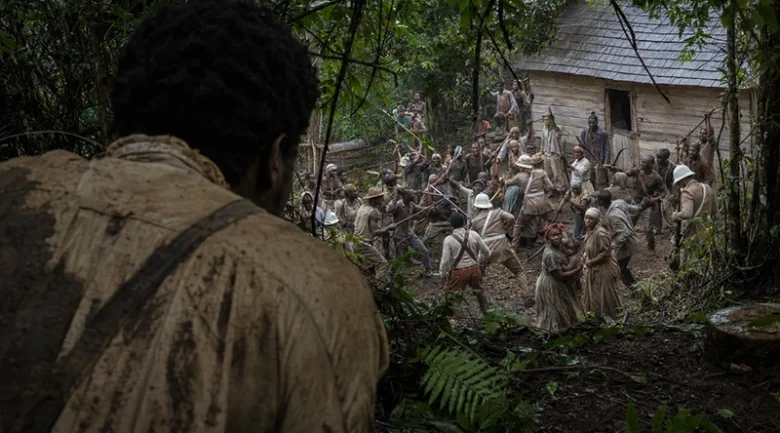
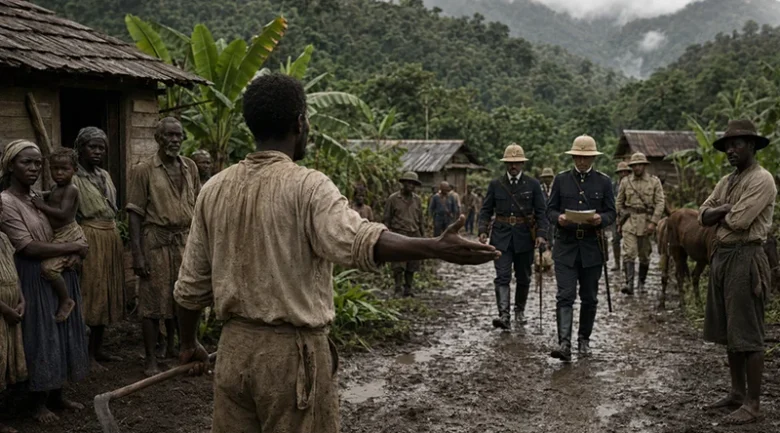
Slavery in Dominica stands as one of the most structurally distinct chapters in the history of the transatlantic slave trade. From its inception under French frontier settlers in the late 17th century to its legal abolition under British administration in the 19th century, the institution of human bondage on the island was dictated by a singular, unyielding variable: geography.
Unlike flat, heavily deforested sugar-producing colonies such as Barbados, Antigua, or Saint-Domingue, Dominica, known globally as the Nature Island of the Caribbean, presented a vertical terrain of dense rainforests, razor-sharp mountain ridges, and deep river ravines.
This landscape made absolute physical confinement impossible. As a consequence, the history of slavery in Dominica was a continuous, multi-century negotiation of power, characterized by a fragile coastal plantation fringe that spent its entire existence terrified of its own laborers and the heavily armed Maroon sovereign states that ruled the interior peaks.
Pre-Columbian Foundations and the Frontier of Resistance
To understand why the plantation system took root so late in Dominica relative to the rest of the Lesser Antilles, one must analyse the initial contact era. The island was originally inhabited by the indigenous people, the Kalinago, who called the island Waitukubuli (“Tall is her body”).
When Christopher Columbus and Dominica crossed paths during his second transatlantic voyage on Sunday, November 3, 1493, he named the island after the day of the week (Dominica). However, the Spanish Empire found the island virtually impossible to conquer. The combination of the island’s sheer cliffs and the sophisticated guerrilla warfare tactics of the Kalinago turned Dominica into a military graveyard for early European expeditions.
Throughout the 16th and 17th centuries, Dominica served as a regional sanctuary for indigenous groups fleeing Spanish, French, and English slaughter on neighbouring islands. The Kalinago weaponised the island’s topography so effectively that in the 1748 Treaty of Aix-la-Chapelle, Great Britain and France officially agreed to declare Dominica a neutral island, leaving it to the permanent sovereignty of the indigenous population.
Yet, this geopolitical neutrality created an economic vacuum. It invited unauthorized, rogue settlements by French logging parties and smallholders from Martinique and Guadeloupe, who brought with them the first small cohorts of enslaved Africans, quietly laying the groundwork for the future plantation state.
The Dual Imperial Imprint: French vs. British Slave Systems
Dominica’s legislative and cultural history is defined by a chaotic transition between two competing European empires, resulting in a hybrid Afro-Creole society found nowhere else in the British West Indies.
French Settlement and the Frontier Coffee Economy (1690s–1763)
By the early 18th century, French inhabitants had established extensive agricultural pockets along the sheltered leeward coast of the island. Because they lacked the immense capital required to clear massive tracts of land for industrial sugar mills, these French pioneers focused on high-value, low-infrastructure crops: cultivating coffee, cocoa, and cotton.
These crops thrived on the slopes of the island’s fertile volcanic soils and required significantly smaller labour forces than sugar estates. The French planters governed their workers under the formal mandates of the Code Noir (Black Code) of 1685. The Code Noir was rooted in a paternalistic, Romanist legal philosophy mixed with Catholic state policy:
- It legally mandated that all slave owners baptize their enslaved workforce into the Roman Catholic Church.
- It established theoretical state-enforced minimum standards for food, clothing, and old-age care.
- It legally banned the separate sale of husbands, wives, and prepubescent children.
However, the punitive realities of the Code Noir were brutally sadistic. It aimed to suppress any attempt at escaping into the mountains (marronage). An enslaved person absent for a month was legally subject to ear-cropping and branding with the fleur-de-lis. A second offence resulted in hamstringing, and a third resulted in judicial execution.
Because the French planters typically lived on their estates rather than managing them from Europe, they formed deep, complex local lineages. This permanent residency rooted the French-Kweyol language and Catholic traditions firmly into the social fabric of the enslaved population.
The British Takeover and the Sugar Revolution (1763–1834)
The geopolitical landscape was shattered in 1763 when the Treaty of Paris officially ceded Dominica to Great Britain following the Seven Years’ War. The British viewed Dominica not as a modest coffee frontier, but as an untapped zone for industrial sugar production. They immediately established a formal legislative House of Assembly in Roseau, entirely dominated by newly arrived white British Protestant planters, and set out to violently convert the island’s ecology.
The British Crown surveyed and divided the island into systematic lots, selling them at high prices to speculators. They rapidly cleared the low-lying river basins and coastal flats to build massive, water-driven and wind-driven sugar works. This expansion focused heavily on the windward and leeward lowlands, transforming areas like Portsmouth, the deep Roseau Valley, and the wide, sweeping plains of Dominica’s northeast.
To power this sudden “Sugar Revolution,” the British drastically accelerated the importation of human cargo directly from West Africa. The demographic shift was explosive. By 1773, a formal colonial census recorded that the island’s population had expanded to include 18,714 enslaved Africans, compared to a microscopic ruling class of just 2,028 whites and 500 Free People of Colour.
To maintain control over a labour force that outnumbered them nearly nine to one, the British Assembly abandoned the paternalistic veneer of the Code Noir, implementing the cold, commercial doctrines of English Common Law and Property Law. Under the strict slave codes of Dominica, the enslaved person was legally stripped of any human status and codified strictly as chattel property (res), equivalent to a piece of machinery, livestock, or land.
The Topography of Labor: Major Industrial Estates
The day-to-day existence of the enslaved population was defined by the specific estate to which they were legally bound. The island’s unique topography divided the agricultural economy into a fractured layout of isolated coastal sugar engines and steep mountain coffee patches. Several estates became central to the Dominica economy, utilizing a heavily exploited labour force of Dominica:
Geneva Estate (Grand Bay)
Situated in the rugged, windward southern district near Grand Bay, Geneva Estate was one of the largest and most profitable sugar operations on the island. Owned by the Lockhart family, the estate featured vast cane fields that stretched from the Atlantic cliffs up into the foothills of the southern mountain range.
Because of its geographical isolation from the military garrisons in Roseau, Geneva was plagued by high rates of escaping laborers and constant guerrilla raids from nearby Maroon camps. The deep-seated institutional resentments built up on this plantation made it the primary epicenter of major post-emancipation uprisings.
Canefield Estate
Located on the Dominica west coast immediately north of the capital city of Roseau, Canefield Estate represented the industrial vanguard of the British plantocracy. This major sugar plantation utilized a sophisticated aqueduct system fed by the Roseau River to power its massive stone crushing mill.
The estate changed hands among several high-profile British imperialists, including Walter Pringle and later George Henry Rose. Its proximity to the capital meant it was heavily policed, yet its enslaved laborers frequently utilized the maritime traffic along the coast to smuggle intelligence and goods.
Macoucherie Estate
Positioned in the parish of St. Joseph along the leeward coast, Macoucherie Estate was an essential sugar and rum-producing hub. In 1804, historical tax records show the property was jointly operated by James Laing, the island’s notoriously ruthless first Provost Marshal, and Robert Reid.
Macoucherie was highly valued for its natural water resources, which allowed for continuous distillation. The estate is unique in West Indian history for preserving its physical sugarcane-processing lineage and traditional rum-manufacturing techniques from the colonial period into the modern era.
Hillsborough Estate
Situated in the Layou River basin, Hillsborough Estate was an industrial sugar operation that faced severe logistical challenges due to seasonal flooding. Colonial judiciary records show that Hillsborough was a frequent flashpoint for internal labor resistance. Enslaved labourers routinely engaged in industrial sabotage, breaking iron machinery components, poisoning draft animals, and setting fire to ripe cane fields, to protest excessive quotas enforced by resident overseers.
Polus Estate
Located in the interior foothills, Polus Estate was a transitional plantation that cultivated both coffee on its higher slopes and provisions on its lower clearings. Historical records concerning slave disciplinary actions show that Polus was heavily involved in the internal island trade network. Its laborers frequently interacted with independent Maroon traders, creating a clandestine pipeline for exchanging stolen plantation tools and gunpowder for mountain-grown provisions.
The Maroon Sovereignty: The High Woods and the Bush Wars
While the white plantocracy controlled the immediate coastlines, the true masters of the Dominican interior were the Maroons. Known in local French-Kweyol as the Neg Mawon (“Black Maroons”), these were individuals who broke the chains of plantation bondage and fled into the unmapped, vertical rainforests.
Dominica’s unique environment, characterised by the impenetrable jungle canopy, jagged cliffs, and subterranean volcanic caves surrounding Morne Diablotin and Morne Trois Pitons, provided an ideal defense against European military tactics.
The Maroons of Dominica did not live as desperate, isolated fugitives. Instead, they engineered a highly organised, self-sustaining parallel state. They cleared hidden mountain plateaus, built thatched villages, and planted extensive agricultural plots of yams, tannias, and sweet potatoes.
They established an internal military hierarchy, manufactured their own clothing from forest fibers, and maintained sophisticated trade alliances with sympathetic enslaved laborers on the coastal estates and French smallholders who despised British rule.
From these mountain fortresses, the Maroons waged an offensive guerrilla war against the plantation economy in Dominica. They marched down the river valleys at night, executing tactical raids on British estates to liberate enslaved women, capture firearms, and burn sugar works to the ground. This territorial conflict escalated into two full-scale colonial wars that threatened to completely dismantle British rule.
The First Maroon War (1785–1786)
By the mid-1780s, the Maroon population had grown large enough to cripple the island’s economic output. Under the synchronized leadership of the prominent Neg Mawon Chiefs, the Maroons launched a massive offensive. Chief Balla targeted the windward plantations, while Chief Pharcelle dominated the southern heights.
Governor John Orde quickly realised that standard British Redcoat regiments, wearing heavy wool uniforms and trained in rigid European field tactics, died of tropical fevers and heat exhaustion in the mountain passes long before they could even locate a Maroon camp.
In response, the British Assembly passed emergency legislation to raise the Black Corps (Rangers). These were specialised paramilitary units composed of agile, locally born enslaved men who were promised freedom, cash bounties, and rum if they hunted their own kin in the mountains. The Black Rangers weaponised the tactics of the interior, using native tracking methods to locate the hidden garden plots of the Maroons.
In 1786, after a brutal war of attrition, Balla was captured via a Ranger ambush. He was brought to Roseau, tried under the slave codes, and executed via a slow, public hanging in an iron gibbet to terrify the urban population. Pharcelle, showing immense tactical flexibility, negotiated a temporary truce with colonial authorities, securing a brief halt to the hostilities.
The Second Maroon War (1809–1814)
While deep tensions and secret resistance had been quietly building in the mountains since 1809, the conflict officially erupted into open, large-scale warfare in 1812. Driven by worsening conditions on the coastal estates and deeply inspired by the historic victory of the Haitian Revolution, this second war was defined by unprecedented unity among separate Maroon camps across the entire island. Leading this island-wide resistance was the legendary Chief Jacko, a master military strategist who had lived as a completely free man in the deep rainforest for over forty years.
Chief Jacko ruled his free nation from Jacko Flats, a hidden highland plateau surrounded by dizzying cliffs near the Layou River. From this secret fortress, he directed a bold, multi-year guerrilla campaign that completely froze the colonial transport routes and plantation operations.
Desperate to crush the resistance, the British government appointed Governor George Ainslie in 1813, a ruthless commander who unleashed a reign of total terror through the wilderness. Ainslie launched a brutal, scorched-earth campaign, ordering his troops to burn down every hidden garden patch of yam and cassava to starve the Maroons out. His official decrees were so horrific that they spared neither age nor sex, ordering everything to the bayonet.
The heartbreaking climax came on July 12, 1814, when a massive force of Rangers discovered the secret trail leading to the plateau. In the fierce, hand-to-hand combat that followed, Chief Jacko was shot and killed. His death, combined with widespread starvation, brought a tragic end to the Second Maroon War. Around 600 freedom fighters were killed, executed at the Roseau Old Market, or banished from our shores. Though Ainslie’s brutality successfully broke their camps and eventually caused his own shameful recall by the British Parliament, the Maroons won the ultimate battle. Their epic defence permanently blocked the spread of the sugar plantations, ensuring that the green, wild heart of Dominica stayed unconquered forever.
Ideological Warfare: The Impact of the Haitian Revolution
The enslaved population of Dominica was not cut off from the wider Atlantic world. Operating as dockworkers, boat pilots, and domestic servants in the port of Roseau, they carefully observed the political shifts of the era. The defining ideological turning point arrived in 1791 with the outbreak of the Haitian Revolution in the wealthy French colony of Saint-Domingue.
News of Black armies defeating British, French, and Spanish imperial forces swept through Dominica’s estates via maritime communication networks. It destroyed the myth of European military invincibility, inspiring immediate local imitation:
The Revolt of late 1791
In the winter of 1791, synchronized insurrections broke out on multiple sugar plantations across the windward coast. Enslaved workers withdrew their labor, refused to follow the orders of managers, and established armed perimeters around their provision grounds.
They framed their demands in the language of the French Revolution, arguing that the King of England had already signed emancipation papers that the local white plantocracy was illegally hiding from them. Although the local militia suppressed the revolt through public executions, the event forced the Assembly to maintain a permanent, costly state of military readiness.
The 1795 French Republican Invasion
The ideological crisis deepened during the French Revolutionary Wars. In June 1795, a French Republican military force sailed from Guadeloupe and made a successful amphibious landing on the coast of Dominica, led by Victor Hugues. Hugues carried copies of France’s universal emancipation decree, offering immediate freedom and modern firearms to any enslaved person who joined the Republican cause.
The response was immediate. Hundreds of French-speaking, Catholic enslaved Dominicans abandoned their estates, formed insurgent columns, and marched alongside the French troops to overthrow the British Crown. The mixed-race Free People of Colour also rose up in large numbers, turning the conflict into a civil war for the future of the island.
The British barely survived the invasion, relying on heavy reinforcements from naval warships to eventually repel the French forces. The 1795 invasion proved that the vast majority of Dominica’s population viewed the British colonial state as an illegitimate occupying force, ready to rise in open rebellion the moment an external ally arrived.
The Amelioration Crisis and the Slave Act of 1826
By the early 19th century, the geopolitical ground began to shift. The humanitarian campaigns of the abolitionist movement in the British Parliament, combined with the declining global profit margins of West Indian sugar, put intense pressure on Caribbean legislatures to reform the plantation system.
London’s strategy was amelioration, a policy designed to legally improve the daily conditions of the enslaved population to increase their natural birth rates and delay the colony’s total collapse. The response from the nervous assembly in Roseau was the passage of the landmark Dominica Slave Act of 1826.
This highly complex document attempted to quantify and legalize violence to make it palatable to British colonial inspectors while preserving the absolute authority of the master:
The Statutory Regulation of the Whip
The 1826 Act stripped owners of their unlimited right to inflict physical torture, replacing it with a precise legal scale. The maximum number of lashes an owner or attorney could legally inflict for a single infraction was strictly capped at 39. For subordinate estate managers, the limit was lowered to 20, and for lower-level overseers, it was capped at 5.
The law also introduced an indecency clause that explicitly abolished the public whipping of female slaves, mandating instead that they be punished with switches or solitary confinement. Furthermore, large plantations were legally required to maintain a formal Punishment Record Book, which had to be sworn under oath before a magistrate every quarter.
In practice, these protections were widely subverted. Because the vast majority of sugar estates were located in isolated valleys far from the eyes of the law, owners and overseers routinely ignored the caps, recording fraudulent data in their ledger books or moving the violence behind closed doors.
The Codification of Provision Grounds
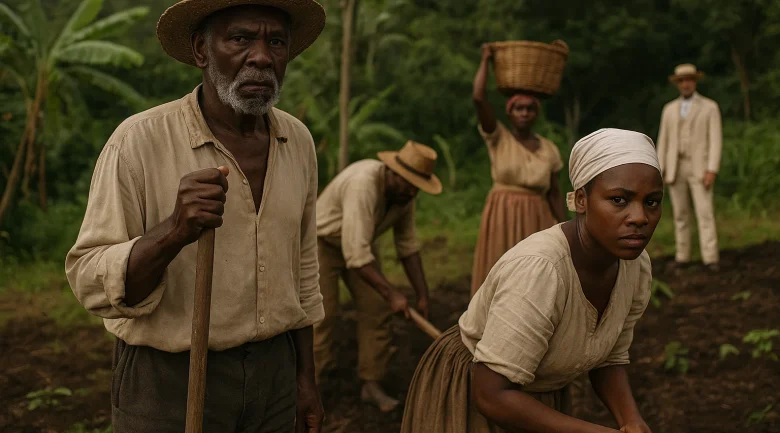
Because Dominica’s mountainous terrain made the importation of foreign food rations highly expensive, the 1826 Act legally mandated that planters allocate a specific portion of land (provision grounds) on the steep, marginal edges of the estates to each enslaved person. Planters were legally required to grant their labourers free time, typically on Saturdays and Sundays, to cultivate these plots.
This clause had a profound, unintended historical impact. It allowed the enslaved population to develop an extensive parallel economy. They cultivated yams, dasheen, tanias, and plantains, transforming the Sunday market in Roseau into a vital trading hub. The enslaved population quickly became experts in the island’s volcanic ecology and market dynamics, carving out an autonomous space that laid the foundation for the post-emancipation society.
The Path to Freedom: Abolition and Apprenticeship (1807–1838)
The formal dismantling of the slave system occurred in two major imperial stages, driven forward by continuous local labor resistance:
The Abolition of the Slave Trade (1807)
The Slave Trade Act of 1807 legally banned the transatlantic trafficking of human beings across the British Empire. This meant that planters in Dominica could no longer import newly arrived laborers from Africa to replace those who died from exhaustion or disease.
The value of each chattel asset skyrocketed. This economic reality forced planters to focus on keeping their existing workforce alive, cementing the importance of the provision grounds and local health management.
The Slavery Abolition Act (1833) and the Apprenticeship Fraud
In 1833, the British Parliament passed the historic Slavery Abolition Act, declaring that the institution of human slavery would be phased out across the empire starting on August 1, 1834. However, the white plantocracy secured a major catch: the implementation of the Apprenticeship System.
Under this transitional framework, the newly liberated population was legally reclassified as ” apprentices. They were forced to provide 40.5 hours of unpaid labor per week to their former masters for a mandatory six-year period. In reality, an apprenticeship was simply slavery by another name, complete with institutionalised corporal punishment enforced by state-appointed Special Magistrates.
The people of Dominica refused to cooperate with this system. They engaged in a massive, coordinated island-wide labor strike. Rather than working for free on the coastal sugar estates, thousands of labourers packed up their belongings and marched up into the mountains, squatting on uncultivated Crown Lands or purchasing small, interior plots from bankrupt coffee planters.
This mass exodus completely starved the coastal sugar mills of labour, causing the island’s economic output to plunge. Realising that the Apprenticeship System was completely unmanageable and on the verge of triggering an island-wide insurrection, the local legislature surrendered. They voted to dissolve the framework early, and on August 1, 1838, the people of Dominica finally achieved full, unconditional emancipation.
Post-Emancipation Reconfiguration: The Rise of the Peasantry
The dawn of full freedom in 1838 triggered a massive shift in Dominica’s demographic and economic geography. The formerly enslaved population staged a near-total withdrawal from the traditional plantation lines, refusing to live under the surveillance of the coastal managers.
The Foundation of Free Villages
Utilising the farming skills they had perfected on their colonial provision grounds, the freed population moved to the edges of the old estates or into the deep mountain valleys to build independent, self-sufficient free villages. Settlements like Grand Bay in the south, Marigot and Wesley in the northeast, and Colihaut on the leeward coast rapidly transformed into thriving centres of Afro-Caribbean culture.
These free communities established an independent peasantry. They rejected the cultivation of sugar, which they associated with the trauma of bondage, and focused instead on subsistence and small-scale agriculture. They grew yams, dasheen, sweet potatoes, and organic staples, trading their surplus via coastal canoes.
By the late 19th century, this peasant network successfully transitioned the island’s export economy away from sugar, focusing instead on cocoa, coffee, and eventually bananas.
The Rise of the Mixed-Race Legislative Majority
One of the most extraordinary consequences of Dominica’s unique colonial journey was its political trajectory. During the 18th century, a substantial population of mixed-race individuals had developed, known historically as the Free People of Colour.
The white ruling class was terrified of their growing numbers and wealth, passing discriminatory laws to bar them from entering politics or owning large properties. However, this group leveraged their education and commercial wealth to launch a sophisticated civil rights campaign.
By 1831, their political agitation forced the British Crown to pass the Brown Privilege Bill, granting them full civil and voting rights. Following full Emancipation, this group mobilised the newly liberated peasant voters.
By the late 1830s, Black and mixed-race leaders successfully won a clear majority of seats in the Dominican House of Assembly. This historic achievement made Dominica the only British Caribbean colony with a Black-majority parliament in the 19th century, turning the island into an early laboratory for Black legislative power.
Cultural and Material Legacies: Mapping the Modern Soil
The centuries of resistance and cultural preservation carried out by the enslaved population form the absolute bedrock of modern Dominican identity:
- Language (Kwéyòl): Developed as a vital tool of camouflage and survival, the Creole language (Kwéyòl) blends an 18th-century French vocabulary with West African grammatical systems and sentence structures, serving as the authentic national voice of the country.
- Music and Dance: Traditional performance styles reflect a brilliant preservation of West African rhythms. The Bélé features a lead female vocalist and a call-and-response chorus driven by the rhythmic pulse of the tanbou drum, preserving ancient West African spiritual connections. The Quadrille adapts European court dances into an Afro-Caribbean rhythm.
- Festivals: The island’s world-renowned Carnival, known natively as Mas Domnik, incorporates deep emancipatory traditions, including traditional drumming and Sensay costumes. Furthermore, Emancipation Day, celebrated annually on the first Monday of August, serves as a vital national holiday dedicated to honoring the ancestors who broke the chains of the plantation state.
Institutional Landscapes of Remembrance
The Commonwealth of Dominica preserves numerous physical landmarks that act as open-air archives of this history:
| Heritage Site | Colonial History | Contemporary Significance |
| Fort Shirley | An 18th-century British garrison built inside Cabrits National Park using the forced labor of enslaved Africans. | A preserved national park and historical site that hosts cultural festivals and educational programs. |
| Morne Bruce | A strategic military fortification overlooking Roseau, built to defend the capital against both French fleets and Maroon raids. | A historic lookout point offering panoramic views of the capital and structural remnants of the colonial army. |
| Bois Cotlette Plantation | One of the oldest surviving estates on the island, retaining its stone infrastructure through centuries of isolation. | A primary archaeological site showcasing a preserved sugar mill, processing works, and slave quarters. |
| The Old Market Square | The central urban clearing in Roseau where human auctions and public executions of Maroon rebels were staged. | A vibrant modern marketplace featuring a formal commemorative plaque honoring the victims of the transatlantic slave trade. |
| The Dominica Museum | The primary national museum located in Roseau, archiving historical artifacts, plantation ledgers, and slave shackles. | The principal educational research institution for preserving the island’s material history. |
| Kalinago Barana Autê | A cultural village located within the Kalinago Territory dedicated to preserving indigenous customs. | An educational center that highlights the early history of the island, including the joint indigenous and Maroon resistance against European rule. |
Beyond the Archives: The Geography of Freedom
The history of enslavement and resistance in Dominica is not a narrative of absolute victimhood, but an epic triumph of space, culture, and human spirit. The island’s unique volcanic geography prevented the white plantocracy from converting the landscape into a monolithic, deforested factory floor. By establishing strategic redoubts in the interior highlands, defending independent provision grounds, and successfully transitioning into a sovereign nation of smallholders, the ancestors of modern Dominicans ensured that the country’s contemporary identity would be permanently defined by autonomy, resilience, and an unbreakable connection to the terrain.
The structural ruins of the sugar processing works at Bois Cotlette and the silent military ramparts of Fort Shirley, the site of the historic 1802 8th West India Regiment revolt, stand not merely as monuments to a painful colonial past, but as physical evidence of the ultimate limits of imperial power. The draconian slave codes, the disciplinary lash caps, and the executive edicts of colonial governors have long since receded into archival repositories. Conversely, the descendants of those who outsmarted, outfought, and outlasted that system hold the definitive legal and cultural title to the soil of the Commonwealth of Dominica today. Acknowledging this history remains crucial for deconstructing past institutional injustices, addressing contemporary developmental challenges, and cementing a future rooted in ancestral resilience and shared heritage.


References
-
1.
Negre Mawon The Fighting Maroons of Dominica https://www.academia.edu/8562448/Negre_Mawon_The_Fighting_Maroons_of_Dominica
-
2.
Dominica, 1826-1887 https://britishonlinearchives.com/collections/73/volumes/502/dominica-1826-1887
-
3.
An imperium in imperio: A Geospatial Analysis of Defensibility and Accessibility of Maroon Settlements in Dominica https://www.cambridge.org/core/services/aop-cambridge-core/content/view/546802B275644DA0575A0A0C419C1CFA/S0002731624000489a.pdf/an-imperium-in-imperio-a-geospatial-analysis-of-defensibility-and-accessibility-of-maroon-settlements-in-dominica.pdf
-
4.
BLACK HISTORY MONTH: Balla – The most feared maroon leader in Dominica https://dominicanewsonline.com/news/homepage/news/black-history-month-balla-the-most-feared-maroon-leader-in-dominica/
- 5.
-
6.
LIVE FREE OR DIE: Dr. Thomson Fontaine’s History Book – The Maroons of Dominica -1764-1818 https://dominicanewsonline.com/news/homepage/news/live-free-or-die-dr-thomson-fontaines-history-book-the-maroons-of-dominica-1764-1818/
-
7.
An Act for the further encouragement, Protection, and better Government of Slaves and for the general amelioration of their condition https://slaveryandfreedomlaws.lib.unb.ca/node/464/legal_article/pdf
-
8.
Slavery and Slave Codes in Overseas Empires https://www.intechopen.com/chapters/71313
-
9.
The end of slavery and apprenticeship in Dominica part 34 https://bernardlauw.wordpress.com/2015/10/30/the-end-of-slavery-and-apprenticeship-in-dominica-part-34/
-
10.
The Abolition of Slavery and the Time of Apprenticeship in Dominica https://bernardlauw.wordpress.com/2015/10/09/the-abilition-of-slavery-and-the-time-of-apprenticeship-in-dominica/
-
11.
Enslaved Rebellion and Abolitionist Imperialism in Britain’s Atlantic World, 1807-1884 https://scholarcommons.sc.edu/context/etd/article/7242/viewcontent/Eliot_sc_0202A_17545_1_.pdf
-
12.
Two sermons preached in Dominica by Charles Peters | A critical exposition https://www.calameo.com/read/0004753238154eef11006
-
13.
Who Freed the Slaves? https://sundominica.com/articles/who-freed-the-slaves-4914/