


John Orde
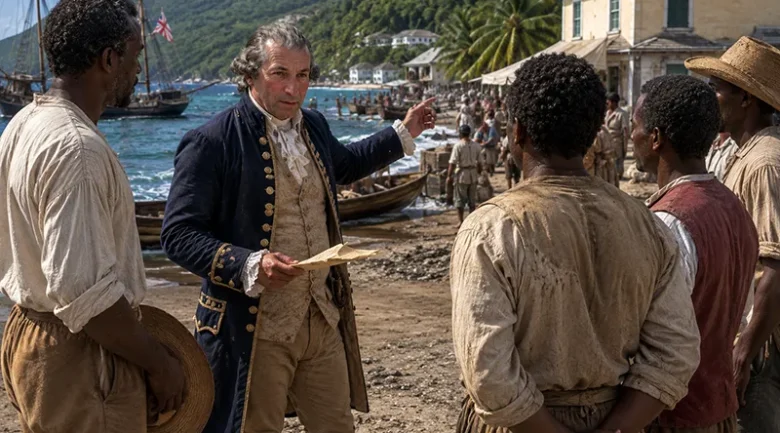
Sir John Orde served as Governor of Dominica from 1783–1793 and remains one of the most polarising figures in the island’s colonial history. His tenure sits at the violent intersection of two distinct eras: the transition from French cultural dominance to firm British administrative control, and the onset of the brutal First Maroon War. He was, in many ways, the primary architect of the British policy that sought to treat Dominica not as a sustainable human society but as a hostile territory to be pacified at any cost.
The Architect of Pacification
When Orde assumed the governorship, he inherited a deeply unstable colony. Dominica had been a French-dominated territory for decades before the British took formal control in 1763, and the French habitants (coffee planters) remained the cultural and economic elite. Orde was tasked by London to break this French influence and solidify British sovereignty.
He approached this mission with a military mindset. Under Orde, the British government ceased treating the island’s interior, the “High Woods”, as a separate, sovereign zone controlled by the Maroons (known locally as the Neg Mawon). Orde famously viewed the presence of the Maroons as an intolerable affront to British order and a direct threat to the profitability of the coastal sugar estates.
The First Maroon War (1785–1786)
Orde is most historically infamous for authorizing the campaign that would become the First Maroon War. By the mid-1780s, the Maroon population in the mountains had grown to include hundreds of escapees from across the region. Under leaders like Balla, Pharcelle, and Jacko, they had developed a sophisticated, self-sustaining society in the interior.
The Logic of the Rangers
Orde quickly realised that traditional British Redcoat infantry, heavily burdened by wool uniforms and rigid, European tactical training, were dying of tropical disease and exhaustion in the vertical ravines of the Roseau Valley long before they could find a Maroon camp.
Driven by the need for quick results, Orde authorised the formation of the Black Corps (Rangers). He weaponised the local population by arming and offering incentives to enslaved men to hunt their own kin. This created a “Black-on-Black” conflict dynamic that became a hallmark of the British colonial strategy in the Caribbean. By pitting the Rangers against the Maroons, Orde effectively externalised the cost of maintaining colonial order.
The Strategy of Divide and Conquer
Orde’s governorship was defined by a ruthless, top-down approach to social control. He utilized the House of Assembly in Roseau to pass ordinances that were specifically designed to disrupt the Maroon and African-descended communities:
- The Reward System: Orde established formal bounty structures for the heads of Maroon chiefs, ensuring that the tracking of insurgents was a profitable enterprise for the Ranger units.
- Scorched Earth: He pushed for the destruction of Maroon provision grounds. Orde understood that if he couldn’t kill the warriors in open combat, he could starve their communities into submission by burning their hidden fields of yam and plantain.
- French Suppression: Orde was suspicious of the French coffee planters who controlled the southern valleys. He used the chaos of the Maroon wars as an excuse to tighten British control, often sidelining French-speaking elites whom he believed were secretly harbouring Maroon refugees.
Historical Legacy: Order vs. Resilience
Orde’s governorship ultimately failed in its long-term objectives. While he succeeded in capturing Maroon leaders like Balla in 1786 and temporarily disrupting the Maroon strongholds, he could never fully dismantle the spirit of resistance in the Dominican interior.
His tactics created a deep-seated trauma that lasted for generations. The brutal efficiency with which he used the Black Rangers to police the island fostered a fractured social fabric that persisted well into the 20th century. By the time Orde left office in 1793, he had successfully enforced British law on paper, but he had also set the precedent for the “Crown Colony” authoritarianism that would eventually trigger the uprisings of the late 19th century.
Summary of Orde’s Impact
| Strategic Goal | Orde’s Method | Long-term Consequence |
| Establish British Rule | Forced out French administrative norms. | Created deep cultural resentment within the planter class. |
| Secure Plantation Interests | Initiated the First Maroon War. | Turned the interior into a permanent battlefield for 50 years. |
| Manage Interior Threats | Formed the Black Rangers. | Codified an internal conflict between the enslaved/free Black groups. |
Note on Historical Memory: While history records John Orde as an efficient agent of the British Colonial Office, the oral history of Dominica often paints a different picture. In the mountain villages, he is remembered as the architect of a “great betrayal”, the man who introduced the formal machinery of the state to hunt people who were simply seeking the fundamental human right of autonomy.
Orde’s tenure highlights a recurring theme in the history of the Nature Isle: the collision between an imperial machine that wanted to count, tax, and control the landscape, and a local population that had spent decades learning how to vanish into the mist of the mountains.


References
-
1.
“A Place of Refuge to Republicans and Royalists”: The French Revolution in British Dominica https://www.cambridge.org/core/journals/journal-of-british-studies/article/place-of-refuge-to-republicans-and-royalists-the-french-revolution-in-british-dominica/25F4CEF27A430F4653C59D16174A9DE7
-
2.
Sir John Campbell Orde https://morethannelson.com/officer/sir-john-orde/
-
3.
ORDE, Sir John, 1st Bt. (1751-1824), of Burwash, Suss. https://www.historyofparliamentonline.org/volume/1790-1820/member/orde-sir-john-1751-1824