


Maroon Chief Pharcel
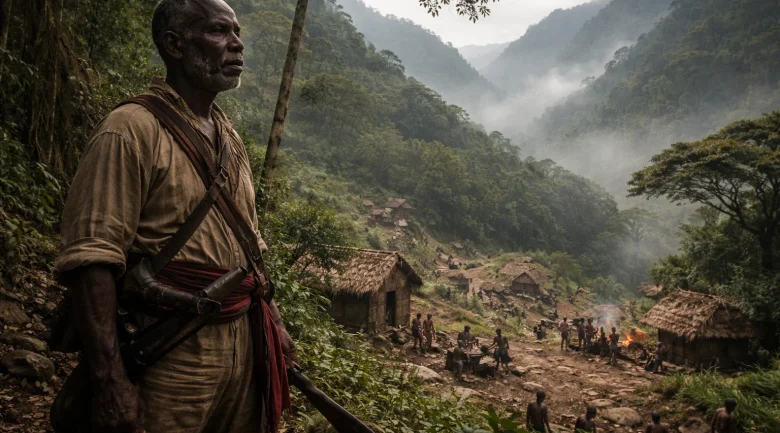
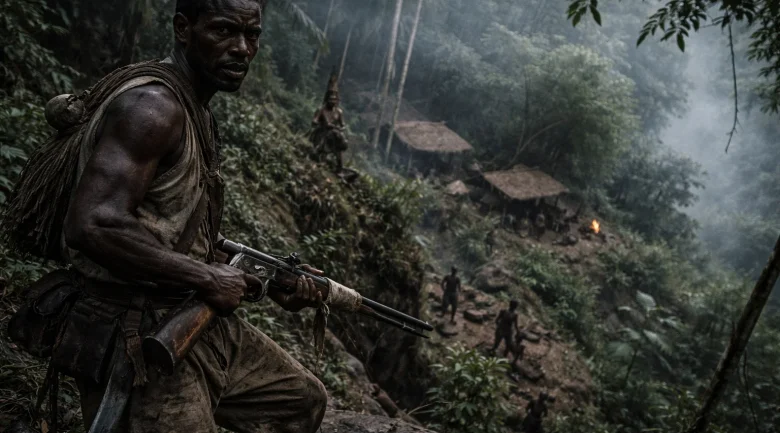
The story of Pharcel (also spelt Pharcelle) is not merely a tale of a runaway slave; it is the history of a seasoned African soldier who successfully established a state within a state in the most rugged landscape of the Caribbean. To understand Pharcel is to understand the soul of 18th-century Dominica, an island fought over by the British and the French, but which the Maroons actually ruled for nearly a century.
The African Soldier: Origins and the Guinea Foundation
Unlike many of the Creole Maroons who were born on the plantations of the West Indies, Pharcel was Bossal, born on the Guinea coast of West Africa. According to colonial accounts and oral traditions, Pharcel was no ordinary labourer before his capture. He was a trained soldier, likely belonging to one of the warrior classes of the Gold Coast or the Bight of Benin.
When he was forcibly transported across the Middle Passage in the mid-18th century, he did not arrive as a broken man, but as a prisoner of war with a sophisticated understanding of forest warfare, ambush tactics, and leadership hierarchy. Upon his arrival in Dominica, Pharcel quickly realised that the island’s topography, a vertical landscape of jagged peaks and impenetrable rainforest, was the perfect theatre for West African guerrilla tactics. He escaped shortly after his arrival, heading straight for the heights.
The Architecture of Resistance: The Colihaut Stronghold
By the 1780s, Pharcel had established himself as the undisputed Maroon Chief of the central and northern interior. His primary base was located in the heights between Colihaut and Morne Diablotins (Dominica’s highest peak). This was not a temporary hideout; it was a permanent, fortified village.
- Agricultural Sovereignty: Pharcel’s camp was a marvel of self-sufficiency. At its height, the British Rangers discovered that he had over four acres of land under systematic cultivation. He grew yams, dasheen, sweet potatoes, and tobacco. Tobacco was particularly important; it served as a currency, allowing his people to trade secretly with coastal “free coloreds” for gunpowder and salt.
- Defense by Design: The camps were located on ridges with steep V-shaped ravines on either side. These were natural bulwarks. Pharcel’s scouts could see a British redcoat battalion climbing the slopes hours before they arrived, allowing the Maroons to vanish or set devastating ambushes.
- Governance: Pharcel ruled with the authority of an African monarch. He had sub-chiefs and captains under his command. He enforced a strict code of conduct; betrayal was punishable by death, but the reward for loyalty was a life of total freedom, far from the whip of the plantation overseer.
The First Maroon War (1785–1786)
The British authorities, led by Governor John Orde, grew increasingly panicked as Pharcel’s raids on coastal plantations intensified. The Maroons weren’t just stealing food; they were liberating property, other enslaved people, and effectively draining the labour supply of the colonial economy.
In 1785, the British launched a massive suppression campaign. Pharcel showed his tactical brilliance here by refusing to engage in a pitched battle. Instead, he led the British troops on ghost chases through the Morne Diablotins rainforest. The British soldiers, laden with heavy gear and suffering from tropical diseases, were picked off by Pharcel’s snipers. While the British managed to capture other leaders like Balla, Pharcel remained elusive, forcing the Governor to realise that he could not win a war of attrition in the forest.
The Masterstroke: The 1791 Grand Bay Insurrection
The year 1791 was a global moment for Pharcel. Across the water in Saint-Domingue (Haiti), the greatest slave revolt in history was beginning. In Guadeloupe, French Republicans were challenging British dominance. Pharcel saw a tactical opening.
In January 1791, Pharcel orchestrated a revolt in the Grand Bay area that nearly toppled the British administration. This event was unique for several reasons:
- The Arsenal of 500 Muskets: When the British finally raided one of Pharcel’s secondary caches, they were horrified to find over 500 muskets. Pharcel had been stockpiling weapons for years, many of them smuggled in from French Guadeloupe.
- The Unlikely Alliance: Pharcel managed to unite the deep-forest Maroons with the plantation slaves and even some free colored landowners. This unified front proved that the Maroons were no longer just “runaways,” but a political force capable of revolution.
- Diplomacy with the French: Pharcel began secret correspondence with French Republican agents. He understood that the British were his immediate enemy, and he used the enemy of my enemy strategy to secure powder and lead.
The Enigmatic Diplomat: The Double Agent Years
One of the most complex aspects of Pharcel’s biography is his period of truce. Between 1791 and 1800, Pharcel occasionally appeared in coastal towns to negotiate with the British. He was described by British officers as insolent and haughty, treating the colonial officials as equals rather than masters.
At various points, Pharcel acted as a guide for British expeditions against other Maroon groups or French incursions. Historians debate his motives here. Most evidence suggests that Pharcel was playing a high-stakes game of divide and rule. By offering the British just enough information to keep them at bay, he protected his own people and his primary camps from total destruction. He was a master of strategic ambiguity, giving the appearance of cooperation while secretly strengthening his forest strongholds.
The Second Maroon War and the Fall of the Chiefs
As the 19th century approached, the British policy shifted. The arrival of Governor George Ainslie signaled an era of total war. The British realised that as long as Pharcel lived in the forest, slavery on the coast would never be secure.
The Second Maroon War (1809–1814) was the final, brutal chapter for the Maroon Republic, but Pharcel’s own personal conflict came to a head a decade earlier. The British began a policy of “scorched earth”, burning the Maroons’ hidden gardens and starving them out. Without their dasheen and yam patches, the Maroon camps began to fracture.
The Capture and Banishment (1800)
By 1800, the strategic alliance between Chief Pharcelle and the British administration had completely deteriorated. Recognising his prestige among both the free and enslaved populations, the colonial authorities deliberately avoided a public execution, fearing that transforming Pharcelle into a martyr would catalyse a general insurrection across the estates. Instead, his downfall was engineered through political betrayal. Having served for over a decade as a colonial forest warden, Pharcelle became militarily dispensable following the deployment of the regular West India Regiments. In 1800, the Dominica House of Assembly formally detained him on charges of insolent and highly suspicious conduct, suspecting him of duplicitous intelligence-sharing with French revolutionary agents.
Rather than execution, the white plantocracy utilised judicial banishment, a sentence of permanent exile meant to sever his deep geographical and spiritual connection to the island. Transatlantic colonial records confirm that Pharcelle was forcibly deported from Dominica, transferred through imperial holding facilities in Jamaica, and ultimately exiled to the British settlement of Nova Scotia, Canada. His banishment marked the definitive conclusion of the Grand Chief era. Stripped of his sophisticated diplomatic mind and his unique capacity to unite disparate, multi-ethnic interior factions, the Maroon resistance fractured into localised, defensive pockets, a structural fragmentation that ultimately culminated in the military isolation and death of Chief Jacko in 1814.
Legacy: The Pharcel in Dominican Identity
Pharcel remains a titan in the Dominican consciousness. He represents a specific type of resistance: Intellectual and Tactical. While Chief Jacko is remembered for his stoic defiance and Chief Balla for his raw courage, Pharcel is remembered as the Statesman of the Forest.
- In Literature: Dominican author Alick Lazare’s novel Pharcel: Runaway Slave serves as the definitive cultural reimagining of his life, portraying him as a man of deep philosophical conviction.
- In Folklore: In the villages of the north, stories are still told of a “spirit general” who could walk through walls of rain and lead British soldiers into invisible pits.
- Modern Symbolism: Pharcel is honoured every year during Heritage Month and Emancipation Day. He is the symbol of the Neg Mawon, the man who refused to be owned, not just through flight, but through the deliberate construction of a free society.
“The woods are his, the mountains are his, and as long as Pharcel breathes, the King of England is but a guest on this island.” — Attributed to a 1791 Maroon oral tradition.
Key Historical Timeline
| Year | Event | Significance |
| c. 1750s | Arrival in Dominica | Pharcel arrives as an African soldier, escapes to the heights. |
| 1785 | First Maroon War | Pharcel establishes the Colihaut camp as a major military base. |
| 1791 | Grand Bay Revolt | Pharcel organizes a unified force with 500 muskets. |
| 1794-1799 | Diplomatic Truce | Pharcel plays the British and French against each other. |
| 1800 | Arrest and Exile | Pharcel is deported, ending his 40-year reign in the interior. |
| 1814 | End of Maroon Wars | The fall of the remaining chiefs following Pharcel’s earlier removal. |

References
-
1.
ResearchGate: Maroon Rebellions and Material Culture https://www.researchgate.net/publication/265390259_Plantation_Labourer_Rebellions_Material_Culture_and_Events_Historical_Archaeology_at_Geneva_Estate_Grand_Bay_Commonwealth_of_Dominica
-
2.
Resistance to Empire (Richard Gott - PDF Chapter) https://anotherhistoryispossible.com/wp-content/uploads/2020/05/gott-r.-chapter-12-resistance-to-empire-in-the-caribbean-in-the-wake-of-the-french-revolution.pdf