


Governor George Robert Ainslie
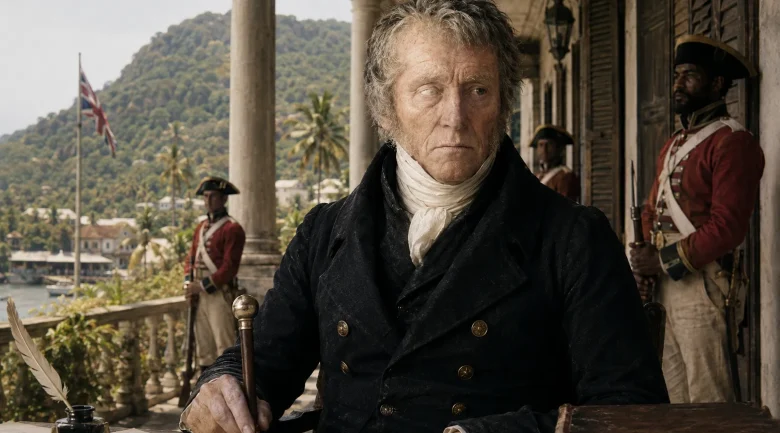
Major-General George Robert Ainslie remains the most polarising and structurally destructive administrative figure in the colonial history of Dominica. Appointed as the executive head of the island during a period of acute imperial crisis, his tenure from April 1813 to June 1814 was characterized by the implementation of a total-war strategy aimed at the complete physical liquidation of the island’s independent Maroon population. By suspending conventional military ethics, instituting extrajudicial execution policies, and authorizing indiscriminate violence against non-combatants in the high woods, Ainslie triggered a massive constitutional and human rights scandal within the British Parliament. His actions not only led to his abrupt removal from office in disgrace but also inadvertently documented the sophisticated societal structures of the Dominican freedom fighters he sought to destroy.
Early Life, Military Advancement, and West Indian Postings
Born in Edinburgh, Scotland, in 1776, George Robert Ainslie was the eldest son of Sir Philip Ainslie and belongs to a lineage deeply embedded in the British military and landed gentry. His mother, the daughter of Lord Grey, provided Ainslie with the necessary aristocratic leverage to exploit the traditional British system of purchasing military commissions. He entered the 19th Regiment of Foot as an ensign in 1793 and advanced rapidly through the officer ranks without establishing a record of tactical brilliance on the battlefield.
Ainslie saw limited action during the Flanders and Helder campaigns in the early phases of the French Revolutionary Wars. By 1800, he had attained the rank of lieutenant-colonel within the 85th Regiment. Despite his promotion to colonel in 1810 and major-general in 1813, Ainslie’s career was largely defined by administrative postings rather than frontline combat commands.
His entry into colonial governance occurred during the global reorganization of the Napoleonic Wars. In 1812, he was appointed Governor of the newly captured Dutch island of Saint Eustatius. Later that same year, he transitioned to the post of Lieutenant-Governor of Grenada. In Grenada, Ainslie’s authoritarian tendencies quickly surfaced; he repeatedly clashed with the local legislature and free population of color, demonstrating a rigid inability to navigate the complex social hierarchies of the Caribbean plantation complex. Seeking a firmer hand to suppress internal instability on a nearby frontier island, the Colonial Office transferred Ainslie to the windward colony of Dominica in the spring of 1813.
The Geopolitical Crisis of 1813
When Governor George Robert Ainslie landed at Roseau in April 1813, he inherited an unsustainable security environment. Following the enforcement of the Abolition of the Slave Trade Act of 1807, the planters of Dominica were legally barred from importing fresh labour from West Africa. Consequently, the monetary value of the existing enslaved workforce skyrocketed, and any successful escape into the interior represented an unrecoverable capital loss for the white plantocracy.
Compounding this economic anxiety was the presence of a highly organised parallel state in the island’s mountainous interior. For over forty years, the Maroons of Dominica had maintained independent, self-sustaining communities deep within the rainforests, led by an elite corps of chiefs including Chief Jacko, Chief Balla, and Chief Congo Ray. These interior settlements possessed their own judicial systems, extensive agricultural fields, and strategic trade networks with sympathetic estate labourers.
Ainslie viewed this sovereign Afro-Caribbean entity not merely as a collection of runaway property, but as an existential threat to British imperial sovereignty, an intolerable imperium in imperio (a state within a state). Armed with a rigid military mindset and encouraged by a desperate local assembly of planters, Ainslie resolved to abandon the defensive containment policies of his predecessors and launch an aggressive offensive to permanently reclaim the interior.
The Proclamation of May 1813
Within weeks of taking his oath of office, Governor Ainslie initiated his anti-marronage campaign through a formal state decree. On May 10, 1813, he published an aggressive proclamation across the island’s parishes, offering a brief fifteen-day grace period for all Maroons to surrender unconditionally to the magistrates in Roseau. To sow division within the resistance, the decree promised a full pardon to ordinary runaways who turned in their leaders, while simultaneously placing an enormous bounty of “Twenty Joes” on the heads of the prominent Maroon chiefs.
The independent interior capitals completely ignored Ainslie’s ultimatum. Recognizing that a voluntary surrender meant either the gallows or being worked to death on coastal sugar estates, the Maroon camps fortified their mountain passes.
When the fifteen-day deadline expired with zero capitulations, Ainslie mobilized the full military apparatus of the colony. He placed the island’s white and mixed-race militias on permanent alert and unleashed the Dominica Loyal Rangers (historically recorded as the Black Corps). The Rangers were units of armed, enslaved trackers who were promised physical freedom in exchange for hunting down the interior families.
Ainslie’s initial strategy focused on logistical starvation. He ordered his columns to bypass direct confrontations with Maroon warriors and instead locate and systematically destroy their hidden agricultural infrastructure. British forces traversed the steep ravines around Mount Joy and the central ridges, burning fields of yams, dasheen, and cassava, hoping to force the interior population down to the coast through systematic hunger.
The October 1813 Decree: “Neither Age Nor Sex Spared”
The operational nature of the Second Maroon War shifted dramatically following a catastrophic hurricane that struck Dominica on July 23, 1813. The storm devastated the island’s infrastructure, flattening processing mills on coastal properties and destroying the high-altitude provision grounds of the Maroons. Faced with sudden starvation, the Maroon forces under Chief Jacko and Chief Quashie were forced to launch aggressive, large-scale nighttime raids on valley estates, including the Macoucherie Estate and properties across the northeast, to secure food and gunpowder.
Ainslie interpreted these desperate resource raids as an open, coordinated insurrection. Infuriated by the Maroon network’s resilience, he abandoned all conventional rules of engagement. On October 3, 1813, Governor Ainslie issued his most notorious and legally fatal executive order. The public decree explicitly instructed his military commanders that the time for conditional warfare had passed:
The Governor is pleased to order that the utmost rigour of military execution shall be put in force against all those runaway slaves that may be apprehended after that period, neither age nor sex spared, all indiscriminately shall be put to the bayonet.
This decree effectively legalized the indiscriminate slaughter of non-combatants, including women, children, and the elderly hidden within the mountain camps. Under Ainslie’s direct supervision, the war in the interior transformed into a series of state-sanctioned extrajudicial executions.
When Maroon refugees were captured, they were frequently executed on the spot rather than being returned to their legal owners or granted a trial. To maximise the psychological terror inflicted upon the remaining labour force, Ainslie ordered the decapitation of fallen Maroon fighters. Their severed heads were brought down from the mountains in baskets and spiked on wooden posts along the public highways leading into Roseau and outside the gates of the Old Market Square.
The Ambush at Jacko Flats and the Climax of 1814
Throughout early 1814, Ainslie’s scorched-earth policy ground down the material capacity of the interior camps. The historical records indicate that between May 1813 and the summer of 1814, Ainslie’s forces killed, captured, or banished approximately 577 Maroons, severely fracturing the demographic stability of the high woods.
The absolute climax of Ainslie’s campaign occurred on July 12, 1814. Utilising intelligence extracted through the torture of a captured Maroon runaway, a heavily armed detachment of the Black Rangers under the command of Captain John LeVilloux bypassed the heavily fortified stone defences of the Jacko Steps. Moving silently under the cover of early morning mountain mist, LeVilloux’s unit scaled the rear cliffs of the central plateau and launched a surprise assault on Chief Jacko’s grand citadel.
In the fierce hand-to-hand combat that followed, the elderly Chief Jacko was shot dead through the chest while defending the clearing to allow civilian refugees to escape into the deeper forests of the Layou Valley. The wholesale destruction of the Jacko Flats citadel and the deaths of secondary commanders like Chief Elephant and Chief Moco George marked the tactical victory of Ainslie’s offensive. The white plantocracy in Roseau celebrated the event by voting to present Ainslie with a luxurious, gold-hilted sword worth hundreds of guineas as a token of their gratitude for securing their financial investments.
The Historical Records: The Maroon Trials of 1813–1814
As hundreds of starving and wounded Maroons were brought out of the interior by the Black Rangers, Governor Ainslie convened a special slave court in Roseau to process the prisoners. These proceedings, known historically as the Maroon Trials of Dominica (1813–1814), were designed as a grand theatrical display of imperial justice. However, the meticulous transcripts kept by the court magistrates inadvertently created one of the most valuable historical archives of slave resistance in the Atlantic world.
The trial records revealed to a stunned colonial administration that the Maroons had constructed a highly sophisticated, functioning parallel civilization right under their noses. Captured runaways testified about extensive, long-term trade agreements with estate drivers, specialized bullet-casting workshops in the woods, and complex kinship lineages where children had lived for over thirty years without ever interacting with a white master.
Instead of proving that the Maroons were disorganized forest bandits, Ainslie’s own court records permanently documented the high level of political consciousness, strategic intelligence, and economic self-sufficiency of the independent Afro-Caribbean state.
Parliamentary Exposure, Censure, and the Fall of Ainslie
Governor Ainslie’s reliance on extreme, unyielding violence ultimately caused his political downfall. Reports of his October 1813 decree, specifically the mandate that “neither age nor sex be spared”, were leaked to Great Britain by sympathetic mixed-race individuals and radical humanitarian abolitionists. By early 1814, prominent anti-slavery members of the British Parliament, led by William Wilberforce and Sir Samuel Romilly, launched a fierce political offensive against the Colonial Office.
The mainstream British press, including The Times, published scathing critiques of Ainslie’s governance, labeling his methods as an international embarrassment to the British Crown, which was simultaneously branding itself as a moral leader for global abolition. Parliamentarians argued that Ainslie had violated the fundamental tenets of English constitutional law by executing British subjects without due process and authorizing the slaughter of children.
In June 1814, the Secretary of State for the Colonies, Lord Bathurst, issued an urgent command order completely stripping Ainslie of his administrative powers and recalling him to London to face an official parliamentary inquiry. To prevent the local plantocracy from altering the evidence, Bathurst ordered secondary administrative officials to bypass the governor’s office and ship the raw, unedited minutes of the Maroon Trials directly to London.
Ainslie returned to England in disgrace. While the formal inquiry eventually declined to prosecute him criminally, largely to protect the empire’s broader geopolitical image during the ongoing war with France, his career as a trusted colonial executive was effectively over. He was subjected to public censure, and the Colonial Office ensured he would never receive another high-profile administrative posting in the West Indies.
In 1816, family political connections managed to secure him a minor, poorly paid assignment as Lieutenant-Governor of Cape Breton Island in Canada. Predictably, his volatile temperament and authoritarian tendencies sparked civil chaos there as well; he locked horns with the local population over land taxes until the territory was dissolved and absorbed into Nova Scotia in 1820. Ainslie spent his final years retired in Scotland, devoting his time to numismatics and historical archaeology before dying in Edinburgh in 1839.
Institutional and Historiographical Impact on Dominica
| Metric / Dimension | Strategic Policy Under Governor Ainslie | Long-Term Historiographical Reality |
| Military Mandate | Complete physical liquidation of the sovereign Maroon parallel state. | Failed to save the plantation complex; accelerated the financial collapse of the estate model. |
| Tactical Execution | Scorched-earth destruction of mountain provision grounds and high-woods agriculture. | Left the steep, vertical interior of the island completely un-cleared and wild. |
| Judicial Strategy | Mass public executions and severed heads displayed at Old Market Square. | Inadvertently preserved the authentic voices and social structures of the Neg Mawon via trial records. |
| Geopolitical Fallout | Total alignment with the local white plantocracy to enforce absolute white supremacy. | Triggered an imperial human rights scandal that resulted in his permanent removal from office. |
The historical legacy of Governor George Robert Ainslie in Dominica is defined by a supreme irony. His total-war campaign was launched to permanently secure the island for corporate, industrial sugar cultivation by destroying the independent Black population of the interior. However, the extreme violence and financial costs of his war had the exact opposite effect.
By destabilizing the local labor framework and drawing the hostile focus of British human rights abolitionists to the abuses in Roseau, Ainslie’s tyranny accelerated the structural decline of the island’s plantocracy. Because his forces spent months destroying farms rather than clearing the terrain for future plantations, the interior of Dominica remained heavily forested, vertical, and untamed.
This preserved geography allowed the liberated population to immediately bypass the estate system following full emancipation in 1838. The descendants of the Maroons moved into the high woods, established an independent, free peasantry, and constructed the agricultural foundation of modern Dominica, completely validating the sovereign vision of the chiefs who had defied Ainslie’s bayonets.


References
-
1.
Conduct of Governor Ainslie. https://api.parliament.uk/historic-hansard/commons/1815/jun/02/conduct-of-governor-ainslie
-
2.
Maroon Chief Jacko in 1812 https://marooncountry.org/jacko-and-1812
-
3.
Ainslie, George Robert: Dictionary of Canadian Biography https://www.biographi.ca/en/bio/ainslie_george_robert_7E.html
-
4.
Your time is done now | Slavery, Resistance, and Defeat: the Maroon Trials of Dominica (1813-1814) https://dokumen.pub/your-time-is-done-now-slavery-resistance-and-defeat-the-maroon-trials-of-dominica-1813-1814-1583675582-9781583675588.html