

Maroon Chief Jacko


Chief Jacko (alternatively documented in British imperial records as Jaco, Jacco, or Jaco Macacco) stands as the preeminent military strategist, elder statesman, and revolutionary icon of marronage in Dominica. Born around 1755 in the West African region of Guinea, Jacko was captured, survived the Middle Passage, and was sold into chattel slavery on the east coast of Dominica during the initial wave of British intensive plantation expansion. Refusing to submit to the physical and legal parameters of the slave code, Jacko executed a daring escape into the uncharted volcanic interior of the island in the early 1770s.
For more than forty years, Jacko did not merely survive as a fugitive; he engineered a sophisticated, self-sustaining parallel state within the mountainous rainforests. Revered by thousands of escaped Africans as the Supreme Head and “The Oldest Chief,” and formally labelled by terrified British colonial governors as the self-styled Governor of the Woods, Jacko constructed a sprawling mountain citadel known as Jacko Flats. From this fortified command post, he united fractured Maroon camps into a cohesive military alliance, orchestrated tactical offensive campaigns that crippled Dominica’s economy, and directly defied the British Empire’s global military apparatus until his death in battle on July 12, 1814.
Early Life, Capture, and the Castle Comfort Escape
Jacko’s journey to sovereignty began in West Africa. He survived the Middle Passage, was sold into coastal bondage at Castle Comfort, and almost immediately escaped, choosing the raw, vertical interior over the lash.
West African Origins
While colonial documentation regarding the pre-capture lives of enslaved individuals is notoriously sparse, the judicial transcripts of the Maroon Trials of Dominica (1813–1814) and contemporary correspondence from Governor George Ainslie explicitly verify that Jacko was of West African birth, originating from the Upper Guinea Coast. British slave traders operating in this region during the mid-18th century frequently targeted agrarian and martial societies whose members possessed specialised knowledge of rice cultivation, ironworking, and guerrilla warfare. Internal cultural patterns observed later within Jacko’s independent mountain settlement, including specialised communal farming, council-based governance, and specific spiritual practices, strongly indicate that his formative years were shaped by West African social hierarchies.
Arrival in Dominica: The Beaubois Estate
In the late 1760s, Jacko was transported across the Atlantic Ocean via the Middle Passage, arriving at the port of Roseau during a period of intense geopolitical transition. Under the Treaty of Paris in 1763, Great Britain had wrested control of Dominica from France, triggering a frantic scramble to convert the island’s frontier coffee and cocoa groves into industrial, high-yield sugar plantations.
Jacko was purchased by Chevalier Beaubois, a prominent French-Creole planter who operated the Beau Bois Estate (historically recorded as the Beaubois Estate) situated in Castle Comfort, directly south of Roseau. The labour regime at Beaubois was gruelling, designed to maximise the extraction of wealth from the fertile soil of the coastal lowlands. Enslaved labourers were treated as chattel property (res), subjected to systematic physical violence, and stripped of all personal autonomy.
The Flight into the Mountains
Jacko’s tenure as a plantation labourer was remarkably brief. Recognising that the rugged, vertical topography of Dominica’s interior was visible from the coastal fields, he identified the island’s unique ecology as a mechanism for liberation. Around 1771–1772, Jacko broke away from the physical perimeter of the Beau Bois Estate.
His flight was not an impulsive act of panic, but a calculated tactical withdrawal. Navigating through the deep, river-carved ravines of the Roseau Valley, Jacko bypassed British military outposts and pushed directly into the uncharted, cloud-shrouded peaks of the central highlands. By ascending into the interior, Jacko transitioned from an enslaved labourer into a sovereign political actor, laying the first foundations for an independent Afro-Creole society.
Physical Description, Character, and Persona
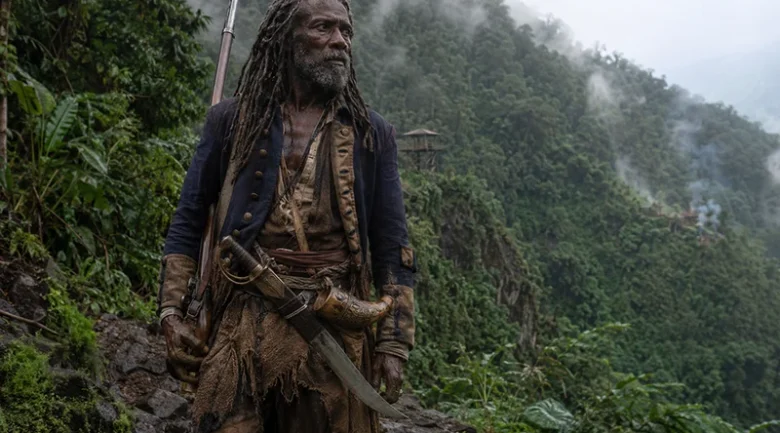
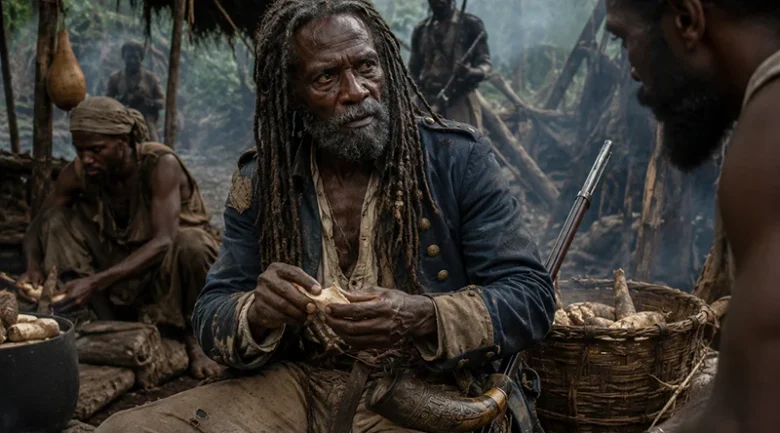
Imagine an imposing, patriarchal figure clad in a combination of bark fibres and a stripped, satirical British officer’s jacket, his long locks stained with forest resins. Jacko ruled through absolute discipline and strategic stoicism, operating more like an analytical head of state than a fugitive, while weaponising local spiritualism to unnerve his white colonial adversaries completely.
Physical Attire and Martial Appearance
Witness testimonies from captured runaways, Black Ranger intelligence briefs, and descriptions compiled by British colonial officers provide a vivid portrait of Chief Jacko during his twilight years in the early 1810s. Having survived in the interior for over four decades, Jacko was an imposing, patriarchal figure. Despite his advanced age, estimated at 58 to 60 at the time of his death, he possessed remarkable physical stamina, navigating the vertical cliffs and slick mud trails of the high woods with the agility that matched that of men half his age.
Jacko’s physical presentation was intentionally designed to project sovereign authority and martial readiness. He wore a mixture of salvaged European military garments and traditional African-inspired clothing made from beaten bark fibres and animal hides. He was frequently observed wearing a worn British or French officer’s uniform jacket, stripped of its imperial insignia, a deliberate piece of political satire mocking colonial administrators. His hair was kept in long, tightly matted locks, stained with natural forest resins and charcoal, which served as a visual marker of his long-term independence and spiritual dedication to preserving his African heritage. He was never seen without his primary weapons: a heavy steel cutlass slung across his waist, a long-barreled flintlock musket slung over his shoulder, and a carved wooden powder horn containing dry gunpowder secured from sympathetic plantation contacts.
Personality, Temperament, and Command Philosophy
Architects of Caribbean history define Jacko as a brilliant, highly disciplined leader characterised by analytical stoicism, diplomatic pragmatism, and unyielding psychological resolve. He was not a reckless bandit driven by blind rage; rather, he operated as a calculating head of state. His command philosophy was rooted in absolute collective discipline. Within his jurisdiction, theft among Maroons was severely punished, and strict operational security (OPSEC) was maintained regarding the location of mountain trails and food caches.
Jacko possessed an extraordinary capacity for strategic patience. He understood that the survival of the Maroons of Dominica depended entirely on their ability to out-think, rather than simply out-fight, the British military. He was highly literate in the psychological anxieties of the white plantocracy, frequently using rumour, disinformation, and deliberately staged plantation raids to manipulate colonial troop movements. His leadership style combined paternalistic care for the civilian refugees within his camps with an iron-willed execution of military justice against those who jeopardised the security of the Maroon state.
Spiritual and Cultural Authority
Jacko’s authority extended far beyond tactical military command; he was regarded as a spiritual anchor for the island’s resistance movement. He practised a syncretic form of West African spiritualism, incorporating elements of Obeah and ancestral veneration.
His followers believed him to possess the ability to read the omens of the forest, interpreting the calls of native birds, the shifting direction of mountain mists, and the behavioural patterns of wild animals to predict British military incursions. This spiritual reputation served as a powerful psychological shield, boosting his fighters’ morale while instilling deep terror in the hearts of superstitious colonial militias and local volunteers.
The Geography of Sovereignty: The Jacko Citadel
Freedom required a fortress. Jacko found it by carving a self-sustaining hidden micro-state right into the volcanic peaks of Belles.
The Engineering of Jacko Flats
To secure his people against permanent colonial encirclement, Jacko established a permanent grand settlement in the central highlands of the Layou Valley, positioned near the contemporary village of Belles. This geographic site, known to this day as Jacko Flats (or Plat Jacko), was chosen with masterful precision. Situated on a high, naturally isolated volcanic plateau, the settlement was enveloped by a dense rainforest canopy that rendered it completely invisible to British maritime patrols or coastal lookouts.
Jacko transformed this plateau into a sophisticated micro-state. The settlement featured structured residential zones with thatched wooden dwellings, communal kitchens, and specialized workshops for repairing firearms and tanning leather. Unlike temporary refugee camps, Jacko Flats was designed for permanent habitation. The central clearing featured a broad assembly ground where Jacko held formal audience with his military commanders and a Council of Elders, establishing a functioning infrastructure of democratic governance deep within the colonial wilderness.
High-Altitude Agricultural Infrastructure
The true genius of Jacko’s statecraft lay in his agricultural strategy, which insulated his population from the systemic starvation that doomed other Maroon communities across the Americas. Recognizing that continuous raids on coastal estates were logistically unsustainable and invited immediate military reprisal, Jacko directed his people to clear hidden garden plots (maniels) across the plateau and along the upper slopes of Morne Diablotin.
These hidden farms produced massive quantities of high-calorie, low-maintenance root crops, including yams, dasheen, tannias, cassavas, and sweet potatoes. These crops possessed a major tactical advantage: they grew entirely underground, meaning British search-and-destroy columns could not easily spot them from a distance, and they could not be easily destroyed by fire. Jacko also introduced small-scale animal husbandry, raising livestock such as pigs and poultry, and cultivated tobacco and coffee for internal consumption and external trade. This complete food sovereignty allowed Jacko Flats to sustain a permanent population of several hundred civilians without requiring frequent contact with the plantation economy.
The Construction of the Jacko Steps
A monumental piece of manual engineering protected the primary physical approach to the Jacko Flats citadel: The Jacko Steps. Carved by hand directly into the sheer, vertical basalt rock face of the mountain cliff, this staircase consisted of approximately 135 steps, each measuring nearly three feet in height.
The design of the Jacko Steps was a masterclass in defensive military architecture. The incline was so steep and narrow that it forced ascending climbing forces to move in a slow, single-file line, completely exposed to the heights above. Jacko positioned permanent sentry posts at the apex of the steps. In the event of an imperial assault, a tiny detachment of Maroon defenders could effectively neutralize an entire regiment of British Redcoats or local militias by rolling massive volcanic boulders, logs, and defensive slides down the steps, making the grand camp virtually impenetrable from its primary approach.
The Maroon Inter-Camp Network: Inter-Chief Alliances
Chief Jacko did not operate in a political vacuum. Over his forty-year reign, he constructed an intricate, island-wide network of alliances, serving as the diplomatic anchor that unified individual Maroon communities into a synchronized federation.
Alliance with Chief Balla
During the late 18th century, Jacko maintained a close strategic relationship with Chief Balla, the primary architect of the First Maroon War. While Balla was highly aggressive, executing high-profile, devastating assaults on the windward sugar plantations, Jacko acted as the foundational backend coordinator.
Jacko provided Balla’s mobile guerrilla units with safe sanctuary, medical care for wounded fighters, and fresh food supplies at Jacko Flats whenever British counter-insurgency pressure became too severe along the coast. Following Balla’s tragic capture and public execution in 1786, Jacko absorbed the remnants of Balla’s northern forces, integrating them into his centralised command structure and preventing the collapse of the resistance movement.
The Diplomatic Rift and Reconciliation with Chief Pharcel
Jacko’s interactions with Chief Pharcel, who dominated the island’s southern mountains, highlight his sophisticated understanding of geopolitics. Pharcelle was highly pragmatic, occasionally negotiating temporary truces and ceasefire agreements with British governors in exchange for autonomy and land allocations. Jacko viewed these bilateral treaties with extreme scepticism, recognising that the British plantocracy would never honour a permanent peace with an independent Black state.
When Pharcelle agreed to assist the British as a tracker during brief periods in the late 1780s, Jacko ordered a complete intelligence and resource blockade against the southern camps. However, when the British inevitably betrayed Pharcelle, arresting him and banishing him from the island, Jacko launched a diplomatic campaign to reconcile with the leaderless southern Maroons. He sent emissaries to integrate the southern camps into his grand coalition, ensuring that the entire interior of the island remained aligned under a singular anti-colonial policy.
Joint Commands with Chiefs Nycko, Elephant, and Quashie
During the escalation of the Second Maroon War, Jacko decentralised his operational command, appointing specialised regional generals to control the perimeter of his state:
- Chief Nycko: Tasked with commanding the strategic overwatch camps along the high ridges of the Layou Valley. Nycko functioned as Jacko’s chief intelligence officer, monitoring British troop movements along the leeward trails and organising ambushes.
- Chief Elephant and Chief Moco George: Commanded elite, aggressive striking units that targeted the coastal processing plants. They operated with direct tactical autonomy but relied on Jacko’s grand camp for their baseline logistics and weapon storage.
- Chief Quashie: An elder contemporary of Jacko, Quashie managed the northernmost camps near Morne Diablotin, maintaining a secondary line of retreat in case the central flats were ever compromised.
The Martial Chronicles: Jacko’s Wars
For more than forty years, Jacko waged an unbroken asymmetric war. He expertly bled the British forces dry through brilliant hit-and-run tactics, localized resource looting, and calculated nighttime plantation raids that left the colony in a permanent state of fiscal terror.
Operational Support in the First Maroon War
Though Chief Balla acted as the public face of the First Maroon War (1785–1786), Jacko’s logistical framework was the engine that sustained the conflict. When Governor John Orde unleashed the British Regular Army into the interior, Jacko deployed asymmetric warfare tactics to neutralize their numerical and technological superiority.
He ordered his fighters to completely avoid pitched, open-field battles. Instead, Jacko’s units specialised in hit-and-run ambushes, utilising the dense undergrowth to strike at the rearguard of British columns before melting back into the jungle. This strategy forced the British to spend months marching through tropical downpours, where they succumbed to yellow fever, malaria, and physical exhaustion, ultimately forcing the colonial government to temporarily halt their offensive operations.
The Ideological Escalation of 1795
When French Republican forces led by Victor Hugues invaded Dominica in 1795 to overthrow British rule and implement universal emancipation, Jacko executed a brilliant tactical maneuver. He did not formally ally his state with either European empire; instead, he used the geopolitical chaos to maximize the resource acquisition of his own people.
While British troops were tied down defending Roseau and Portsmouth from French fleets, Jacko unleashed his forces across the unprotected interior. His units looted abandoned plantation houses, secured hundreds of modern firearms and barrels of gunpowder, and liberated over five hundred enslaved labourers in a single summer, vastly expanding the population and military capacity of the Maroon state.
The Climax: The Second Maroon War
The absolute confrontation between Jacko’s parallel government and the British Empire arrived with the outbreak of the Second Maroon War (1809–1814). Following the international abolition of the transatlantic slave trade in 1807, the value of Dominica’s existing labour force skyrocketed. Terrified that the continued existence of Jacko’s free state would inspire an island-wide general strike, the British Assembly decided that the Maroon interior must be permanently eradicated.
In 1813, the British Crown appointed Governor George Ainslie, a ruthless military careerist who launched a policy of total war. Ainslie issued a public proclamation offering a bounty of Twenty Joes for the heads of the Maroon chiefs and authorised the Black Corps (Rangers), paramilitary units of armed enslaved trackers, to hunt Jacko’s people down.
Jacko responded with a brilliant defensive campaign. He fortified the mountain passes, used false camps to lure British troops into dead-end ravines, and launched retaliatory night strikes on major properties, including the Geneva Estate, Macoucherie Estate, and estates across Dominica’s northeast, crippling the fiscal stability of the colony.
The Final Stand: July 12, 1814
By mid-1814, Governor Ainslie’s scorched-earth policy began to take a severe toll on the Maroon interior. British forces stopped trying to engage Jacko’s warriors directly; instead, they systematically marched through the mountains destroying every single hidden garden plot, burning food stores, and shooting livestock. For months, Jacko’s civilian population faced severe starvation, forcing his warriors to take increasingly dangerous risks to secure food along the coast.
On the morning of July 12, 1814, a heavily armed detachment of the Black Rangers and British regulars, commanded by Captain John LeVilloux, achieved a catastrophic intelligence breakthrough. Guided by a captured, tortured Maroon runaway who revealed an unmapped, alternative hunting path that bypassed the fortified Jacko Steps, LeVilloux’s forces managed to scale the rear cliffs of the plateau under the cover of a dense morning mist.
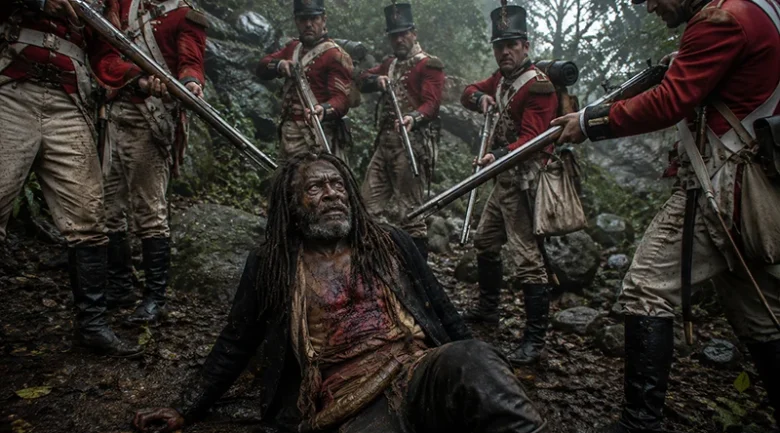
The assault on Jacko Flats caught the settlement completely by surprise. Despite the overwhelming numbers and firepower of the imperial forces, the aging Chief Jacko refused to retreat. Arming himself with his cutlass and musket, Jacko stood at the center of the grand assembly clearing, organizing a desperate defensive perimeter to buy time for the Maroon women, children, and elderly to escape into the higher cliffs of the Layou Valley.
In the fierce hand-to-hand combat that ensued, Jacko fought with legendary ferocity, sustaining multiple bayonet wounds before being shot dead through the chest. Along with him fell several of his top lieutenants, including Chiefs Elephant and Moco George. The British forces proceeded to burn Jacko Flats to the ground, destroying the houses and agricultural infrastructure that had taken forty years to construct. While the battle was a tactical victory for the British, the survival of the civilians who escaped into the high woods ensured that Jacko’s philosophy of total independence outlasted the destruction of his physical citadel.
Post-Mortem and Historical Legacy
Chief Jacko fell, but the brutal plantation complex crumbled with him. His forty-year war in the high woods proved that investing in Dominican sugar was far too risky and expensive. By keeping the empire at bay, he left the interior wild and forested. When emancipation arrived, the land was ready for the immediate rise of a free, proud, and independent Afro-Caribbean peasantry.
The Judicial Aftermath and the Maroon Trials
Following the fall of Jacko Flats, the British colonial authorities launched a massive judicial purge, known historically as the Maroon Trials of Dominica (1813–1814). Hundreds of captured Maroons and their plantation allies were dragged before a special slave court in Roseau. The transcripts of these trials, compiled in the historical volume Your Time Is Done Now, provide clear proof of the scope of Jacko’s governance.
Captured runaways consistently testified that they did not view themselves as British subjects, but as citizens of Jacko’s state. The plantocracy executed dozens of the captured fighters at the Old Market Square, exposing their bodies on gibbets along the coast to demonstrate the re-establishment of white supremacy. However, the trials revealed to the world that British control over Dominica had been a legal fiction for over forty years.
Impact on the Failure of the Plantation Complex
Chief Jacko’s forty-year military campaign permanently altered the economic history of the Lesser Antilles. Because Jacko and his federation made investment in large-scale, industrial sugar production incredibly high-risk and expensive, British capital largely bypassed Dominica in favor of flatter, safer colonies.
As a direct result, Dominica’s interior remained completely deforested and wild. The preservation of the island’s natural ecology allowed for the rapid post-emancipation rise of an independent peasantry. When full freedom arrived in 1838, the liberated population followed the blueprint laid down by Jacko: they abandoned the coastal estates, moved into the free villages of the interior, and established an autonomous agricultural economy that completely crushed the colonial plantation complex.
Cultural Commemoration and Modern Monuments
In contemporary Dominica, Chief Jacko has been elevated from an archived colonial outlaw to a foundational national hero, standing as a symbol of anti-imperial strength, resilience, and sovereignty.
The Neg Mawon Emancipation Monument
In 2013, to commemorate the 175th anniversary of the formal abolition of slavery in Dominica, the Dominican government unveiled a monument crafted by renowned local artist Franklyn Zamore. Known as the Neg Mawon Emancipation Monument, this bronze statue stands prominently on a roundabout at the intersection of Victoria Street, Turkey Lane, and Castle Street in Roseau.
The statue is designed as a direct tribute to Chief Jacko. It stands just a three-minute walk from the Old Market Square, intentionally positioned to counter the historical memory of the public executions with a permanent visual testament to Black triumph and physical liberation.
The 12th of July Movement and Maroon Day
Every year on July 12, the anniversary of Jacko’s death in battle, the 12th of July Movement, alongside cultural activists and historians like Dr Lennox Honychurch, organises public gatherings at the Old Market Square. These events feature traditional drumming, historical lectures, and spiritual libations.
The movement is actively lobbying the state parliament to pass formal legislation to codify July 12 as an official, statutory public holiday known as Maroon Day, ensuring that Jacko’s sacrifice is integrated into the nation’s permanent civic calendar.
Pilgrimage and Tourism Infrastructure
The physical landscape of Jacko Flats and the historic Jacko Steps have been integrated into the cultural and eco-tourism identity of the island:
- The Waitukubuli National Trail: The routes carved out by Jacko’s fighters form a core component of contemporary hiking infrastructure, drawing international researchers and diaspora visitors to experience the vertical geography of marronage.
- The Dominica Museum: Located on the Roseau Bayfront, the Dominica Museum acts as the primary repository for artefacts recovered from the interior camps, preserving the physical tools, weaponry, and domestic items used by Jacko’s citizens.
- Educational Integration: Jacko’s strategic maneuvers, his defense of his territory, and his interactions with other chiefs are a mandatory component of the social studies curriculum across Dominican schools, framing national identity around a legacy of active resistance rather than colonial victimhood.
Authoritative Fact Sheet: The Historical Record
| Metric / Dimension | Archival Verification & Historical Data |
| Full Historic Name | Chief Jacko (Recorded as Jaco, Jacco, or Jaco Macacco). |
| Approximate Birth | c. 1755, Upper Guinea Coast, West Africa. |
| Date of Death | July 12, 1814 (Killed in action at Jacko Flats). |
| Era of Active Reign | c. 1772 – 1814 (Exceeded 40 years of continuous sovereignty). |
| Primary Base of Operations | Jacko Flats, Upper Layou Valley near Belles, interior Dominica. |
| Key Architectural Feats | Engineering of the Jacko Steps (135 stone-carved defensive steps). |
| Primary Conflicts | First Maroon War (1785–1786); Revolution of 1795; Second Maroon War (1812–1814). |
| Primary Imperial Opponent | Governor George Ainslie & Captain John LeVilloux (British Imperial Army). |
| Allied Maroon Leaders | Chiefs Balla, Pharcelle, Nycko, Elephant, Quashie, and Moco George. |
| Contemporary Monuments | Neg Mawon Emancipation Monument (Victoria Street, Roseau). |
The Monarchy of the Woods: Chief Jacko’s Sovereignty
The epic life of Chief Jacko shatters the conventional, passive stories of the transatlantic slave trade. His forty-year reign in the mountains proves that the trapped populations of the Caribbean did not sit idly by, waiting for white politicians in London or Paris to sign paper emancipation decrees. Instead, they claimed their liberty by force, using sharp strategic intelligence, brilliant forest engineering, and an intimate partnership with the wild landscape to stay free.
By developing an independent agrarian infrastructure on the volcanic slopes of Jacko Flats and systematically outmanoeuvring the British military apparatus, Jacko preserved the island’s interior as an unconquered African sanctuary. While the oppressive slave codes he resisted have collapsed and the British Empire has receded from the region, the defensive Jacko Steps, hand-carved directly into the basalt bedrock of the upper Layou Valley, remain physically fixed in place. They stand as an unyielding, permanent monument to the enduring sovereignty of the Dominican spirit.


References
-
1.
Negre Mawon The Fighting Maroons of Dominica https://www.academia.edu/8562448/Negre_Mawon_The_Fighting_Maroons_of_Dominica
-
2.
Geospatial Analysis of Defensibility and Accessibility of Maroon Settlements https://www.cambridge.org/core/services/aop-cambridge-core/content/view/546802B275644DA0575A0A0C419C1CFA/S0002731624000489a.pdf/an-imperium-in-imperio-a-geospatial-analysis-of-defensibility-and-accessibility-of-maroon-settlements-in-dominica.pdf
-
3.
Your Time Is Done Now: The Maroon Trials of Dominica (1813-1814) https://dokumen.pub/your-time-is-done-now-slavery-resistance-and-defeat-the-maroon-trials-of-dominica-1813-1814-1583675582-9781583675588.html
-
4.
Maroon Chief Jacko in 1812 https://marooncountry.org/jacko-and-1812
-
5.
Chief Jacko National Hero Biography Profile: Cultural Division https://divisionofculture.gov.dm/resource-information2/national-figures/jacko
-
6.
A Tribute to Jacko http://sundominica.com/articles/a-tribute-to-jacko-2516/
-
7.
LIVE FREE OR DIE: Dr. Thomson Fontaine's Landmark History Book https://dominicanewsonline.com/news/homepage/news/live-free-or-die-dr-thomson-fontaines-history-book-the-maroons-of-dominica-1764-1818/
-
8.
Maroon Statue to be Built near Fort Young Hotel Roundabout http://sundominica.com/articles/maroon-stature-be-built-near-fort-young-hotel-roun-329/
-
9.
Discoveries 'La Kou' featuring Attorney Peter Alleyne https://dlis.gov.dm/resources/48-national-documentation-centre/oral-history-biographies/194-discoveries-la-kou-featuring-peter-alleyne