

Livestock in Dominica
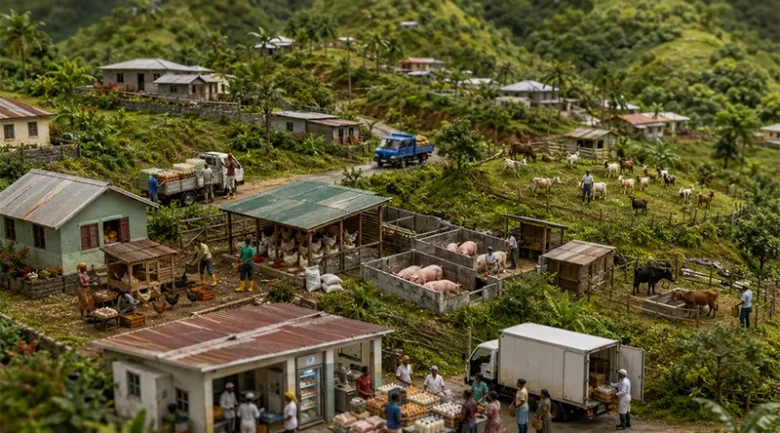
The development of livestock in Dominica is a crucial pillar of the nation’s broader agricultural sector, which historically has been dominated by export crop cultivation, particularly bananas. Raising animals for meat, dairy, and eggs in Dominica serves as an essential mechanism for rural livelihood support, household food security, and national import substitution. Characterized primarily by smallholder production systems, the island’s livestock sector features a mix of traditional backyard husbandry and semi-intensive commercial enterprises focusing on poultry, pigs, sheep, goats, and cattle.
Administratively managed by the Ministry of Agriculture (specifically the Livestock Development & Veterinary Unit), the subsector operates within unique geographic and climate constraints. Despite facing challenges ranging from high feed costs to devastating tropical storms, the livestock industry continues to adapt through public-sector genetic improvement initiatives, veterinary disease control programs, and targeted infrastructure investments such as the national abattoir.
Historical Context of Livestock Production
Historically, the agricultural economy of Dominica focused almost exclusively on cash-crop cultivation. Under colonial rule, sugarcane, lime juice, cocoa, and eventually bananas occupied the flat coastal plains and gentle lower slopes of the island’s volcanic terrain. During these eras, livestock rearing was largely an informal, domestic activity. Rural households kept a small number of goats, pigs, or chickens to supplement their diet with animal protein and to provide a form of living financial security that could be quickly liquidated in times of economic distress.
The transition towards a structured livestock subsector began in the latter half of the twentieth century. Recognising the high financial drain of importing meat and dairy products, successive post-independence governments prioritised livestock diversification. The establishment of the Central Livestock Farm (CLF) as a nucleus for research, breeding, and technical training marked the first formalized attempt to scale up local animal production.
The sector’s trajectory has been deeply impacted by natural disasters. Tropical storms and hurricanes regularly disrupt production by destroying animal housing, wiping out pastures, and interrupting imported feed supplies. For example, Hurricane Maria in 2017 caused catastrophic damage to the island’s agricultural infrastructure, requiring years of coordinated rehabilitation of pastures, poultry houses, and breeding stock. Today, government policies place a heavy emphasis on climate-resilient livestock farming practices, including sturdier shelter designs and the cultivation of local forage varieties.
Key Livestock Categories in Dominica
The livestock population in Dominica is diverse, consisting of several distinct animal species managed under varying production systems. The primary animal categories include:
Small Ruminants (Goats and Sheep)
Goats and sheep are highly suited to Dominica’s rugged topography and steep slopes, making them the most widely kept grazing animals on the island.
- Goats: Goats represent the most abundant livestock species in Dominica, with an estimated national population of approximately 10,000 head. They are traditionally kept in small numbers (typically under five animals per holding) and are tethered along roadsides, hillsides, or in fallow fields to graze on wild vegetation. The predominant local breed is the Creole goat, valued for its hardiness, disease resistance, and ability to thrive on low-quality forage. The Ministry of Agriculture has introduced dairy and meat breeds, such as the Anglo-Nubian and Boer, to crossbreed with Creole stock to improve carcass weight and milk yield.
- Sheep: The national sheep population stands at approximately 6,000 head. Hair sheep breeds, specifically the Barbados Blackbelly and Virgin Island White (St. Croix), are preferred over wool sheep due to their tolerance of the island’s humid tropical climate. Sheep are primarily reared for mutton and lamb, and like goats, they are kept on a semi-intensive basis, utilising natural pastures and agricultural by-products.
Poultry (Broilers and Layers)
The poultry subsector is the most economically significant and highly commercialised component of Dominica’s livestock production. It is divided into egg production (layers) and meat production (broilers).
- Egg Production: Egg production is the most established and successful livestock activity in Dominica, with the country achieving near self-sufficiency in table eggs during periods of stable production. Commercial layer operations utilize intensive deep-litter or battery cage systems, relying on imported high-productivity hybrid strains.
- Broiler Production: Local chicken meat production has historically lagged behind imports due to the high costs of imported feed and chick stock. However, targeted state initiatives, such as the rehabilitation of the national abattoir and poultry expansion packages for farmers, have aimed to scale up local broiler processing capacities.
Swine (Pigs)
Pork production is widely distributed across rural communities in Dominica, operating as a vital source of income and household meat. Pigs are kept in small-scale concrete pens (often utilising flush-out waste management systems). Local farmers raise a mix of Large White, Landrace, and Duroc breeds. Feed regimes typically combine commercial concentrate feeds with locally sourced food waste, root-crop surpluses (such as dasheen and sweet potato), and banana rejects, thereby reducing production costs.
Cattle (Beef and Dairy)
Cattle farming is the smallest and most challenging livestock activity on the island, primarily due to the substantial land, pasture, and initial capital requirements. The national herd is estimated at roughly 5,000 head.
- Dairy: Dairy production is highly limited. The government has historically maintained Holstein and Jersey herds at the Central Livestock Farm to assess milk production under local conditions and distribute dairy-adapted genetics to farmers.
- Beef: Beef production is largely a byproduct of the small dairy sector or involves smallholders raising Creole cattle crossed with beef breeds like the Jamaica Black or Zebu (Bos indicus) to enhance heat and parasite tolerance.
Apiculture (Honeybees)
Although not classified as traditional livestock, honeybee (Apis mellifera) management is a highly lucrative niche sector overseen by the Livestock Development Unit. Dominica’s extensive forest cover, wild floral resources, and relatively low pesticide use provide ideal conditions for producing high-quality, organic honey. Apiculture is promoted as a sustainable, non-destructive forestry activity that provides vital pollination services for the island’s fruit crops.
Technical and Diagnostic Support Services
The public sector framework for livestock management is centered on the Livestock Development & Veterinary Unit of the Division of Agriculture. Headquartered at the Botanical Gardens in Roseau, this unit provides critical veterinary, diagnostic, and breeding support to the island’s agricultural community.
Veterinary Services and Disease Surveillance
Veterinary services in Dominica focus on preventing the entry of exotic animal diseases and controlling endemic pathogens. The country’s island status provides a natural biosecurity barrier, which is protected through strict quarantine import controls at air and sea ports.
- Disease Surveillance: Regular testing and monitoring programs are executed for transboundary animal diseases, such as Foot and Mouth Disease (FMD), Classical Swine Fever (CSF), and Avian Influenza.
- Eradication Programs: Dominica has historically participated in regional pest control campaigns, such as the Amblyomma Tick Eradication Program, which targets the tropical bont tick (Amblyomma variegatum), a vector for dermatophilosis in cattle.
- Ambulatory Care: Government veterinarians and Animal Health Officers provide low-cost emergency clinical care, vaccinations, and deworming treatments to livestock farmers island-wide.
Diagnostic Capabilities
The Division of Agriculture utilizes a Molecular Diagnostic Laboratory equipped to conduct advanced diagnostics. Key diagnostic services include:
- Leptospirosis Testing: Critical for both animal welfare and human public health, given the zoonotic risk in wet, tropical environments.
- Parasitology: Identifying internal parasites (such as gastrointestinal nematodes in small ruminants) to guide selective deworming programs and combat anthelmintic resistance.
- Microbiology and Pathology: Post-mortem investigations and bacterial cultures to identify herd-level disease outbreaks.
The Central Livestock Farm (CLF)
Located in the agricultural district of Londonderry (with additional operations historically in Portsmouth and agricultural stations), the CLF serves as the genetic nucleus of the island. It maintains several dedicated breeding units:
- Goat and Sheep Multiplication Units: Breeding purebred Anglo-Nubians, Boers, and Barbados Blackbellies to produce genetically superior offspring for sale to local farmers.
- Pig Breeding Unit: Generating high-quality weaners to supply commercial pork producers.
- Input Revolving Fund: The farm stocks and distributes specialized inputs, such as sheep fencing wire, barbed wire, and rabbit cage wire, at subsidized rates to encourage proper animal housing and pasture management.
Production Systems and Feed Challenges
Livestock rearing in Dominica is shaped by the island’s physical geography. Due to the mountainous terrain, dense rainforests, and limited flat plains, large-scale open-range ranching is virtually non-existent. Instead, systems are adapted to fit small, fragmented land holdings.
Intensive vs. Semi-Intensive Systems
- Intensive Systems: Commercial poultry and large-scale pig farms operate under intensive systems where animals are housed permanently in concrete or wooden structures. These systems offer high productivity per unit of land but require high capital investment and rely heavily on commercial concentrates.
- Semi-Intensive and Extensive Systems: Small ruminants and backyard pigs are kept under semi-intensive conditions. Goats and sheep may be grazed during the day on communal lands, roadsides, or small private pastures and brought into elevated wooden sheds at night to protect them from theft, rain, and stray dogs.
The Feed Dependency Constraint
The single largest economic barrier to expanding livestock production in Dominica is dependence on imported animal feed. Dominica does not produce grain crops like corn or soybeans, which are the main components of commercial animal feed. Consequently, feed must be imported from regional producers (such as Jamaica, Barbados, or Trinidad) or international markets, making local feed prices highly vulnerable to global supply chain disruptions and shipping costs.
To mitigate this constraint, the Ministry of Agriculture and regional bodies like the Caribbean Agricultural Research and Development Institute (CARDI) promote the use of alternative local feed resources. These initiatives focus on:
- Forage and Fodder Grasses: Establishing high-protein pasture grasses such as Mulberry (Morus alba), Trichanthera (Trichanthera gigantea), and King Grass to supplement grazing.
- Agricultural By-Products: Utilising waste streams from the local root crop, citrus, and banana industries to create low-cost silage and feed rations.
Economic Contribution and National Policy
The livestock subsector represents a modest but strategically critical component of Dominica’s agricultural Gross Domestic Product (GDP). While crop production (particularly root crops, plantains, and coconut products) accounts for the bulk of agricultural value added, livestock provides stable, year-round economic activity that is less seasonal than crop harvesting.
Agricultural Contribution to GDP
National accounts demonstrate that the combined Agriculture, Livestock & Forestry sector contributes significantly to Dominica’s economy.
| Year | Agriculture, Livestock & Forestry Contribution (Constant Prices, EC$ Millions) |
| 2019 | EC$ 9.35 Million |
| 2020 | EC$ 11.21 Million |
| 2021 | EC$ 13.06 Million |
| 2022 | EC$ 12.12 Million |
| 2023 | EC$ 11.35 Million |
Note: The fluctuations in these figures reflect the sector’s recovery cycles following major climate events and shifting trade dynamics within the CARICOM region.
Import Substitution and Food Security
Dominica’s national agricultural policy is heavily oriented toward reducing the country’s food import bill, particularly for poultry meat and pork. Annually, millions of dollars are spent importing frozen poultry parts and processed pork products from North America and Europe.
To counter this, the government has implemented targeted support frameworks, including:
- The National Abattoir: Funded through international cooperation, this facility in Layou Valley provides modern, hygienic slaughtering and processing services for poultry and pigs, giving local farmers a reliable market outlet.
- Commercial Poultry Support: Financial incentives, technical training, and input subsidies are offered to commercial poultry farmers who commit to expanding their cycle capacity.
- CARICOM Integration: Dominica operates under the CARICOM Common External Tariff (CET) and regional biosecurity standards, thereby protecting local markets while facilitating potential export opportunities for certified livestock products within the Caribbean Single Market and Economy (CSME).
Technical Challenges and Future Outlook
While the potential for growth in Dominica’s livestock sector is clear, sustainable expansion requires addressing several structural and environmental challenges:
- Climate Vulnerability: The frequency of extreme weather events requires substantial investments in climate-resilient animal housing. Open, unreinforced structures are highly susceptible to wind damage, leading to animal exposure and high mortality rates.
- Praedial Larceny: The theft of agricultural produce and livestock remains a persistent challenge for farmers. Because many animals graze on isolated or unfenced plots, they are vulnerable to theft, which discourages long-term investment in high-value pedigree stock.
- Land Use Conflicts: As a mountainous island with limited flat terrain, competition for land between urban development, tourism, crop cultivation, and livestock grazing is intense. Fencing and pasture management are critical to preventing grazing animals from damaging commercial crop plantations.
- Aging Farmer Demographics: Much like the crop sector, the average age of livestock farmers in Dominica is relatively high. Attracting younger generations to the sector requires transitioning from laborious, traditional husbandry to modern, technology-driven production systems (such as automated feeding, biosecure housing, and value-added processing).
By leveraging advanced diagnostic support from the Molecular Diagnostic Lab, implementing genetic improvements via the Central Livestock Farm, and optimizing local feed alternatives, Dominica is progressively working to build a more resilient, self-sufficient, and economically viable livestock industry.


References
-
1.
Livestock Development Unit Page via the Ministry of Agriculture https://agriculture.gov.dm/about-us/units/livestock-development-unit
-
2.
Animal Importation Guide on Dominica Customs https://www.customs.gov.dm/importing-goods/animal-importation
-
3.
Government of Dominica Response to Animal Feed Shortage https://pressroomopm.gov.dm/government-of-dominica-response-to-animal-feed-shortage/
-
4.
National Abattoir Set to Resume Operations This Summer After Years of Reconstruction https://dominicanewsonline.com/news/homepage/news/national-abattoir-set-to-resume-operations-this-summer-after-years-of-reconstruction/
-
5.
ESMP Rehabilitation of the Central Livestock Farm of Dominica Phase 1 http://documents.worldbank.org/curated/en/994161623393562822/pdf/Environmental-and-Social-Management-Plan-for-Rehabilitation-of-the-Central-Livestock-Farm-of-Dominica-Phase-1.pdf