
Obeah in Dominica
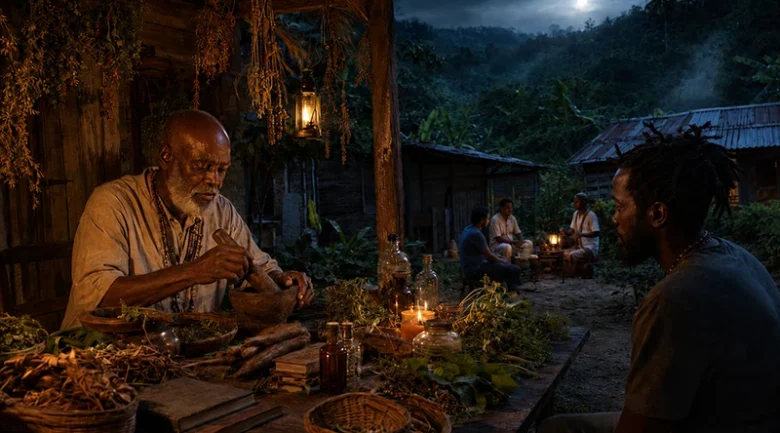
Obeah refers to a complex system of syncretic Afro-Caribbean spiritual practices, herbalism, and supernatural beliefs in Dominica that have functioned as a cornerstone of rural island life for centuries. Defined in the national legal code as a “vulgar fraud,” Obeah is technically illegal under The Obeah Act (Chapter 10:38) of the Laws of Dominica. Despite its illegality, the practice persists in various forms, ranging from traditional bush medicine and protective rituals to malicious intent, often intersecting with the island’s social structures and a rich oral tradition of folklore featuring entities such as the Soucuyant and the Loogaroo.
In the contemporary context, Obeah exists in a state of cultural tension: it is simultaneously viewed as a vestige of West African resistance to colonial rule and as a superstitious practice that challenges the state’s dominant Christian orthodoxy.
Legal Status: The Obeah Act (Chapter 10:38)
The primary legislation governing the practice is the Obeah Act, originally enacted on August 2, 1904, as part of the Leeward Islands’ colonial legal framework and subsequently incorporated into the independent Laws of Dominica. The Act is designed not only to punish the practice itself but to suppress the literature and consultation associated with it.
Legal Definitions
Under Section 2 of the Act, Obeah is broadly defined to include witchcraft and any activity involving working or pretending to work by spells or by professed occult or supernatural power. The law further defines “instruments of obeah” as any object ordinarily used in the practice or any object intended to be used by a person who claims it possesses supernatural properties.
Punishments and Enforcement
The Act provides for severe penalties for those convicted of practicing or consulting Obeah:
- Practising Obeah: Individuals found practicing Obeah are liable to imprisonment for twelve months. For male offenders, the law allows for flogging (whipping) either in addition to or instead of imprisonment.
- Consulting a Practitioner: Under Section 6, any person who consults an Obeah practitioner to bring about a specific event or effect an object is liable to a fine of three thousand dollars ($3,000 XCD) or twelve months in prison.
- Search and Seizure: Magistrates or Justices of the Peace may issue warrants authorising the police to enter and search premises, using force if necessary, where instruments of obeah are suspected to be hidden.
- Presumption of Guilt: Section 8 stipulates that if an instrument of obeah is found during a search, the possessor is deemed to be practising Obeah unless they can prove otherwise.
Suppression of Literature
Section 10 specifically criminalises the composition, printing, or distribution of any material calculated to promote the superstition of obeah. This historically targeted pamphlets and occult books, particularly those from the De Laurence catalogue, which were widely imported into the Caribbean in the early 20th century.
Historical Context: Resistance and Creolization
The origins of Obeah in Dominica are rooted in the transatlantic slave trade, where West African spiritual traditions (primarily from the Akan, Igbo, and Ewe peoples) were adapted to the harsh realities of the plantation system.
Obeah as a Tool of Resistance
Throughout the 18th and 19th centuries, Dominica’s volcanic landscape, which facilitated the development of Maroon communities, allowed African spiritual practices to survive in more insulated environments than on flatter, more controlled islands. For the enslaved population, Obeah was a source of empowerment. Practitioners, known as Obeah-men or Obeah-women, acted as community leaders, spiritual advisors, and healers. They provided “gardes” (protections) to those planning rebellions and used their perceived influence over the supernatural to maintain internal social discipline outside the gaze of the plantation owners.
The British fear of Obeah reached a peak following the 1760 Tacky’s Rebellion in Jamaica, leading to the first widespread anti-Obeah laws in the region.
The French Influence
Dominica’s unique history of shifting between French and British rule led to a distinct creolization of Obeah. French colonial influence introduced elements of European folklore, such as the Loup-garou (werewolf), which merged with African beliefs in shadow-catching and skin-shedding to create the Dominican Loogaroo.
Typology of Practice: Garder vs. Practitioner
In Dominica, a sharp distinction is often made between malevolent Obeah (sorcery used for harm) and “Garder” (from the French garder, meaning “to keep” or “to guard”), which refers to protective or healing spiritual work.
The Garder (Traditional Healer)
A Garder is a rural specialist who uses bush medicine and spiritual insight to diagnose ailments that modern medicine may fail to explain, such as wasting diseases or soukouyant marks. One must remember that all types of Obea summon or channel supernatural, harmful entities. Garder’s primary functions include:
- Healing: Using herbal poultices, teas, and spiritual baths (known as jays) to treat physical and spiritual sickness.
- Protection: Creating amulets or performing rituals to safeguard a house or a newborn child from malicious spirits.
- Justice: Acting as an informal mediator to identify thieves or settle disputes within a village.
The Malevolent Archetype
In contrast, the Obeah Man of popular folklore is often portrayed as a reclusive, often physically repulsive figure who has made a pact with malevolent entities (such as Bazil, the spirit of the Silk Cotton tree) to manipulate others for a fee. This archetype is frequently used in cautionary tales to enforce community morals and warn against greed and isolation.
Folklore and Supernatural Entities (The Jumbies)
Obeah is forever linked to the Dominican belief in Jumbies (spirits of the dead or supernatural beings). These entities are central to the island’s oral storytelling traditions – today, no one believes these stories anymore.
The Soucuyant and Loogaroo
These are skin-shedding vampires that take the form of a fireball at night.
- Transformation: They shed their skin in a wooden mortar and fly through the air to suck the blood of victims, leaving blue-black bruises.
- Defenses: Traditional defences include scattering salt or rice on a doorstep; the creature is compulsively driven to count every grain, allowing the sun to catch them before they can re-enter their skin.
The Bolom and Douen
- Kokma: A spirit created from a fetus or an unbaptized child, often used by Obeah practitioners to perform tasks or bring wealth to their masters.
- Douen: Mischievous spirits of unbaptized children characterized by backward-facing feet and large straw hats; they are known to lure living children into the forest.
Guardians of Nature
- Papa Bois: The half-human, half-beast protector of the forest who punishes those who disrespect the environment.
- Mama D’Leau: The river spirit and wife of Papa Bois, who protects aquatic life and may lure men to watery deaths.
Instruments and Bush Medicine
The instruments of obeah cited in legal documents often overlap with the tools of traditional Caribbean ethnobotany. Colonial authorities routinely criminalised indigenous medical knowledge, intentionally mislabeling sacred roots, leaves, and amulets as evidence of malicious witchcraft.
Herbal Foundations
Common plants used in both healing and spiritual protection in Dominica include:
- Silk Cotton Tree (Ceiba pentandra): Known as the Jumbie Tree, it is believed to house powerful spirits.
- Lemon Grass and Bay Leaves: Used in herbal teas and ritual baths to promote relaxation and cleansing.
- Gommier (Dacryodes excelsa): The white latex gum is used for medicinal purposes (toothaches) and as a spiritual incense.
- Noni and Castor Oil: Frequently used for circulation and digestive issues, respectively.
Ritual Objects
Objects confiscated in historical Obeah trials often include:
- Animal remains: Bones, teeth, or horsehair used to maintain connections with the dead.
- Grave Dirt: Falesly, considered a potent substance for both protection and harm.
- Consecrated Items: Occasionally, practitioners may incorporate elements of Catholic ritual, such as blessed candles or consecrated bread, into their work.
Socio-Cultural Impact in the 21st Century
Today, Obeah remains a point of significant socio-cultural debate in Dominica. While the Obeah Act is rarely enforced, usually only coming into play in cases of fraud or violence, the stigma of the law persists.
Religious Opposition
The dominant Christian denominations in Dominica, particularly the Catholic Church and various Evangelical groups, generally view Obeah as demonic or mental slavery. In other Caribbean islands like Jamaica, church leaders have actively protested against the decriminalisation of Obeah as recently as 2025, fearing it would embolden criminal activity.
Decolonization and Heritage
Conversely, many scholars and cultural activists in the region view the Obeah Act as a colonial relic used to suppress African identity. There is an increasing movement to distinguish Obeah from criminal fraud and recognize it as a valid, though misunderstood, part of the African diaspora’s spiritual heritage.
Tourism and Public Perception
Despite its illegality, Obeah and its associated folklore are magnetic to travellers and locals alike, adding a layer of mystery to Dominica’s image as the Nature Isle. Figures like the Soucuyant are now celebrated during Independence storytelling competitions, shifting from objects of genuine terror to icons of cultural performance.
The Danger of Spiritual and Financial Exploitation
Obeah is not a harmless cultural relic; it is a system that thrives on fear, psychological manipulation, and the exploitation of the vulnerable. Most practitioners operate as predators (the remaining few remain ignorant of what they do), targeting individuals at their lowest points; during illness, grief, or financial ruin. They extract exorbitant sums of money for remedies and protections that have no basis in reality.
Beyond the financial loss, the psychological harm is devastating. The belief that one is under a curse can lead to severe anxiety, clinical depression, and even physical deterioration. In Dominica, Obeah has been used to tear families apart, incite violence over land disputes, and shield criminal activity under a veil of supernatural intimidation. It is a real and present danger that causes tangible suffering in our communities. It is not a joke; it is a tool of harm.


References
-
1.
The Obeah Act (Chapter 10:38) https://dominica.gov.dm/laws/chapters/chap10-38.pdf
-
2.
“Obeah Man” for DOMFESTA https://dominicanewsonline.com/news/homepage/news/entertainment/obeah-man-for-domfesta/
-
3.
Creole slave society, obeah, and the law https://www.cambridge.org/core/books/cultural-politics-of-obeah/creole-slave-society-obeah-and-the-law/614D64A80BF1F8CCF008F662FC7AD8D3
-
4.
Obeah Vagrancy and the Boundaries of Religious Freedom Analyzing the Proscription of Pretending to Possess Supernatural Powers https://www.cambridge.org/core/journals/journal-of-law-and-religion/article/obeah-vagrancy-and-the-boundaries-of-religious-freedom-analyzing-the-proscription-of-pretending-to-possess-supernatural-powers-in-the-anglophone-caribbean/11EEE1AD5948F72F423FE174FFE61F87