


First Maroon War (1785–1786)
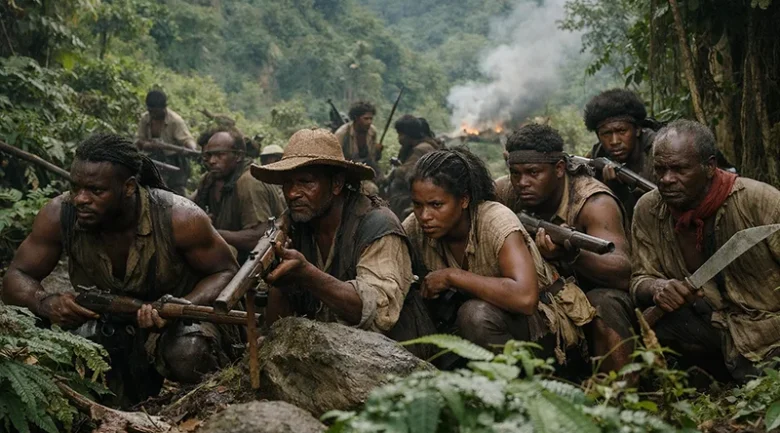
The First Maroon War (1785–1786) represents a critical paradigm shift in the colonial history of Dominica, marking the transition from localised resistance to a state-level military conflict between the British administration and sovereign communities of self-liberated Africans. While individual acts of defiance had occurred since the inception of European settlement, this specific confrontation marked the first time the British crown authorised a coordinated, publicly funded counter-insurgency campaign to systematically eradicate the autonomous maniels (Maroon fortresses) that controlled the island’s interior. This conflict was fundamentally shaped by the vertical, unforgiving terrain of the island, historically known as Waitukubuli, the strategic brilliance of Maroon commanders such as Balla and Pharcel, alongside the enduring influence of the elder chief, Jacko. Ultimately, the campaign severely depleted the colonial treasury, transformed regional military defence strategies, and firmly established the Maroon Spirit as a permanent, defining pillar of the Dominican national identity.
Historical Origins and the 1783 Re-Occupation
To understand the outbreak of the First Maroon War (1785–1786), one must examine the geopolitical instability of Dominica in the late 18th century. Following the Treaty of Paris in 1763, the British began a rapid and often violent expansion of the plantation system. However, during the American Revolutionary War, the French successfully invaded and occupied Dominica from 1778 to 1783.
During these five years of French rule, British colonial authority over the interior forest vanished. The Maroons, who had already established strongholds in the mountains, took advantage of this power vacuum. They expanded their provision grounds, solidified their internal governance, and increased their numbers by liberating enslaved people from British-owned estates that the French had neglected. When the British returned to power in 1784 following the Treaty of Versailles, they found an island where the interior frontier was effectively a separate, hostile state. The plantocracy, desperate to reclaim their property and secure their investments in coffee and sugar, pressured the newly returned Governor, John Orde, to take immediate military action.
The Geography of Resistance: Waitukubuli as a Fortress
The First Maroon War was, in many ways, a war against the landscape itself. The Maroons utilized the island’s natural defenses to offset the British military’s superior weaponry.
- The Southern Strongholds: Balla and his followers operated primarily in the rugged heights above the Soufrière and Grand Bay areas. These mountains offered steep ridges and deep ravines (known as fondes) where a handful of men could hold off an entire battalion.
- The Windward Sanctuary: Pharcelle’s territory encompassed the dense, rain-soaked forests of the east coast. The heavy rainfall and dense canopy made it nearly impossible for British regulars to keep gunpowder dry or to navigate without indigenous guides.
- Jacko’s Central Plateau: Hidden deep within the island’s misty centre near Belles, the mountain plateau of Jacko Flats became the ultimate symbol of Maroon independence. The true power of this high-altitude sanctuary was not that the Maroons could see the oceans, but that the colonial forces could not see them. Buried beneath a dense canopy of ancient trees and guarded by the roaring waters of the Layou River valley, this self-sustaining base was an invisible fortress. To protect their home, Chief Jacko and his followers hand-carved the legendary Jacko Steps into the vertical cliffside. These massive, slippery stone steps forced invading British troops to climb in single file, completely exposed, making the camp virtually untouchable and allowing the Maroons to launch raids to liberate enslaved people on the coasts safely.
Primary Figures of the Conflict
The First Maroon War was a brutal chess match played out in the rainforests, driven by the clashing personalities of two extraordinary Maroon leaders and a desperate British governor.
Balla (The Warrior Chief)
Balla was the most feared military mind of his time, famous for fighting to destroy the plantation economy itself. Instead of merely hiding in the wilderness, he organised his mountain camps into highly disciplined military units. Balla became a legend for his lightning raids, striking coastal estates at the break of dawn, freeing enslaved workers, capturing vital caches of weapons and salt, and vanishing back into the impenetrable forest before the local militia could even assemble.
Pharcelle (The Master of Strategy)
Ruling the rugged northern mountains around Morne Diablotin, Pharcelle fought with information just as much as weapons. He built a hidden web of informants running through the plantations and free communities to track British movements. While Balla was aggressive, Pharcelle was an expert diplomat; he understood that the British were terrified by the prospect of an island-wide revolution, and he used that fear to negotiate and protect his people’s freedom.
Governor John Orde
A British naval officer out of his depth, Orde had no idea how to fight a guerrilla war in Dominica’s wild interior. His first attempt, sending standard British redcoats deep into the jungle, failed miserably. Suffocating in heavy wool uniforms, the regular soldiers were cut down by yellow fever, heat exhaustion, and sudden ambushes by Maroons who moved like ghosts through the trees. Desperate to save the colony, Orde finally abandoned European tactics and created the armed Black Corps.
The Economic and Social Triggers of 1785
While the re-establishment of British sovereignty created structural friction, a sequence of critical environmental and legislative developments between late 1784 and early 1785 precipitated the transition to open warfare.
- The Environmental Catastrophe of 1784: In August 1784, a severe hurricane devastated Dominica, decimating both coastal plantation crops and the wild foraging ecology of the interior highlands. Facing acute starvation due to the destruction of mountain food sources, Maroon communities were structurally forced to escalate tactical raids on lowland estates to secure critical provisions, notably salt fish, flour, and livestock.
- Encroachment via Estate Expansion: The aggressive influx of British capital led to the rapid clearing of dense forest tracts in the Layou Valley and the parish of St. Joseph. The plantocracy’s territorial expansion directly encroached upon ancestral hunting grounds and agricultural perimeters that the Maroons categorised as sovereign, independent territory.
- The Maroon Suppression Act of 1784: In June 1784, the Dominica House of Assembly ratified the An Act for Suppressing the Maroon Negroes. This draconian legislation, aggressively enforced by Governor John Orde through executive proclamations throughout early 1785, designated all self-liberated individuals as existential enemies of the state. By offering substantial financial bounties for Maroons delivered “dead or alive,” the colonial administration eliminated any avenue for diplomatic truce, rendering defensive military mobilisation the Maroons’ sole mechanism for survival.
The Formation of the Black Corps (The Rangers)
Realising that European regular infantry were entirely unsuited for counter-insurgency warfare in the tropical rainforest, the British administration made a strategic and deeply controversial decision: the creation of the Black Corps, historically formalised as the Colony Rangers. This paramilitary unit was composed of approximately 500 enslaved men, systematically selected for their physical endurance, familiarity with the interior terrain, and linguistic capabilities. To secure their compliance, the British colonial apparatus leveraged two primary incentives:
- Conditional Manumission: The highly restricted promise of legal freedom, reserved almost exclusively for those who demonstrated exceptional battlefield asset value or directly facilitated the assassination or capture of prominent Maroon leaders.
- Financial Bounties: Substantial cash rewards paid in hard currency directly to the handlers and Rangers for the verified decapitation or capture of Maroon combatants.
The establishment of the Black Corps effectively transformed the First Maroon War into an asymmetric and tragic conflict of brother against brother, weaponising sub-sets of the exploited population against one another. The Rangers possessed the exact wilderness survival skills as the Maroons; they could decipher broken foliage, identify hidden food crops, detect the microscents of woodsmoke over vast distances, and navigate vertical cliff faces with identical agility. Ultimately, their deployment was the single most important factor in shifting the tactical balance of power, penetrating interior sanctuaries that had remained completely impenetrable to European arms, and securing the eventual British successes during the 1785–1786 campaign.
| Feature | Regular British Troops | The Black Corps (Rangers) |
| Mobility | Low (encumbered by gear) | High (lightly armed and agile) |
| Terrain Knowledge | Poor (relied on maps) | Excellent (indigenous/local knowledge) |
| Climate Resilience | Low (vulnerable to tropical disease) | High (acclimatized to Dominica) |
| Tactics | Conventional line infantry | Guerrilla and tracking specialists |
Military Campaigns and Scorched Earth Tactics
The First Maroon War was not a war of massive battlefields; it was a brutal, slow-burning conflict fought through hundreds of hidden, bloody skirmishes. Realising they could not match the Maroons in direct combat, the British used the Colony Rangers to execute a ruthless “scorched earth” strategy.
War by Starvation
The most devastating blow to the Maroon resistance was the systematic destruction of their hidden farms. The Maroons were master cultivators, turning secret mountain slopes into rich gardens of yams, tannias, cassava, and tobacco. The Rangers methodically ripped up these crops, trampled the soil, and burned the storage sheds. With their food reserves wiped out, starving Maroon families were left with no choice but to risk everything and descend to the coastal plantations to scavenge for survival, walking straight into deadly traps set by the waiting British militia.
The Destruction of the Maniels
The Rangers were sent deep into the mountains with orders to find and burn every Maroon village to the ground. These hidden settlements were surprisingly well-established, complete with sturdy wooden huts, communal cooking spaces, and sacred areas for worship and gathering. By turning these mountain homes into ash, the British stripped the Maroons of their only protection against Dominica’s relentless, freezing mountain downpours, using the harsh tropical climate as a weapon.
The Siege of Balla’s Territory
In the closing months of 1785, the fires of the First Maroon War shifted to the towering, misty peaks of the south. High in the rugged heights of Morne Anglais, Chief Balla had carved out a formidable mountain fortress. He kept his followers one step ahead of the British by using forest telegraphy, sending booming acoustic messages across the valleys through the deep beating of drums and the sharp, piercing echo of blown conch shells to warn the camps the moment the Rangers advanced.
Yet, the mountain canopy could not protect the Maroons from the sting of betrayal. The British captured a number of Balla’s top lieutenants, including a warrior named Cuffee. Facing a brutal execution, Cuffee cracked under pressure and revealed the secret, heavily guarded trails that led straight to Balla’s main camp. Under the cover of total darkness, the Colony Rangers swarmed the sleeping settlement in a surprise raid. While Balla himself miraculously survived by plunging headfirst down a treacherous ravine into the jungle below, the damage was done. The loss of his winter food stores, the capture of his people, and the shattering of his myth as an untouchable leader dealt a heartbreaking, fatal blow to the spirit of the Maroon resistance.
The Capture and Execution of Balla (1786)
By the opening quarter of 1786, the structural foundation of the southern Maroon resistance was experiencing total collapse under the weight of the colonial scorched-earth campaign. Chief Balla, compromised by systemic isolation and supply depletion, was ultimately tracked down on Sunday, March 18, 1786, near the Layou River basin. His precise position was compromised by an enslaved informant operating under the colonial promise of personal manumission. Engaging in a final, desperate skirmish with a detachment of Colony Rangers, Balla sustained a mortal firearm wound. Exhibiting profound ideological defiance on his deathbed, he refused to capitulate to interrogators, verbally taunting Governor John Orde’s forces and demanding his own decapitation in accordance with his spiritual beliefs regarding metaphysical immortality.
Following his death in the forest, the British administration decapitated his corpse to maximise psychological deterrence across the plantation labour force. Balla’s remains were brought to the capital and exposed on a public gibbet within the Old Market Plaza in Roseau. While the physical elimination of the supreme chief marked the structural conclusion of organised Maroon campaigns in the southern districts, it permanently solidified Balla’s martyrdom. His demise gave rise to the historic, mournful Kwéyòl lamentation, “Balla mort, bois gatay” (“Balla is dead, the woods are ruined”), which was sung clandestinely across the island’s estates, converting a horrific act of colonial display into an enduring anthem of subaltern resistance.
Pharcelle’s Peace: The Fragile Truce of 1786
While the elimination of Chief Balla pacified the southern districts, the northwestern sectors near the Morne Diablotin range remained locked in a costly military stalemate. Chief Pharcelle had consolidated his forces deep within the interior highlands, forcing Governor John Orde to recognize that a continued war of attrition would financially cripple the colonial treasury.
In a highly atypical departure from standard counter-insurgency protocols, Orde initiated diplomatic backchannels with Pharcelle. The resulting 1786 agreement was legally structured not as a sovereign treaty, but as a framework of conditional capitulation. The accord featured several critical provisions:
- Conditional Amnesty: Pharcelle and a strictly audited registry of his immediate, long-term followers were granted personal, legal manumission.
- Spatial Demarcation: The Maroons were permitted to occupy designated interior crown lands, conditioned on an absolute prohibition against territorial expansion toward low-altitude plantation boundaries.
- Surrender of Future Fugitives: In exchange for colonial recognition, Pharcelle was structurally co-opted into the plantocracy’s security apparatus, agreeing to actively capture and return any future runaway slaves to their respective estates.
- Colonial Stipend and Surveillance Roles: Pharcelle was formally commissioned as a colonial forest warden, receiving a recurring monthly allowance to police the interior on behalf of the British crown.
This pacification strategy was met with intense hostility by the local House of Assembly. The white plantocracy vehemently argued that compromising with a self-liberated leader undermined the foundational security of the slave economy, viewing it as an ideological surrender. However, for the executive British administration, the agreement represented a highly pragmatic, cost-effective solution to a fundamentally unwinnable war in the rugged northwestern interior.
Administrative and Financial Impact
The First Maroon War (1785–1786) was more than a bloody conflict; it was the single most expensive and destabilizing event in Dominica’s 18th-century history, leaving a scar that reshaped the island’s economy and laws.
- A Crushing National Debt: The war cost the House of Assembly a staggering £30,000, an astronomical sum at the time that nearly bankrupted the colony. To pay off this massive debt, the government slapped heavy new taxes on coffee and rum, forcing the plantation owners to pay out of pocket for the very war they had begged the British to fight.
- The Birth of a Standing Army: The constant threat of a Maroon resurgence forced Dominica to become a permanent military state. The conflict led to a highly professionalized local militia and kept the specialized Black Rangers active as a standing army, forever patrolling the edges of the dark mountain forests.
- The Tightening of the Chains: Out of pure fear, the colonial assembly passed ruthless new laws designed to completely crush the spirit of the enslaved population. The government banned any enslaved person from traveling between estates without a written “pass” signed by their master and placed armed guards at the traditional Sunday markets, aggressively choking off the secret trading networks that the Maroons had used to survive.
The Enduring Presence of the Maroon Spirit
The First Maroon War (1785–1786) did not culminate in the total eradication of Marronage across Dominica; instead, it institutionalised a structural pattern of hidden sovereignty that persisted for generations. While Chief Balla was executed and Chief Pharcelle was temporarily co-opted via conditional capitulation, the peace remained inherently fragile. A decade after the agreement, a deeply paranoid British Assembly violated the truce, arresting Pharcelle and exiling him to Jamaica, and later Canada, out of fear that he would align with the French-backed rebellions of the 1790s. Despite these colonial manoeuvres, the interior command infrastructure remained resilient. Hegemonic leaders like Chief Jacko continued to operate entirely unhindered within their central mountain redoubts, steadily expanding their autonomous communities.
The most enduring consequence of the 1785 campaign was psychosocial and systemic. It demonstrated that the British imperial apparatus could not govern Dominica without navigating the tactical avoidance of those who controlled the highlands. The Nèg Mawon evolved into an absolute symbol of anti-colonial resistance. Their complex trail networks, extensive botanical knowledge of the Waitukubuli forest canopy, and advanced agro-ecological techniques became the structural foundation for the independent, land-owning peasantry that emerged following the complete abolition of slavery in 1834.
Today, the First Maroon War is remembered across Dominica not as a tragic defeat, but as our first true declaration of independence. The names of our warrior ancestors and the hidden sanctuaries they built are woven into the very maps of our country, celebrated along trails like the Waitukubuli National Trail. They serve as an eternal reminder that the towering ridges and deep, green valleys of Dominica have always been a fortress for those who value freedom above all else. This history ensures that the story of Dominica is never just a story of the whip and the plantation, but a magnificent, lasting triumph of human resilience over the machinery of empire.


References
-
1.
An imperium in imperio: A Geospatial Analysis of Defensibility and Accessibility of Maroon Settlements in Dominica https://www.cambridge.org/core/services/aop-cambridge-core/content/view/546802B275644DA0575A0A0C419C1CFA/S0002731624000489a.pdf
-
2.
Dominica, 1826-1887 https://britishonlinearchives.com/collections/73/volumes/502/dominica-1826-1887
-
3.
List of colonial governors and administrators of Dominica facts for kids https://kids.kiddle.co/List_of_colonial_governors_and_administrators_of_Dominica
-
4.
Sir John Orde, 1st Baronet facts for kids https://kids.kiddle.co/Sir_John_Orde,_1st_Baronet
-
5.
Balla – The most feared maroon leader in Dominica https://dominicanewsonline.com/news/homepage/news/black-history-month-balla-the-most-feared-maroon-leader-in-dominica/
-
6.
Balla — The Greatest Maroon (Neg Mawon) of Dominica https://qrdominica.com/page/balla-neg-mawon
-
7.
Tribute to the Maroons and their contribution to Dominica’s history https://dominicanewsonline.com/news/homepage/homepage-carousel/tribute-to-the-maroons-and-their-contribution-to-dominicas-history-2/
-
8.
LIVE FREE OR DIE: Dr. Thomson Fontaine’s History Book – The Maroons of Dominica -1764-1818 https://dominicanewsonline.com/news/homepage/news/live-free-or-die-dr-thomson-fontaines-history-book-the-maroons-of-dominica-1764-1818/
-
9.
First Maroon War: EDSCO Research https://www.ebsco.com/research-starters/history/first-maroon-war