

Plantation Economy in Dominica
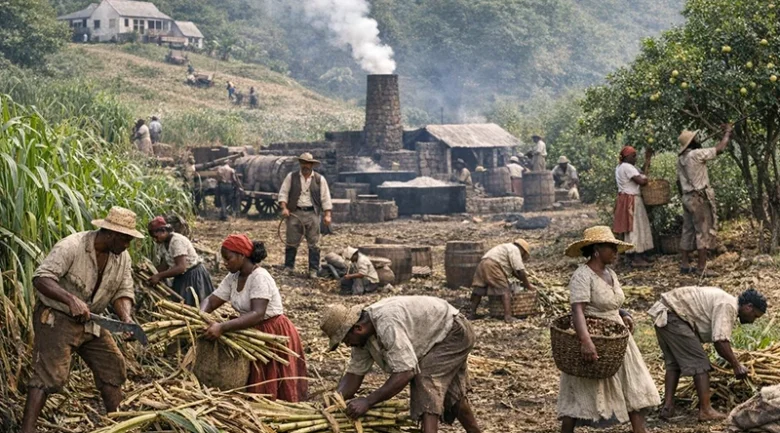
The Plantation Economy in Dominica refers to the historical socio-economic system that dominated the island from the mid-18th century through the late 19th century. Characterised by large-scale agricultural production for export, the system relied heavily on the exploitation of enslaved African labour and, later, indentured workers and sharecroppers. Unlike the monoculture sugar economies of neighbouring islands such as Antigua or Barbados, Dominica’s plantation history was defined by a more diverse range of crops, specifically coffee, cocoa, and limes, necessitated by the island’s rugged, mountainous terrain. This economic structure not only dictated the island’s trade relationships with Europe but also fundamentally shaped the social hierarchy, land tenure patterns, and demographic composition of the modern state of Dominica.
The Genesis of the Plantation System (1763–1783)
The formal establishment of a plantation economy in Dominica occurred significantly later than in the rest of the British West Indies. Although French woodcutters and smallholders had settled on the island in the early 1700s, it was the Treaty of Paris in 1763, which ceded the island to Great Britain, that triggered the systematic division of the land for commercial agriculture.
The 1765 Land Sales and John Byres
Following the British acquisition, the colonial administration sought to maximise revenue by selling off Crown Lands. To facilitate this, the surveyor John Byres was commissioned to map the island.
The Byres survey divided the island into ten parishes, with land lots sold primarily to British speculators and investors. However, the survey largely ignored the existing French settlers and the indigenous Kalinago population. This period saw the first massive influx of capital intended to transform the wilderness into a productive engine for the British Empire. The primary goal was to establish sugar estates, but the British soon realised that the verticality of the Dominica landscape posed unique logistical hurdles that flat islands did not.
The Sugar Frontier: Ambition vs. Topography
Sugar was the white gold of the 18th century, and British investors were eager to replicate Jamaica’s success in Dominica. However, the Sugar Industry in Dominica faced extreme environmental challenges.
- Steep Slopes: Sugar cane requires significant labor for hauling during harvest. In Dominica, many estates were situated on slopes so steep that traditional ox-carts could not be used.
- Water Power: Because of the island’s 365 rivers, Dominica’s sugar mills were often powered by water wheels rather than wind (common in the Lowland Antilles) or livestock. This required complex masonry and aqueduct systems, many of which are still visible today in areas like Old Mill Cultural Centre and Hampstead.
- Soil Erosion: The high rainfall in the interior led to rapid soil depletion when the protective forest canopy was cleared for cane fields.
Despite these challenges, sugar became the dominant export in the coastal lowlands in parishes such as St. George, St. John, and St. Andrew. However, production costs remained higher than elsewhere, making Dominican sugar less competitive on the global market.
The Coffee Boom and the French Influence
While the British pushed for sugar, the French-speaking population (the Gros Blancs and Gens de Couleur) focused on Coffee Production. Coffee was significantly better suited to the Dominican interior for several reasons:
- Altitude: Coffee trees flourished in the cooler, mist-shrouded mountains of Soufrière, Grand Bay, and the Layou Valley.
- Logistics: Harvested coffee beans were lighter and easier to transport down mountain trails by mule or human labor than heavy bundles of sugarcane.
- Smaller Acreage: A profitable coffee habitation required less land and fewer enslaved labourers than a sugar plantation.
By the late 1700s, Dominica became one of the leading coffee producers in the Caribbean. This created a dual-track plantation economy: a British-led sugar sector on the coast and a French-influenced coffee sector in the highlands. This economic split mirrored the island’s linguistic and religious divisions.
The Mechanics of Enslaved Labor
At the heart of the Plantation Economy in Dominica was the system of chattel slavery. Between 1763 and the abolition of the slave trade in 1807, tens of thousands of Africans were forcibly transported to Dominica.
Demographics and the Slave Registry
By the early 19th century, the enslaved population reached a peak of approximately 22,000 individuals, vastly outnumbering the white and free colored populations. The 1817 Slave Registry provides a detailed view of the labour force, categorised by age, colour, and occupation.
- Field Slaves: The majority of the population, responsible for the grueling work of clearing land, planting, and harvesting.
- Artisans: Skilled workers such as coopers (barrel makers), blacksmiths, and masons who were essential for maintaining the mill infrastructure.
- Domestic Workers: Those assigned to the Great House to serve the planter’s family.
The Provision Ground System
One unique aspect of the Dominican plantation was the Provision Ground. Because the terrain was so rugged, many planters allowed enslaved people to cultivate their own food on steep hillsides that were unsuitable for export crops. This allowed the enslaved population to maintain a degree of nutritional autonomy and even sell surplus produce in the Saturday markets in Roseau. This informal economy laid the groundwork for the independent peasantry that would emerge after Emancipation.
Economic Diversification: Cocoa and Limes
The volatility of the sugar and coffee markets, combined with the devastating Coffee Blight of the 1830s, forced the plantation economy to diversify.
The Rise of the Lime Industry
By the mid-19th century, Dominica began to pivot toward citrus fruits. The British Royal Navy’s requirement for lime juice to prevent scurvy created a stable market. The L. Rose & Company, established in the late 1800s, transformed Dominica into the world’s largest producer of lime juice. Large estates in the Roseau Valley, such as Bath Estate and Canefield, shifted their focus from sugar to limes, leading to the construction of specialised processing plants and a network of concentrated juice exports.
Cocoa Production
Cocoa (Cacao) served as another secondary crop, often grown alongside coffee. It required less intensive labor than sugar and could be harvested by families on smaller land plots. This crop became particularly important for the emerging class of smallholders following the decline of the large-scale estate system.
The Social Hierarchy of the Estate
The plantation was more than an economic unit; it was a total social system. The hierarchy was rigid and enforced by law and violence.
| Position | Role and Description |
| The Proprietor | Often an absentee landlord living in England or France, relying on agents to manage the estate. |
| The Attorney | The legal representative of the owner, often managing several estates simultaneously. |
| The Manager | The resident authority figure responsible for the day-to-day operations and the “discipline” of the workforce. |
| The Overseer | Usually a young white or mixed-race man who supervised the labor in the fields. |
| The Driver | An enslaved man appointed to lead the field gangs and enforce work quotas. |
This structure created a culture of surveillance and tension. In Dominica, the proximity of the “Great House” to the “Negro Houses” (slave quarters) varied by terrain, but the psychological distance was maintained through the Slave Code of Dominica, which strictly regulated movement, assembly, and punishment.
Trade, Ports, and the Merchant Houses
The plantation economy was entirely dependent on external trade. Roseau and Portsmouth (Prince Rupert’s Bay) served as the primary conduits for this exchange.
- Exports: Sugar (hogsheads), rum (puncheons), coffee, and cocoa were loaded onto ships bound for London, Liverpool, and Bordeaux.
- Imports: The plantations were not self-sufficient. They imported salted fish (cod) from Newfoundland, timber from North America, and clothing (Osnaburg cloth) for the enslaved population.
- The Merchant Class: A powerful group of merchants in Roseau, such as the houses of Garraway and Bellot, financed the planters. When the plantation economy began to fail in the late 19th century, many of these merchant houses foreclosed on the estates, becoming the new landed elite.
The 1834 Transition: Emancipation and Apprenticeship
The Abolition of Slavery Act (1833), which took effect on August 1, 1834, fundamentally disrupted the plantation economy. The transition was managed through the Apprenticeship System, a four-year period (six for field slaves, later reduced) where the formerly enslaved were required to continue working for their former masters for 40.5 hours a week without wages, in exchange for food and housing.
The failure of Apprenticeship in Dominica was due to the flight from the estates. Unlike in Barbados, where there was no vacant land, Dominica’s vast, unoccupied interior allowed the formerly enslaved to leave the plantations and establish free villages or become squatters. This created a massive labour shortage for the estates, leading to the eventual bankruptcy of many traditional sugar and coffee families.
The Decline of the Plantocracy and Crown Colony Rule
By the late 19th century, the traditional plantation economy was in a state of collapse.
- The Sugar Duties Act (1846): The British removal of preferential tariffs for colonial sugar meant that Dominican sugar had to compete with cheaper, slave-produced sugar from Cuba and Brazil.
- Natural Disasters: Hurricanes in 1834 and 1851 destroyed infrastructure that many planters could not afford to rebuild.
- The Encumbered Estates Act: This allowed for the forced sale of bankrupt estates.
In 1898, the British government utilised the economic instability of the plantation class to justify imposing Crown Colony Status. The British argued that the local legislature, which was increasingly dominated by the mixed-race middle class, could not manage the economic crisis. This marked the end of the Old Plantocracy as a political force, replacing it with direct imperial administration.
The Environmental Legacy
The plantation economy left a permanent mark on the Dominican environment. To create the estates, vast swathes of primary rainforest were cleared. This led to:
- Deforestation: Particularly in the foothills, altering local microclimates.
- Invasive Species: The introduction of the mongoose to control rats in the cane fields, which decimated native bird and reptile populations.
- Monoculture Remnants: The persistence of specific estate trees like the flamboyant and mango trees, which were originally planted as markers or food sources on the boundaries of plantations.
The Evolution of the Dominican Economic Identity
The legacy of the Plantation Economy in Dominica is a narrative of both extreme exploitation and remarkable adaptation. While the system was designed to enrich the British Empire through the forced labour of thousands, the unique Dominican terrain consistently undermined the totalizing ambitions of the plantocracy. The shift from sugar to coffee, and later to limes and cocoa, reflects a history of economic resilience necessitated by the “Waitukubuli” landscape. More importantly, the plantation system inadvertently fostered the birth of the Dominican peasantry. By allowing enslaved people access to provision grounds in the mountains, the plantation owners provided the tools and the land knowledge that would eventually allow the population to survive the collapse of the estate system.
Today, the physical remnants of the plantation, the stone ruins of mills, the terraced hillsides, and the estate names that define Dominican geography stand as monuments to a period of profound struggle. The modern Dominican economy, which has transitioned from the Green Gold Era toward eco-tourism and service-based industries, still grapples with the historical patterns of land ownership and export-dependency established in the 1700s. Understanding the plantation era is not merely an exercise in historical archival research; it is an essential requirement for comprehending the social stratification, the Kweyol language, and the deep-seated connection to the land that defines the Commonwealth of Dominica in the 21st century. The plantation was the forge in which the modern Dominican identity was struck, a process marked by the tension between the coastal aspirations of empire and the mountain-bound reality of a people determined to be free.


References
-
1.
Peasants and Capital: Dominica in the World Economy (HAU Books) https://haubooks.org/wp-content/uploads/2025/09/Trouillot_2025_Peasants-and-Capital_HAU-Books_9781914363221.pdf
-
2.
The Failed Promise of Freedom - Wiley Online Library https://onlinelibrary.wiley.com/doi/10.1111/ehr.13386
-
3.
Peasantry's Role in Post-Emancipation Caribbean (Scribd) https://www.scribd.com/document/267250734/Peasantry
-
4.
Historical Archaeology at Geneva Estate, Grand Bay (ResearchGate) https://www.researchgate.net/publication/265390259_Plantation_Labourer_Rebellions_Material_Culture_and_Events_Historical_Archaeology_at_Geneva_Estate_Grand_Bay_Commonwealth_of_Dominica
-
5.
Dominica's Historical Plantations: Traces of the Past https://paradisedominica.com/dominicas-historical-plantations-traces-of-the-past/
-
6.
British Caribbean Plantations (1750-1840) https://core.tdar.org/collection/64826/british-caribbean-plantations-1750-1840-cross-disciplinary-dialogues-among-historians-and-historical-archaeologists
-
7.
Plantation Economy Model - Digital Commons https://digitalcommons.du.edu/cgi/viewcontent.cgi?article=2978&context=etd
-
8.
Dominica: Country Report to the FAO https://www.fao.org/fileadmin/templates/agphome/documents/PGR/SoW1/americas/DOMINICA.pdf