

Informal Economy in Dominica
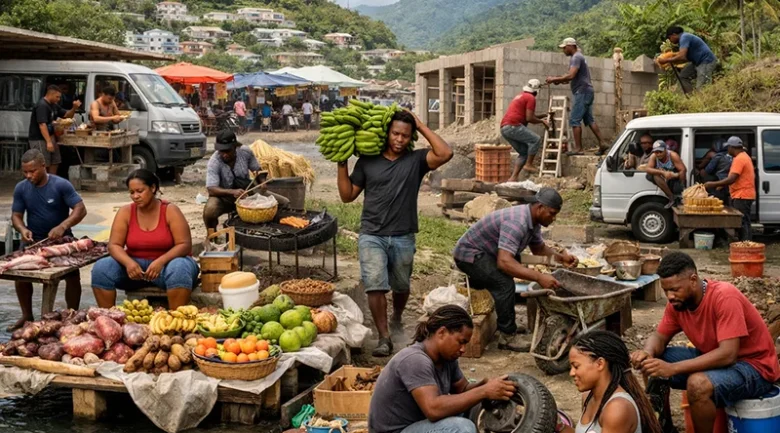
The informal economy represents a complex, resilient, and highly dynamic segment of Dominica’s socioeconomic landscape. While the government of Dominica aggressively pursues its mandate to become the world’s first climate-resilient nation, the shadow economy remains both a vital safety net for the vulnerable and a structural bottleneck for ultimate macroeconomic stability. In a small island developing state with a population of approximately 72,000, the traditional boundaries between formal enterprise and informal livelihood are frequently blurred. Understanding the informal economy requires looking beyond registered storefronts in Roseau and examining grassroots networks of trade, agriculture, and services that keep the nation functioning during economic contraction and natural disaster recovery.
Unlike the illegal underground economy, which involves illicit activities, the informal economy in Dominica comprises legitimate, productive activities that are simply unregulated, untaxed, or unregistered by state authorities. This sector absorbs the systemic shocks that the formal market cannot handle. Following the catastrophic impact of Hurricane Maria in 2017, which wiped out an estimated 226% of the national Gross Domestic Product (GDP), and the subsequent disruptions of the COVID-19 pandemic, the informal sector became the primary survival mechanism for thousands of displaced workers. Today, as the formal economy stabilises with the International Monetary Fund (IMF) noting real GDP growth stabilising around 3.3% to 4.3% in the mid-2020s, the informal sector has not contracted; rather, it has evolved, becoming fused with the island’s broader economic recovery and ongoing infrastructure boom.
Defining the Shadow Economy
To quantify and understand informality in Dominica, one must first identify its participants. The informal sector is not monolithic; it spans a wide spectrum of the national labour force, from subsistence farmers in the high interior to gig-economy workers navigating the digital landscape. Based on recent labour force surveys and Caribbean-wide economic assessments, the working-age population participating in the labor force fluctuates between 54,080 under strict definitions and over 60,900 when accounting for discouraged or marginally attached workers. The International Labour Organization (ILO) notes that in regions similar to the Caribbean, upwards of 60% of the adult labor force engages in the informal sector at least part-time.
Against the Dominican backdrop, this manifests in a variety of deeply entrenched traditional and modern roles that bypass the formal registry of the Inland Revenue Division and the Dominica Social Security board.
- The Huckster Trade: A cornerstone of Dominican informality, hucksters are predominantly female agricultural traders who purchase local produce, travel by ferry to export goods to neighbouring islands like Guadeloupe, Martinique, and Antigua, operating largely outside corporate tax nets.
- Unregistered Construction Labor: Fueled by the Citizenship by Investment (CBI) program’s massive infrastructure projects, thousands of independent masons, carpenters, and day laborers work strictly on a cash basis without formal contracts or site insurance.
- Transit and Minibus Operators: Much of the island’s public transportation is decentralized, managed by independent owner-operators who function as micro-enterprises, often under-reporting daily cash revenues.
- Domestic and Private Care: Private housekeepers, independent landscapers, and unregulated childcare providers form a massive, invisible workforce that sustains the formal working class.
- Street Vending and Micro-Retail: From roadside fruit stands to temporary food stalls during Mas Dominik and the World Creole Music Festival, these micro-retailers operate on cash flow alone, bypassing the 15% Value Added Tax (VAT) framework.
The Macroeconomic Statistical Footprint
Measuring the exact size of the informal economy is inherently difficult because its participants actively avoid observation. However, utilizing monetary approaches, currency demand models, and electricity consumption proxies, economists can estimate its weight. Regional studies analyzing the Organization of Eastern Caribbean States (OECS) and the broader Caribbean place the average size of the informal economy at approximately 32.3% of total GDP.
Applying this metric to Dominica, whose nominal GDP is steadily approaching the $650 million USD mark in 2026, implies that well over $200 million USD of economic activity occurs entirely off the books each year. This shadow GDP circulates rapidly within local communities. Because informal workers generally live on a hand-to-mouth basis, their propensity to consume is incredibly high. A dollar earned in the informal sector is almost immediately spent at local formal grocery stores, hardware shops, and utility providers. In this way, the informal economy acts as a continuous, untaxed stimulus package that subsidises the formal corporate sector’s revenues. Furthermore, the informal sector is heavily capitalised by diaspora remittances. With remittances historically accounting for up to 12% of the national GDP, funds sent from the United States, Canada, and the United Kingdom via money transfer operators frequently bypass the traditional commercial banking sector and are injected directly into informal micro-enterprises, funding everything from the purchase of seeds for unregulated farming to the importation of second-hand vehicles for private transport.
Core Drivers of Informality
The persistence and growth of the informal economy in Dominica are not born out of a collective desire to evade civic duty, but rather out of rational economic survival choices. The regulatory and financial environment in the Caribbean historically places a disproportionate burden on the smallest actors, incentivizing them to remain in the shadows.
- High Compliance Costs: Registering a business, maintaining accounting standards, and paying the baseline 25% corporate tax rate require financial literacy and capital that survivalist entrepreneurs simply do not possess.
- Labor Market Frictions: With youth unemployment historically hovering around 30% under relaxed definitions, the formal private sector simply cannot generate enough entry-level jobs, forcing young people to create their own unregulated employment.
- Onerous Taxation Thresholds: While the government offers micro-enterprise exemptions, the fear of retroactively applied taxes and the complexity of VAT compliance keep many small vendors away from formal registration.
- Seasonal Volatility: Both agriculture and tourism, Dominica’s primary economic engines, are highly seasonal, making it irrational for workers to formalise and pay fixed monthly social security contributions when their income fluctuates drastically.
- Information Asymmetry: Many informal workers remain unregistered simply due to a lack of awareness regarding the benefits of formalization, viewing government engagement strictly as a punitive tax extraction mechanism rather than a source of business support.
Demographics and Gender Dynamics
The demographic composition of Dominica’s informal economy reveals stark inequalities, particularly concerning gender and education. The sector is overwhelmingly populated by individuals who lack advanced tertiary education or certified vocational training. A 2022 working paper by the IMF analysing natural disasters in small island states explicitly modelled the behaviour of unskilled workers in Dominica. The model highlights that skilled workers generally secure formal employment or have the capacity to migrate during economic downturns. Conversely, unskilled households are locked into the domestic agricultural and informal service sectors.
Women are disproportionately represented in the most vulnerable tiers of the informal economy. While men often dominate the informal, yet higher-paying, construction and transit sectors, women are heavily concentrated in domestic work, street vending, and the aforementioned huckster trade. These female-dominated spaces are characterised by lower daily returns, higher physical risk, and a severe lack of capital accumulation. The gendered division of labor means that female informal workers bear the brunt of economic instability. They operate without maternity leave, sick pay, or occupational health and safety protections. When the cruise season dips, or when a tropical storm washes out the agricultural feeder roads, the female informal worker instantly loses her livelihood, plunging her household into immediate food and financial insecurity.
Vulnerability to Climate Shocks
Dominica’s geographic reality dictates that climate vulnerability and economic informality are inextricably linked. The overarching tragedy of the informal sector is that it functions entirely without a safety net. In the formal sector, an employee who loses their job or suffers a workplace injury can rely on the Dominica Social Security (DSS) system for unemployment or disability benefits. A formally registered business can claim insurance on lost inventory after a hurricane. The informal worker has none of these protections.
When an extreme weather event strikes the Nature Island, the capital of the informal worker, whether it is an unregistered fishing boat, a roadside vendor’s stall, or a plot of cash crops, is usually destroyed. Because they operate outside the financial system, they cannot access commercial bank loans to rebuild; instead, they must rely on predatory informal lenders or await state-sponsored disaster relief. The IMF models indicate that while corporate tax policies and formalised public-sector investments can buffer the formal economy against natural disasters, unskilled, informal households experience a severe and immediate drop in consumption. The lack of institutional resilience within the informal sector means that every major storm resets the wealth accumulation of the island’s poorest citizens back to zero, creating an inescapable cycle of poverty and vulnerability.
Strategies for Systemic Formalization
Given that a large informal sector threatens the long-term sustainability of the national tax base and the social security system, the Government of Dominica has launched a multi-pronged approach to encourage formalisation. We’ve moved away from punitive crackdowns and toward creating an environment that makes formalisation highly attractive and easily accessible.
- Targeted Micro-Exemptions: The government actively promotes its Fiscal Incentives program, which offers qualified micro and small businesses generating under EC$250,000 annually exemptions from specific taxes, removing the immediate financial penalty of registering.
- The Digital Transformation Push: Through the Caribbean Digital Transformation Project (CARDTP), the state is rolling out digital payment gateways and financial literacy programs, bringing cash-reliant vendors into the traceable, formal electronic banking ecosystem.
- Tourism Value Chain Integration: Under the National Resilience Development Strategy 2030, the government is deliberately structuring vendor arcades and cruise ship ports to require basic registration, effectively pulling informal artisans and tour guides into the regulated tourism supply chain.
- Accessible Grant Funding: Institutions like the Small Business Support Unit (SBSU) provide direct cash injections and technical training to microenterprises, with the strict condition that the business must formally register with the Inland Revenue Division to receive the funds.
- Social Security Reform: Ongoing dialogues aim to create flexible, voluntary contribution tiers within the Dominica Social Security system, allowing seasonal and gig workers to pay into a pension fund during high-earning months without penalizing them during the off-season.
The Macroeconomic Horizon
Looking toward the end of the decade, the informal economy in Dominica is situated at a critical crossroads. The influx of Citizenship by Investment capital has modernized the island’s physical infrastructure, but human capital infrastructure remains fractured by the formal-informal divide. For the government to realize its vision of a fully resilient society, economic resilience must reach the grassroots level. A nation cannot be truly resilient if one-third of its economic activity and over half of its labor force operate outside the protective umbrellas of state regulation, insurance, and social security.
The transition will require a delicate balancing act. Heavy-handed taxation or sudden regulatory enforcement could crush the fragile livelihoods of thousands of Dominicans who rely on informal trade to survive. Conversely, allowing the sector to grow unchecked will continually starve the national treasury of the funds required to build the climate-resilient roads, hospitals, and seawalls that protect all citizens. The path forward lies in the continued digitalisation of the Dominican economy and the fostering of a business climate where the benefits of operating in the light finally outweigh the costs of remaining in the shadow.


References
-
1.
OP-ED: The Caribbean labour market paradox – What the 2026 ILO report reveals https://dominicanewsonline.com/news/homepage/news/op-ed-the-caribbean-labour-market-paradox-what-the-2026-ilo-report-reveals/
- 2.
-
3.
Registration of Self-Employed Persons https://dss.dm/contributors/definition-se/registration-se/
-
4.
2024 Article IV Consultation—Press Release; Staff Report; and Statement by the Executive Director for Dominica https://www.elibrary.imf.org/downloadpdf/journals/002/2024/192/002.2024.issue-192-en.pdf
-
5.
Hucksters and Regional Trade https://www.adaptation-undp.org/explore/latin-america-and-caribbean/dominica
-
6.
Wholesale & Retail Trade https://www.customs.gov.dm/uploads/Go_CD_Budget_Address_for_FY_2025_2026_dd6ee9208f.pdf
- 7.
-
8.
ILO Caribbean Labour Paradox 2026 https://www.ilo.org/resource/article/caribbean-labour-market-paradox-what-2026-ilo-report-reveals