
Disability in Dominica
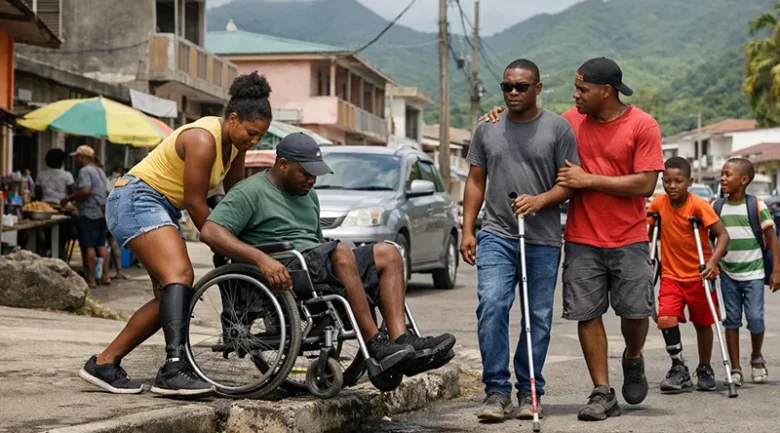
In the Commonwealth of Dominica, disability represents a profound cross-section of human rights, public health, and national resilience. For a Nature Island defined by its rugged, volcanic terrain and its vulnerability to extreme climatic events, the experience of living with a disability is uniquely shaped by the environment. Dominica is currently navigating a pivotal era of transformation, moving from a traditional charity-based model of disability care to a modern, rights-based framework aligned with the United Nations Convention on the Rights of Persons with Disabilities (CRPD).
Living with a disability in Dominica, whether physical, sensory, intellectual, or psychosocial, requires a level of adaptability that mirrors the island’s own history of recovery. We will examine the prevalence of disability, the legislative landscape, the impact of climate change, and the strategic roadmap for an inclusive “Dominica for All.”
Demographic Profile and Prevalence
Disability in Dominica is influenced by three primary drivers: the ageing population, the prevalence of non-communicable diseases (NCDs), and the aftermath of natural disasters.
The Statistical Reality
According to the most recent census data and specialised surveys conducted by the Ministry of Health, approximately 10% to 12% of the Dominican population lives with some form of disability. This aligns with Caribbean regional averages but presents specific challenges due to the island’s small, dispersed population.
| Category of Disability | Prevalence Trend | Primary Drivers |
| Physical/Mobility | Increasing | Diabetes-related amputations; Stroke; Age-related frailty. |
| Visual Impairment | Stable | Diabetic retinopathy; Cataracts; Glaucoma. |
| Hearing/Speech | Stable | Congenital factors; Occupational noise exposure. |
| Intellectual/Developmental | Better Reported | Improved early childhood screening (Autism, Down Syndrome). |
| Psychosocial/Mental | Rising | Post-traumatic stress (post-disaster); Depression; Substance use. |
The Link Between NCDs and Disability
In Dominica, the disability curve is inextricably linked to the NCD curve. Uncontrolled hypertension and diabetes are the leading causes of acquired disability.
- Amputations: Complications from diabetic foot ulcers remain a leading cause of limb loss.
- Stroke: As discussed in previous cardiovascular reports, strokes are the primary cause of long-term adult paralysis and cognitive impairment on the island.
- Vision Loss: Diabetic retinopathy is the leading cause of preventable blindness among working-age Dominicans.
Legislative Framework: The Rights-Based Shift
Evolving international commitments and community advocacy form the baseline for the disabled community in Dominica. The government, in close consultation with the Dominica Association of Persons with Disabilities (DAPD), continuously utilizes international human rights frameworks to improve local accessibility.
The UNCRPD Mandate
Dominica’s ratification of the United Nations Convention on the Rights of Persons with Disabilities (UNCRPD) serves as the primary operational baseline for social inclusion. It focuses on several key areas:
- Accessibility: Integrating inclusive design principles into modern infrastructure developments, including public facilities, schools, and medical centers.
- Economic Empowerment: Providing specialized vocational skill-building opportunities through targeted NGO workshops and national employment frameworks.
- Social Protection: Administering financial support to citizens whose physical or cognitive limitations prevent traditional employment through the national Public Assistance Grant and standard Social Security Invalidity Benefits.
The Role of the DAPD
The Dominica Association of Persons with Disabilities (DAPD) is the most vocal and effective advocate in the country. Founded in 1983, it has transitioned from a small support group to a national powerhouse. Its headquarters in Canal Lane, Goodwill, serves not just as an office, but as a “Centre for Empowerment,” providing computer literacy, braille training, and mobility orientation.
The Challenge of Topography and Transport
Dominica’s greatest beauty, its mountains and rivers, is also the greatest barrier to physical accessibility.
Urban vs. Rural Accessibility
- Roseau: The capital city has seen incremental improvements, such as sidewalk ramps in the newer sections of the Bayfront. However, the historic cobblestone aesthetic and narrow, high curbs of the inner city remain a significant hazard for wheelchair users and the visually impaired.
- Rural Districts: In villages perched on hillsides, such as Castle Bruce or Grand Bay, a person with a mobility disability is often house-bound without a private vehicle or a dedicated caregiver. The lack of wheelchair-accessible public transport (commuter vans) remains one of the most significant hurdles to education and employment.
The Smart Hospital Impact
One area of immense progress is the Smart Hospitals Initiative. Every retrofitted health building (such as the new Marigot Hospital and the Wesley Health Centre) incorporates universal design features to ensure full physical accessibility. These resilient facilities feature:
- Wide corridors and non-slip ramps.
- Accessible restrooms with grab bars.
- Visual and tactile signage for the sensory impaired.
Inclusive Education: The Next Generation
Dominica has moved away from the segregation of children with disabilities. The Ministry of Education’s policy is now Inclusive Education, in which children with special educational needs are integrated into mainstream classrooms whenever possible, with support from Special Education Leads.
Specialized Institutions
For children who require more intensive, specialized support, the island maintains key institutions:
- The Alpha Centre: A pioneer in providing education and life skills for children with intellectual disabilities.
- The Dominica School for the Hearing Impaired: Focuses on sign language acquisition and primary education for the deaf and hard-of-hearing.
The focus has shifted toward Early Intervention. By identifying developmental delays in children at the district clinic level (age 0–3), the government can provide speech therapy and occupational therapy earlier, significantly improving long-term outcomes.
Climate Change and Disability: Leave No One Behind
For Dominica, climate resilience is not a luxury; it is a necessity for survival. For persons with disabilities, a hurricane or a flash flood is a disproportionate threat.
Lessons from Hurricane Maria (2017)
The 2017 season highlighted critical gaps in disaster management. Many emergency shelters were not wheelchair accessible, and the “Early Warning Systems” (sirens and radio announcements) were often inaccessible to the deaf or those with cognitive disabilities who might not understand the urgency.
The Resilient Strategy
Under the coordination of the Office of Disaster Management (ODM) and integrated government ministries, targeted emergency protocols protect vulnerable citizens during extreme weather events:
- The Vulnerability Registry: District health teams maintain localized community registries mapping the locations of individuals with disabilities, ensuring they are prioritized by emergency responders for early evacuation during tropical storm or hurricane warnings.
- Accessible Shelters: Modern regional emergency shelters are constructed using universal design principles as a core requirement, providing reliable, barrier-free access, ramps, and specialized facilities.
- Inclusive Warnings: Emergency disaster alerts are actively disseminated via multi-channel SMS networks for the deaf and hard-of-hearing community, while utilizing simplified visual layouts and broadcast sign-language interpreters to maximize public accessibility.
Economic Participation and Social Stigma
Despite incremental legislative and physical accessibility gains, social stigma remains a stubborn barrier. In many Caribbean cultures, an outdated social shame is occasionally associated with disability, leading families to keep disabled relatives hidden from public view.
The Labor Market
Unemployment among the disabled community in Dominica remains significantly higher than the regional average. To combat this economic gap, national employment and digital hub frameworks focus on two key areas:
- Remote Work Integration: Leveraging the island’s expanding digital infrastructure and broadband expansion to create work-from-home pathways, allowing individuals with severe mobility challenges to secure viable employment in data entry, customer service, and digital marketing.
- Targeted Entrepreneurship: Providing accessible micro-grants and concessionary financial options through the AID Bank for disabled entrepreneurs looking to launch sustainable, home-based micro-enterprises, such as local craft production or small-scale agro-processing.
Healthcare for the Disabled
Beyond treating the disability itself, persons with disabilities often have complex secondary health needs.
Specialized Services at DCFH
The Dominica China Friendship Hospital (DCFH) provides the specialised diagnostics and surgeries necessary for the disabled:
- Rehabilitation Medicine: The physiotherapy department has been expanded to include more advanced robotic-assisted gait training.
- Ophthalmology: The Eye Clinic is a regional leader in restoring sight through cataract surgery and managing glaucoma.
- Audiology: New screening programs ensure that hearing aids are fitted and maintained for those with sensory loss.
Mental Health and Disability
There is a growing recognition of the Psychosocial Disability burden. The long-term stress of living in a disaster-prone region, combined with the social isolation of physical disability, has led to increased rates of depression. The Acute Psychiatric Unit (APU) at the DCFH and the community-based mental health teams are now integrating disability sensitivity into their psychological support models.
Summary of Progress and Remaining Gaps
| Area of Analysis | Current Progress | Remaining Gap |
| Legislation | National Policy and CRPD alignment. | Full enforcement of accessibility fines. |
| Healthcare | Universal compliance in “Smart” facilities. | Lack of specialized pediatric neurologists. |
| Education | Inclusive education policy in schools. | Shortage of trained sign-language interpreters. |
| Infrastructure | Accessible new hospitals and shelters. | Historic Roseau remains difficult to navigate. |
| Social | Strong advocacy from DAPD. | Persistent rural stigma and hiding of patients. |
The Roadmap to 2030: Dominica for All
The goal for the next four years is to move from access to full participation. The strategic roadmap includes:
- The National Registry: Moving the vulnerability registry to a blockchain-secured National ID system, ensuring that a disabled person’s needs are instantly known to any healthcare provider or emergency responder they encounter.
- Accessible Tourism: Promoting Dominica as an accessible nature destination. This involves creating All-Access trails in national parks (such as Emerald Pool) so wheelchair users can experience the island’s natural beauty.
- Para-Sports Development: Building on the success of Dominican athletes, there is a push to develop a national Para-Athletics program, using sports as a tool for social inclusion and physical rehabilitation.
Dismantling Barriers, Building Inclusion
Disability in Dominica is proof of the island’s resilience. From the survivor of a hurricane-induced injury to the child born with Down Syndrome in a remote mountain village, the disabled community is an integral part of the Dominican identity.
The Nature Island is learning that true resilience is measured by how it protects and empowers its most vulnerable citizens. By combining the high-tech capabilities of the DCFH with the grassroots advocacy of the DAPD and the climate-resilient engineering of CREAD, Dominica is on a path to becoming a regional model for disability inclusion. The challenge of the topography remains, but the barriers of the mind and the law are finally being dismantled.


References
-
1.
Disability Statistics No.1 (2011 Census Report) https://stats.gov.dm/wp-content/uploads/2019/10/Disability-Report.pdf
-
2.
The Disability Data Report 2022 https://www.disabilitydatainitiative.org/wp-content/uploads/2022/Main_text_2022_Disability_Data_Report.pdf
-
3.
How Disability and Poverty Take Effect in Dominica https://borgenproject.org/disability-and-poverty-in-dominica/
-
4.
Disability Inclusion: A Path to Sustainable Development https://www.gfdrr.org/en/publication/situation-dominica
-
5.
Impact of Climate Change on Disabled Communities in Dominica https://www.cijn.org/the-impact-of-climate-change-on-the-disabled-communities-health-in-dominica/
-
6.
World Bank: Disability Inclusion in Latin America and the Caribbean https://documents1.worldbank.org/curated/en/099061024112026984/pdf/P1712561cb605f0bc1b414176b029286096.pdf
-
7.
Inclusion in Climate Change Discourse https://climatetrackercaribbean.org/climate-justice/the-inclusion-of-persons-with-disabilities-pwds-in-the-climate-change-discourse-in-dominica/