Special Educational Needs (SEN) in Dominica
In the Commonwealth of Dominica, the approach to Special Educational Needs (SEN) is built upon the foundational belief that “Every Child Can Learn; Every Child Must Learn.” Within the context of a Small Island Developing State (SIDs), this isn’t just an educational goal; it is a pillar of national resilience. For a nation that is frequently challenged by natural disasters, the protection and empowerment of its most vulnerable citizens, including those with physical, intellectual, and sensory disabilities, is a benchmark of its social maturity.
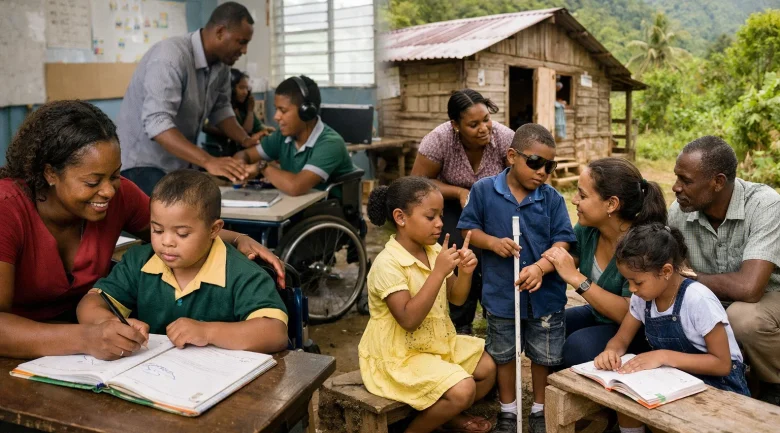
As of the mid-2020s, Dominica has shifted from a welfare-based model, where children with special needs were often isolated or kept at home, to a rights-based model. This transition acknowledges that students with SEN are entitled to the same high-quality, digital-forward education as any other Dominican child, adapted to their specific learning profile.
The Legal and Policy Framework for Inclusion
The primary legal instrument governing special education is the Education Act of 1997. While this legislation was groundbreaking for its time, mandating that the government provide for children with special requirements, the modern execution of these laws is guided by the Education Sector Plan.
This plan emphasises Inclusive Education, a strategy that aims to bring SEN students into the mainstream classroom whenever possible. The policy is designed to reduce the stigma associated with “Special Ed” and to foster empathy and social cohesion among the general student population. In the future, the Ministry of Education will have further refined these policies to align with the Sustainable Development Goals (SDG 4), focusing on ensuring equitable access to technical and vocational training for students with disabilities to prepare them for the workforce.
Institutional Landscape: The Specialized Hubs
While the goal is inclusion, certain conditions require specialised equipment and therapeutic interventions that mainstream schools cannot always provide. In Dominica, this gap is bridged by a robust partnership between the government and non-governmental organizations (NGOs).
Alpha Centre
Located in Goodwill, the Alpha Centre has been a pioneer in the field for decades. It primarily serves children with intellectual disabilities and focuses on a “Life-Skills Curriculum.” Students here aren’t just taught basic literacy and numeracy; they are taught the functional skills required for daily living, such as personal hygiene, social interaction, and basic vocational tasks like gardening or craft-making.
Achievement Learning Centre (ALC)
The Achievement Learning Centre has emerged as the premier facility for children on the Autism Spectrum (ASD). Recognising that the sensory environment of a standard school can be overwhelming for neurodivergent children, the ALC provides sensory-integrated spaces. Their approach is highly individualised, using Individualised Education Programs (IEPs) to track the minute progress of each student in communication and social-emotional regulation.
School for the Hearing Impaired
Communication is the greatest barrier for the deaf and hard-of-hearing community. The School for the Hearing Impaired provides a specialised environment where Dominican Sign Language and English literacy are taught in tandem. The school also acts as a resource centre, providing hearing aid maintenance and speech therapy services that are otherwise scarce on the island.
The Role of the District Education Officer (DEO) in SEN
The District Education Officer is the frontline coordinator for special education in rural areas. In a country where the topography can make a 10-mile journey take an hour, the DEO ensures that students in remote villages aren’t forgotten.
- Early Identification: Through screening clinics held in various health districts, DEOs work with health officers to identify developmental delays in children before they reach primary school age.
- Resource Redistribution: The DEO manages the flow of assistive technology. If a school in the Eastern District (Kalinago Territory) requires a specialised standing frame for a student with cerebral palsy, the DEO facilitates the logistics of getting that equipment from the central stores to the school.
- Teacher Support: DEOs are responsible for ensuring that the mainstream teachers in their district aren’t overwhelmed. They organise SEN-Clusters where teachers can consult specialists on adapting a standard lesson plan for a student with dyslexia or ADHD.
District-Level Integration and Resource Rooms
To facilitate inclusion, several primary schools across Dominica’s Educational Districts have been outfitted with resource rooms. These are dedicated spaces within a regular school where SEN students can go for one-on-one sessions with a specialised teacher before returning to their regular class for social subjects.
- Goodwill Primary (Roseau Central): Serves as a model for urban inclusion, housing a large SEN unit that integrates students into the wider school culture.
- Grand Bay Primary (South): A hub for the southern villages, focusing on students with physical disabilities and providing specialised physiotherapy support.
- Salybia Primary (East/Kalinago Territory): Focuses on cultural relevance in SEN, ensuring that the indigenous Kalinago context is respected while delivering specialised learning support.
Assistive Technology and Digital Equity
By the mid-2020s, technology became the great equaliser for Dominican SEN students. The Ministry of Education’s digital push has specific provisions for those with disabilities:
- Screen Readers and Braille Displays: For students with visual impairments, allowing them to access the Digital OECS Harmonized Primary Curriculum alongside their sighted peers.
- Alternative and Augmentative Communication (AAC): Non-verbal students are increasingly using tablet-based apps that allow them to speak by selecting icons, significantly reducing the frustration and behavioral issues often associated with communication barriers.
- The MyPD Portal: This online platform allows teachers in the North or West to access the same high-level SEN training modules as those in the capital, ensuring that “Location is not a barrier to Expertise“.
The Ridge-to-Reef Resilience for SEN
In Dominica, a school isn’t just a school; it is a hurricane shelter. Under the DOMCREP Project, the physical infrastructure of SEN-supporting schools has been significantly hardened.
For a child with a disability, a hurricane is a double trauma. The loss of a specialized wheelchair or a familiar routine can be devastating. Current disaster protocols now include “Vulnerable Person Registries” at the district level. When an Atlantic storm approaches, the DEOs and the Office of Disaster Management (ODM) prioritize the evacuation of SEN families to shelters that have been specifically retrofitted with:
- Wheelchair-accessible bathrooms.
- Backup power for medical devices (nebulizers, oxygen concentrators).
- Calm Rooms to mitigate the sensory overload of a crowded shelter.
Vocational Transition and The Blue-Green Economy
A critical area of focus in recent years is what happens after a student with special needs turns 18. The Technical Vocational Education and Training (TVET) units in Dominica are now adapting to include SEN students.
Programs in Hydroponics, Hospitality, and Digital Data Entry are being tailored to provide meaningful employment. In the Blue Economy, for example, students with certain intellectual disabilities are being trained in sustainable fishing gear repair and aquaculture monitoring, proving that they can contribute to the island’s GDP while gaining a sense of independence and dignity.
Current Challenges and Future Outlook
Despite these advancements, the Nature Island faces persistent hurdles in its quest for total inclusion:
| Challenge Area | Description | Impact on SEN |
| Topography | Steep inclines and volcanic valleys. | Makes door-to-door transport for physical disabilities expensive and difficult. |
| Specialist Retention | Brain Drain of therapists to larger islands or North America. | Leads to long wait times for speech and occupational therapy. |
| Public Stigma | Residual cultural beliefs regarding disability. | Can lead to late diagnosis as parents may delay seeking help. |
| Data Gaps | Inconsistent tracking of “Invisible Disabilities” (e.g., Dyscalculia). | Some students may be labeled as lazy when they actually require specialized support. |
The 2035 Inclusive Horizon
The roadmap for the next decade in Dominica involves the total normalisation of special education. The goal is to reach a stage where every teacher graduating from the Dominica State College is essentially an SEN teacher, possessing the fundamental skills to differentiate instruction for a diverse classroom.
By strengthening the District Education Officer network and continuing to leverage high-speed digital tools, Dominica is moving toward a future where a child’s zip code, or their physical or cognitive architecture, never dictates their potential. Through the spirit of “Koudmen” (community help) and state-of-the-art resilience, the nation is ensuring that the “Nature Isle” remains a sanctuary for all types of minds.


References
-
1.
Ministry of Education: Special Education Department https://education.gov.dm/departments-units/school-operations-unit/special-education
-
2.
Government Continues to Place Emphasis on Special Education https://mail.news.gov.dm/news/news-items/government-continues-to-place-emphasis-on-special-education
-
3.
Alpha Centre: Universal Service Fund (ICT Support) https://usfdominica.dm/alpha-center/
-
4.
OECS PEARL: Project Overview https://oecs.int/en/oecs-pearl-educational-advancement-and-relevant-learning
-
5.
Meeting special education needs in Dominica, Grenada, St. Lucia and St. Vincent and the Grenadines https://www.globalpartnership.org/blog/meeting-special-education-needs-dominica-grenada-st-lucia-and-st-vincent-and-grenadines
-
6.
CXC Calls for Greater Accessibility in Educational Resources https://dominicanewsonline.com/news/homepage/homepage-carousel/cxc-calls-for-greater-accessibility-in-educational-resources/