



Dominica Community Resilience Enhancement Project (DOMCREP)
The Dominica Community Resilience Enhancement Project (DOMCREP) is a transformative EC$70 million (USD 26 million) initiative designed to build absolute climate security at the community level. Approved by the Green Climate Fund (GCF) in late 2025, it marks the first single-country project for the Commonwealth of Dominica under the GCF’s “Simplified Approval Process” (SAP062).
While national policies like the Climate Resilience Act (2018) set the legal stage, DOMCREP is the operational vehicle that delivers resources directly to the eight most vulnerable districts in Dominica. It focuses on three interconnected pillars: food security, disaster-proof infrastructure, and community-led adaptation.
Why was DOMCREP launched in late 2025?
The launch of DOMCREP in 2025 follows the successful “sunset” of CREAD and the mainstreaming of resilience into the Ministry of Finance, Economic Development, Climate Resilience and Social Security. Despite significant progress since 2017, rural communities remain exposed to the twin threats of high-intensity hurricanes and erratic rainfall patterns that affect rain-fed agriculture.
The project addresses the “resilience gap” by providing grant-based funding, ensuring that the nation does not increase its debt burden while adapting to the climate crisis. It serves as the primary implementation tool for the Climate Resilience and Recovery Plan (CRRP) 2030, specifically targeting the goal of 100% community self-sufficiency during natural disasters.
Pillar 1: Climate-Smart Agriculture and Food Security
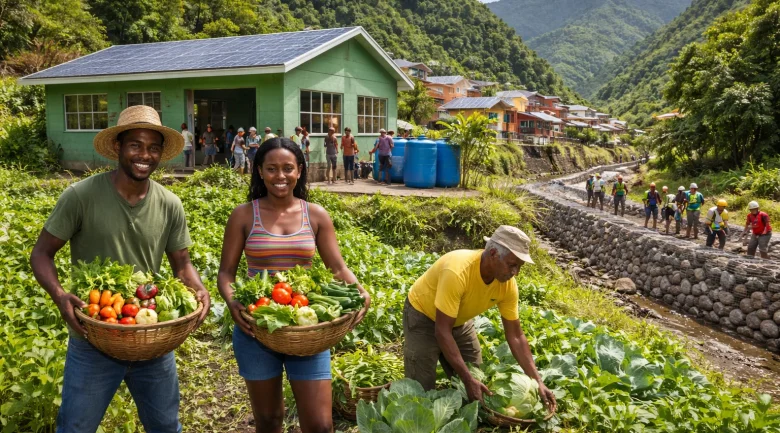
The cornerstone of DOMCREP is the total modernization of the agricultural sector to ensure that a hurricane does not lead to a food crisis. Agriculture in Dominica has historically been vulnerable to “mono-crop” failure; DOMCREP changes this through technology and diversification.
Implementing Protective Agriculture
Under the 2025 guidelines, DOMCREP is funding the installation of high-tech shade houses and greenhouses. These structures are engineered to the same 157-mph wind standards as residential buildings, allowing farmers to protect high-value crops (like peppers, tomatoes, and leafy greens) from torrential rain and wind.
Irrigation and Water Management
To combat the increasing frequency of droughts, the project provides:
- Solar-Powered Irrigation: Reducing the cost of water delivery to hillside farms.
- Rainwater Harvesting: Large-capacity tanks (1,000+ gallons) installed at farm sites to ensure water availability during the dry season.
- Resilient Crop Varieties: Distribution of heat-tolerant and wind-resistant tubers and root crops to ensure caloric stability.
Empowering Women and Youth in Agribusiness
DOMCREP has a strict social mandate: at least 40% of beneficiaries must be women, and 35% must be youth or marginalized groups. This is achieved through a specialized on-granting mechanism that provides micro-finance for agro-processing, turning raw crops into shelf-stable products like flours, dried fruits, and essential oils.
Pillar 2: Upgrading Critical Disaster Management Infrastructure
A community is only as resilient as its strongest building. DOMCREP applies the 2025 Climate Resilient Building Codes to ensure that “safekeeping” infrastructure is functional even if the national grid fails.
Hurricane Shelter Retrofitting
The project is currently retrofitting over 20 primary hurricane shelters across the eight target communities. These are not mere repairs; they are full-scale structural upgrades including:
- Reinforced Roofing: Installation of heavy-duty hurricane straps and 24-gauge galvanized sheeting.
- Energy Autonomy: Each shelter is being equipped with a Solar PV system and battery storage to ensure lighting and communications remain active when the grid goes down.
- Water Independence: Integration of high-capacity filtration systems and 15,000-gallon underground cisterns.
Strengthening Early Warning Systems (EWS)
DOMCREP is expanding the national Multi-Hazard Early Warning System. This includes the installation of automated weather stations and flood sensors in high-risk river basins. In late 2025, the system was upgraded to include satellite-linked sirens and SMS-alert capabilities that reach residents in “dead zones” where cellular signal is typically weak.
Pillar 3: Establishing the National Climate Resilience Knowledge Hub
To ensure long-term sustainability, DOMCREP is creating a Knowledge Hub to collect and analyze climate data. This hub serves as a central repository for “Best Practices” in resilient construction and agriculture.
- Contractor Training: Local builders are being certified in “Resilience Masonry,” ensuring they have the technical skills to implement the 2025 codes.
- Data-Driven Planning: Using GIS (Geographic Information Systems) to map landslide-prone areas and guide future investment under the Physical Planning Act.
- Regional Leadership: The hub allows the Commonwealth of Dominica to export its “Resilience Template” to other Small Island Developing States (SIDS) across the Caribbean.
Key Performance Indicators (KPIs) for DOMCREP 2030
The success of the project is measured against the strict targets of the CRRP. By the end of the project cycle, the following results are expected:
| Target Area | 2030 Objective |
| Agricultural Recovery | 50% reduction in time to restart food production post-disaster. |
| Shelter Capacity | 100% of targeted communities have a Category 5 hurricane certified shelter. |
| Gender Equity | 40% of climate-smart grants awarded to female-led enterprises. |
| Water Security | 30% increase in communal water storage capacity in rural districts. |
How can communities access DOMCREP support?
Access to DOMCREP resources is managed through the village councils and the Ministry of Agriculture. Farmers and community groups must submit a “Resilience Plan” that demonstrates how their requested funding will reduce long-term vulnerability.
As of December 2025, the project has already begun its first round of “On-Granting” for agro-processors in the northern and eastern districts. This grassroots approach ensures that the USD 26 million investment results in tangible, visible improvements in every street and every farm.


