
Hearing Loss in Dominica
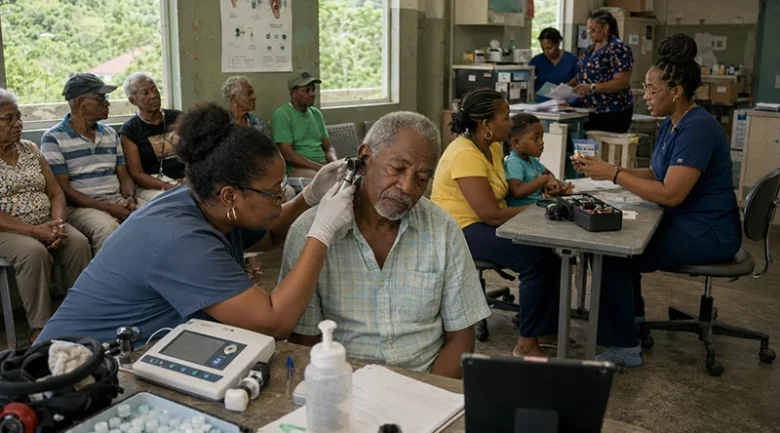
Dominica’s experience with hearing loss is uniquely shaped by biological ageing, genetic history, and a modernising public health system. We will examine the strategic shifts necessary to provide comprehensive ear care and audiological support across the island. Understanding hearing health on the Nature Island requires looking beyond basic clinical data to the social, economic, and legislative forces affecting the population. Modern health assessments estimate that between 7,000 and 8,500 Dominicans live with some form of disability, a figure within which hearing impairment represents a significant, yet historically underreported, component.
In Dominica, hearing loss is more than a medical condition; it is a silent barrier that intersects with the island’s rugged, mountainous geography and its rich linguistic heritage of English and Kwéyòl. From the expanding specialized diagnostic capabilities at the Dominica China Friendship Hospital (DCFH) to the dedicated grassroots advocacy of the Dominica Association of Persons with Disabilities (DAPD), the nation is successfully navigating a transition away from a culture of quiet endurance toward sustainable, proactive audiological care.
Prevalence and Statistical Overview
While comprehensive, longitudinal data on hearing loss specifically for Dominica has historically been scarce, regional Caribbean data and local health assessments provide a clear window into the scale of this challenge.
- Regional Context: The World Health Organization (WHO) estimates that nearly 80% of people living with disabling hearing loss reside in low- and middle-income countries, a designation that includes the Caribbean archipelago.
- Dominican Estimates: Based on a localized disability prevalence rate of 10% to 12% and global epidemiological averages, an estimated 2% to 3% of Dominica’s general population suffers from disabling hearing loss, defined by the WHO as a threshold greater than 35 decibels (dB) in the better hearing ear.
- The Ageing Demographic: Globally recognised as a land of longevity, Dominica boasts one of the highest per-capita concentrations of centenarians in the world, a phenomenon tracked by the Dominica Council on Ageing (DCOA). With approximately 13% of the total population aged 65 or older, age-related sensorineural hearing loss (presbycusis) serves as the primary driver of local audiological statistics. Within this over-65 demographic, the prevalence of disabling hearing loss is estimated to climb sharply to between 25% and 30%.
Prevalence Trends by Age Group
| Demographic Cohort | Estimated Local Prevalence | Primary Etiological Drivers |
|---|---|---|
| Neonatal (Newborns) | 1.0–2.0 per 1,000 live births | Congenital genetic factors; Perinatal insults (neonatal hypoxia, hyperbilirubinemia, low birth weight). |
| Pediatric (School-Age) | 3.0%–5.0% | Chronic Suppurative Otitis Media (CSOM); Otitis Media with Effusion; Secondary acoustic or physical trauma. |
| Adults (Ages 20–60) | 8.0%–12.0% | Hazardous occupational noise exposure; Microvascular auditory damage secondary to metabolic NCDs (Diabetes/Hypertension). |
| Geriatric (Ages 60+) | 25.0%+ | Presbycusis (progressive sensorineural degeneration); Cumulative microvascular damage from long-term NCDs. |
Etiological Determinants of Audiological Impairment
The etiology of hearing loss across the Dominican population is multifactorial, spanning preventable environmental exposures, chronic systemic pathologies, and congenital or genetic markers.
Metabolic Pathologies (NCDs) and Pharmacological Ototoxicity
Dominica experiences a pronounced public health burden from metabolic non-communicable diseases, specifically Type 2 diabetes mellitus and chronic hypertension. Epidemiological data confirm that diabetic individuals exhibit a twofold increase in the prevalence of sensorineural hearing loss compared to non-diabetic cohorts. Sustained hyperglycemia induces microvascular angiopathy and neuropathy within the stria vascularis and the cochlear nerve. Furthermore, the therapeutic management of severe NCD complications frequently utilises ototoxic pharmacological agents, such as specific aminoglycoside antibiotics and loop diuretics. Due to constrained local audiological surveillance protocols, these treatments carry an elevated risk of causing irreversible secondary auditory degradation.
Chronic Suppurative Otitis Media (CSOM)
Within the pediatric demographic, chronic or recurrent middle ear infections represent the premier driver of acquired conductive hearing loss. In rural and geographically isolated parishes, structural barriers to timely Otorhinolaryngology (ENT) interventions frequently exacerbate these conditions. Prolonged fluid retention or unmonitored tympanic membrane perforations subsequently elevate the risk of permanent auditory deficits, causing secondary delays in speech acquisition and linguistic development.
Industrial and Recreational Acoustic Trauma
Acoustic overexposure across Dominica’s economic and social sectors accelerates early-onset sensorineural damage through two distinct vectors:
- Occupational Acoustic Hazards: Laborers within the agricultural, timber processing, and infrastructural construction sectors are routinely subjected to hazardous decibel levels. The inconsistent enforcement of standardized personal protective equipment (PPE) protocols leads to insidious, progressive Noise-Induced Hearing Loss (NIHL).
- Socio-Recreational Acoustic Stress: Cultural practices, specifically highly amplified audio systems utilised during local festivals, carnival events, and public transit vehicles (minibuses), expose the adolescent and young adult demographics to prolonged, unsafe sound pressure levels. This trend is directly correlated with a rising clinical incidence of early-onset tinnitus and auditory fatigue.
The Institutional Architecture of Audiological Care
The administration and delivery of audiological services in Dominica are sustained through a collaborative matrix comprised of public tertiary healthcare systems and specialised non-governmental organisations (NGOs).
The Public Sector: Dominica China Friendship Hospital (DCFH)
The Dominica China Friendship Hospital (DCFH) serves as the central hub for advanced otolaryngological diagnostic infrastructure. The Department of Otorhinolaryngology (ENT) manages surgical interventions for middle-ear pathologies and conductive impairments, while specialized clinic spaces provide the requisite acoustic environments for audiometric testing and diagnostic screening.
The NGO Backbone: DAPD and the Unit for the Deaf
The Dominica Association of Persons with Disabilities (DAPD), established in 1983, remains the premier civil society organization driving legislative and social advocacy for hearing-impaired populations.
- Sign Language Instruction: To circumvent widespread communication barriers, the DAPD coordinates targeted instructional courses in sign language, facilitating bridging communication between hearing demographics and the Deaf community.
- Assistive Device Distribution: Operating as a critical resource pipeline for economically vulnerable patients, the DAPD functions as a conduit for international donations of amplification technologies, providing hearing aid fittings and auxiliary technical support.
Educational Integration Frameworks
Dominica’s Ministry of Education has moved away from institutional segregation toward a modern, inclusive education framework. Rather than placing hearing-impaired children into isolated public school units, the national strategy prioritises mainstreaming pediatric patients into standard classrooms. This integration is structurally reinforced by Special Education Needs (SEN) professionals who facilitate visual-manual accommodations and early sign language acquisition.
Legislative Guardrails and Quality Assurance
To safeguard the delivery of audiological and otolaryngological services, Dominica utilizes robust legislative frameworks that ensure clinical accountability and standardisation.
- The Medical Laboratories Act 2024: Enforced by the Medical Laboratories Council, this statute mandates strict licensing and ISO 15189 compliance for pathology and diagnostic facilities analysing biological samples. Within the broader scope of diagnostic fidelity, this ensures that core metabolic screening, such as diabetic biomarker testing, is scientifically validated, indirectly supporting the accurate diagnosis of metabolic conditions linked to secondary sensorineural hearing loss.
- The Medical Profession Act 2026: This legislation modernised healthcare governance by establishing the Dominica Medical Council. Through the enforcement of a stringent Specialist Registry and annual practicing certificates, the Act dictates that only certified Otorhinolaryngologists (ENT specialists) can legally execute medical and surgical interventions for complex auditory pathologies. This structure explicitly protects the public from unauthorised practices and ensures alignment with regional health protocols.
- Newborn Hearing Screening (NHS) Protocols: While a universal district mandate is still in development, specialized clinical initiatives are actively integrating newborn screening protocols within immediate postnatal care workflows at the Dominica China Friendship Hospital (DCFH). This targeted push aims for standard, early objective testing (OAE/AABR) within the first 48 hours of life to mitigate early childhood developmental delays.
Socio-Economic Impact and the Silent Tax
Untreated audiological deficits impose a severe economic and psychosocial burden across the lifespan of the Dominican population, functioning as an invisible structural tax on national human capital.
Academic Deficits and Cognitive Development
Pediatric patients with undiagnosed or unmanaged hearing impairments are frequently misdiagnosed with cognitive or behavioral disorders. In the standard Dominican educational setting, which relies heavily on acoustic-oral instruction, even a mild 20dB bilateral hearing threshold shift can degrade speech intelligibility by up to 50%. This severe loss of acoustic access correlates with increased rates of academic underachievement, higher secondary school dropout rates, and a subsequent compression of lifetime earning capacity.
Psychosocial Isolation and Accelerated Neurodegeneration
Within Dominica’s rural communities, age-related hearing decline acts as a primary catalyst for profound social withdrawal and clinical depression among the elderly. Longitudinal epidemiological research establishes a robust causal link between unmanaged sensorineural hearing loss and accelerated cognitive decline, including dementia and Alzheimer’s pathology. Implementing structured audiological screening and amplification interventions provides a highly cost-effective mechanism to mitigate the long-term operational burden on regional geriatric healthcare systems.
Labor Market Barriers and Digital Transformation
Societal stigma surrounding the use of manual communication (ASL/Kwéyòl sign variations) or visible amplification devices creates artificial barriers to workforce entry. However, Dominica’s aggressive expansion into the regional digital economy, characterized by decentralized text-based communication and remote service sectors, is structurally transforming the labour market. This digital pivot bypasses traditional acoustic barriers, creating accessible channels for economic self-sufficiency within the Deaf and hard-of-hearing community.
Realities Facing Ear Care in Dominica
Even with recent legal and medical steps forward, several major roadblocks still stop Dominicans from getting the hearing care they deserve:
- The Crushing Cost of Equipment: A single, high-quality digital hearing aid costs between $1,500 and $4,000 XCD. Because our national health systems and local insurance plans do not cover these necessary prosthetic devices, some Dominicans are priced out of a normal life and left to live in silence.
- Nowhere to Fix Broken Devices: There is a total lack of local tech support to repair or service complex digital hearing aids on the island. When an expensive donated or purchased device breaks down, there is no one to fix it, forcing the user right back into isolation.
- The Invisible Struggle: Because you cannot see hearing loss, it is a hidden disability. This makes it incredibly difficult to attract the same public sympathy, government funding, and corporate sponsorship that naturally flows toward visible physical disabilities like mobility issues.
- A Severe Shortage of Speech Therapists: Finding an issue is only half the battle. Dominica currently faces an acute shortage of certified Speech-Language Pathologists. Without these vital specialists, local children who receive hearing aids or implants lack the professional coaching they need to develop speech and communication skills.
Roadmap Ahead: Building Hearing Resilience
Transforming hearing care in Dominica requires a clear, practical, three-step action plan to protect our citizens from infancy to old age:
- Mandatory Baby Screenings: Making the simple, painless OAE (Otoacoustic Emissions) hearing test a strict requirement for every single baby born on the island, catching early issues before a child even leaves the hospital.
- Crackdowns on Noise Pollution: Passing and enforcing modern noise-ordinance laws to shield our families and communities from dangerously loud volumes in residential areas, public transport, and business districts.
- Bringing Care Home with Tele-Audiology: Utilizing Dominica’s high-speed internet to bridge the specialist gap. This lets local patients visit their community clinic and connect digitally with world-class audiologists across the Caribbean and North America for remote adjustments to their hearing devices.
A Vision for an Inclusive Nature Island
Hearing loss in Dominica is a challenge that can be overcome through the synergy of legislation, technology, and empathy. By upholding the standards of the 2024 and 2026 medical reforms, the island is ensuring that its citizens are not just Nature Island residents, but active participants in the sounds of their culture. From the rhythmic Kwéyòl of the marketplace to the voices of their centenarians, preserving the gift of sound is essential to preserving the soul of Dominica.


