

Crown Colony Status of Dominica
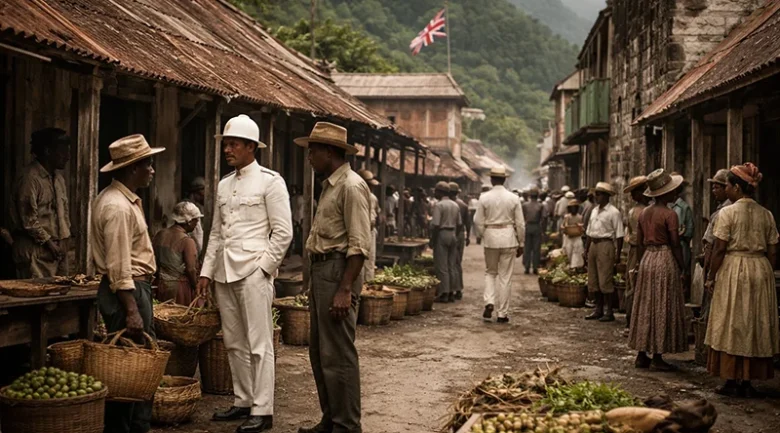
Crown Colony Status in Dominica refers to a specific period in the island’s constitutional history, beginning in 1898, during which the British government revoked the island’s semi-representative form of government in favour of direct rule. Under this system, administrative and legislative authority was centralised in the hands of a Governor appointed by the British Monarch, effectively ending the era of local legislative dominance by the Dominican middle class. This shift was a significant moment in the British Empire’s management of the West Indies, representing a move away from local autonomy toward imperial consolidation and efficiency.
The Constitutional Landscape Prior to 1898
Before the imposition of Crown Colony Status in Dominica, the island operated under a Representative System that allowed for a House of Assembly with elected members. Following the 1831 Brown Privilege Act, this system enabled a mixed-race, locally born elite to gain a majority in the legislature, a phenomenon known as the Mulatto Ascendancy.
By the late 19th century, the British Colonial Office viewed this local control as an obstacle to imperial interests. The House of Assembly was frequently in deadlock with the British-appointed Governor over issues of taxation, infrastructure spending, and the management of the island’s dwindling coffee and sugar industries. The British argued that the local legislature was factious and incapable of managing the island’s finances. In contrast, local leaders argued that the British were attempting to suppress the political rights of non-white subjects.
The Catalyst for Change: The La Plaine Riots of 1893
The move toward Crown Colony rule was accelerated by civil unrest in the village of La Plaine in 1893. The conflict began when residents refused to pay land taxes, which they viewed as an unfair burden imposed by a distant administration. When police attempted to carry out evictions, the situation escalated into a violent confrontation, resulting in the deaths of four villagers after British marines opened fire.
The La Plaine Riots provided the British government with justification for intervening. In response, they dispatched a Royal Commission headed by Sir Robert Hamilton to investigate the working of the constitution and the general state of the island.
The Hamilton Report and the Imperial Offer
Sir Hamilton’s report, published in 1894, was a pivotal document in the history of Crown Colony Status in Dominica. Hamilton concluded that the island’s elective system was inefficient and that the legislative deadlock was preventing necessary economic development.
The British government presented the Dominica House of Assembly with an ultimatum, often referred to as the Imperial Offer:
- The British Treasury would provide a significant grant of £30,000 for the construction of an Imperial Road to open up the interior for agriculture and for a coastal steamer service.
- In exchange, the House of Assembly must vote to abolish the elective principle and accept a single-chamber Legislative Council (LegCo) composed entirelyof members appointed by the Crown.
The Legislative Self-Dissolution of 1898
The debate over the Imperial Offer divided the Dominican elite. Pro-British members and some merchants believed that injecting capital was necessary to save the island from bankruptcy. Opponents, led by the remnants of the Mulatto Ascendancy, argued that the price, the total loss of political representation, was too high.
In July 1898, after intense pressure from Governor Sir William Haynes-Smith, the House of Assembly held its final vote. By a narrow margin of 8 to 6, the Assembly voted for its own dissolution. This act effectively committed political suicide, transitioning Dominica from a colony with a representative voice to a Crown Colony under direct rule from London.
| Legislative Body | Before 1898 (Representative) | After 1898 (Crown Colony) |
| Structure | Bi-cameral or semi-elected House | Single-chamber Legislative Council |
| Membership | Majority elected by property owners | 100% appointed by the Governor |
| Authority | Could block colonial budgets | Purely advisory to the Governor |
| Primary Voice | Local Dominican middle class | British Colonial Office / Governor |
Administrative Structure Under Crown Colony Rule
With the establishment of Crown Colony status, the Governor became the supreme authority on the island. He was assisted by an Executive Council and a Legislative Council, both of which he chaired.
- The Governor: Acted as the direct representative of the British Monarch. He had the power to override any local concerns and was responsible only to the Secretary of State for the Colonies in London.
- The Legislative Council: Consisted of Official members (British civil servants like the Treasurer and Attorney General) and Unofficial members (usually wealthy white planters or merchants appointed by the Governor). Because the Official members were required to vote as the Governor directed, the government always held an Official Majority.
- The Imperial Road: One of the primary projects of the early Crown Colony period was the construction of a road from the coast into the center of the island. While it was intended to facilitate British capital and large-scale plantations, the project was plagued by mismanagement and the difficult Dominican terrain.
The Social and Political Impact of Direct Rule
The imposition of Crown Colony Status in Dominica had a chilling effect on local political life. For nearly three decades, the people of Dominica were denied any formal voice in their own governance. This led to a period of stagnation in civil rights, as the British focused primarily on economic extraction rather than social development.
However, this period also sowed the seeds of modern Dominican nationalism. The lack of representation led to the formation of the Representative Government Association in the early 20th century. Led by figures such as Cecil Rawle, the RGA argued that Dominicans were being taxed without representation and that the Official Majority in the Legislative Council was a mockery of British democratic values.
The Gradual Restoration of the Elective Principle
The absolute nature of Crown Colony rule began to soften in the 1920s. Following the Wood Report of 1922, which investigated constitutional grievances across the West Indies, the British agreed to a Mixed Council for Dominica. In 1924, the elective principle was partially restored, allowing a minority of elected members to sit alongside appointed members.
It was not until the introduction of Universal Adult Suffrage in 1951 that the final vestiges of the 1898 Crown Colony system were dismantled. This allowed all Dominican adults, regardless of property ownership, the right to vote, eventually leading to the island’s transition to Associated Statehood (1967) and full Independence (1978).
The Historical Significance of 1898
The era of Crown Colony Status serves as a stark reminder of the tension between imperial administrative goals and the local desire for self-determination. By trading political autonomy for the promise of infrastructure and financial stability in 1898, the island entered a period of direct subordination that fundamentally altered its development path. While the Imperial Road and other projects were intended to modernise the economy, the loss of a representative voice meant that these developments often ignored the needs of the broader Dominican population in favour of British commercial interests.
The struggle to regain the rights lost during the 1898 transition became the defining political theme of the 20th century in Dominica. The resilience of local leaders during the Crown Colony years ensured that the tradition of parliamentary debate and civic engagement survived, providing the foundation for the vibrant democracy that exists in the Commonwealth of Dominica today. The memory of 1898 remains a cautionary tale in the national consciousness regarding the inherent value of sovereignty and the dangers of compromising political rights for temporary economic relief.


References
-
1.
Dominica: History & Constitutional Roots (Commonwealth iLibrary) https://www.thecommonwealth-ilibrary.org/index.php/comsec/catalog/download/789/789/6238?inline=1
-
2.
Dominica profile - Timeline https://www.bbc.com/news/world-latin-america-19409492
-
3.
Dominica 1826-1887: Pre-Crown Colony Data (British Online Archives) https://britishonlinearchives.com/collections/73/volumes/502/dominica-1826-1887
-
4.
U.S. Department of State: Dominica History Archive https://2009-2017.state.gov/outofdate/bgn/dominica/34673.htm
-
5.
Colonial Administration in the English-Speaking Caribbean (Springer) https://link.springer.com/rwe/10.1007/978-3-319-31816-5_2991-1
-
6.
Dominica: The Windrush Scandal Historical Context https://windrushscandal.org/project/dominica/
-
7.
The 1924 Return of Elected Members (globalEDGE) https://globaledge.msu.edu/countries/dominica/history
-
8.
Colonial Origins and Economic Performance (IMF iLibrary) https://www.elibrary.imf.org/view/journals/001/2007/043/article-A001-en.xml