
Robert Hamilton
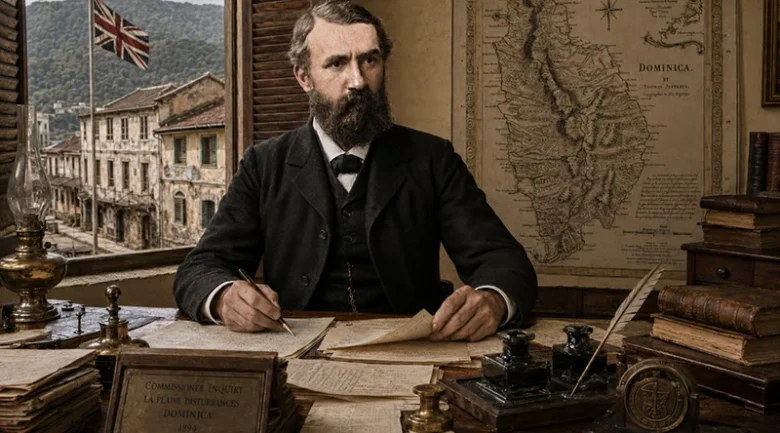
Sir Robert George Crookshank Hamilton entered Dominican history at a moment of absolute fracture. Appointed as a Special Royal Commissioner following the fatal shootings at the La Plaine Uprising Land Tax Riots in 1893, Hamilton was sent by London to determine why Britain’s rule over the “Nature Isle” was collapsing into rural warfare. His subsequent investigation and the groundbreaking Hamilton Report of 1894 became the ultimate turning point for Dominica, vindicating the island’s independent peasantry while inadvertently providing the British Empire with the exact pretext it needed to strip the colony of its democracy.
Temperament, Domestic Life, and Adaptation
Sir Robert George Crookshank Hamilton was not merely an analytical state strategist; he was a man whose late-career worldview was deeply shaped by cross-cultural observation. Accompanied by his wife, Teresa, Lady Hamilton, a woman known for her keen interest in botanical preservation and local arts, Hamilton approached his Dominican assignment with an unexpected level of domestic adaptability.
Having previously served as Governor of Tasmania, he was already familiar with the complex dynamics of island societies and was deeply sceptical of traditional, metropolitan colonial perspectives.
In Roseau, Hamilton quickly alienated the local white plantocracy by declining to establish his temporary residence within their exclusive suburban enclaves. Instead, he and Lady Hamilton chose a more central, accessible base, signalling to the wider public that the Royal Commission was open to all classes.
Archival letters indicate that Hamilton possessed an intensely disciplined, methodical personality balanced by a quiet, approachable demeanour. He deliberately avoided the formal military dress uniform expected of high-ranking British commissioners, opting for lightweight, practical linen suits that allowed him to travel through the island’s humid interior without constant administrative pomp.
Daily Realities and Travel Logs
Hamilton spent weeks travelling along the steep, unpaved perimeter of Dominica, navigating rough Atlantic coastal waters in small canoes and climbing rain-slicked clay trails on horseback.
Excerpts from Hamilton’s personal diaries and field notes reveal a deep fascination with the raw natural environment of Dominica, alongside a clear recognition of how the terrain isolated its people:
- The Sylvania and Penrice Climbs: Hamilton recounted scaling the muddy tracks toward the interior forests, noting that the torrential downpours made standard travel impossible. He frequently slept in modest, thatched-roof wooden police stations or the small homes of rural parish priests rather than returning to the comfort of Roseau.
- The Language Frontier: Because the independent peasantry spoke Dominican Creole (Kwéyòl) as their primary language, Hamilton bypassed official colonial translators, whom he suspected of bias. He relied instead on independent local teachers and non-conformist ministers to ensure that the smallholders’ exact grievances were accurately captured in his records.
- The Dietary Adaptations: Local oral traditions in the windward parishes preserve memories of the “Grand Commissioner” sitting in open village squares, dining on local ground provisions such as dasheen, yams, and roasted breadfruit offered by the families who came forward to give testimony.
His Investigative Methodology
The social impact of Hamilton’s tour left a lasting impression on the collective memory of the rural communities in Dominica. For generations after his departure, the name of “Sér Robert” was invoked in the windward and southern villages as a rare symbol of imperial justice.
Hamilton’s meetings with notable local personalities helped reframe the official colonial narrative:
Interrogating the La Plaine Defendants
During his field hearings in the east, Hamilton insisted on personally interviewing the individuals arrested during the La Plaine riots. He listened directly to accounts of how colonial police had opened fire on farmers who were simply defending their homes from arbitrary property seizures.
His patient, non-threatening manner broke through the deep-seated distrust of British authority, encouraging families who had fled into the high woods to return and speak freely.
Interactions with the Mulatto Elite
In the island capital, Hamilton maintained a productive working relationship with prominent mixed-race political figures, including lawyers and legislators from the local reform movement.
While earlier governors had dismissed these leaders as dangerous agitators, Hamilton spent hours in private consultation with them, analyzing the island’s financial accounts and confirming that local tax revenues were being unfairly diverted to support the federal administration in Antigua.
The Memory of the “Listening Crown”
In the folk songs and oral histories of the windward coast, Hamilton’s commission was remembered as the moment the “Crown came down from the veranda.“
By treating Kweyol-speaking smallholders as intelligent, sovereign economic actors rather than lawless laborers, his physical presence in the villages provided a major psychological boost to the peasantry, grounding their long-term struggle for land ownership in official colonial history.
The Core Findings of the 1894 Hamilton Report
Published in August 1894, Hamilton’s 160-page report was a damning indictment of decades of British neglect and administrative incompetence. His analysis broke down the colonial failure into three systemic issues:
The Administrative Drain (The Antigua Conflict)
Hamilton identified that Dominica was being paralyzed by its forced inclusion in the Leeward Islands Federation, which was governed from Antigua.
- Dominica’s mountainous topography required a completely different infrastructure plan than flat sugar islands like Antigua or St. Kitts.
- Taxes collected from Dominican peasants were being funneled to Antigua to pay the salaries of federal officials who had never visited the island.
- The Solution: Hamilton strongly recommended that Dominica be decoupled from the Leeward Federation and given its own independent, resident administrator.
The Victory of the Peasant Economy
Hamilton officially declared what the white plantocracy had spent decades trying to deny: the sugar plantation model was dead in Dominica. He noted that while the grand estates were drowning in debt, the independent peasant plots were thriving. The report urged the empire to abandon sugar entirely and invest in agricultural diversification, focusing on Limes, Cocoa, and Coffee.
The Infrastructure Deficit
Hamilton famously observed that the legendary fertility of Dominica’s soil was useless if farmers could not get their produce to the coast. He advocated for an immediate injection of imperial capital to build a coastal steamer network and a trans-island highway that would cut through the interior forests.
The Great Betrayal: Weaponising the Report
While Hamilton genuinely sympathized with the rural population and respected the intelligence of the island’s mixed-race political class, the Colonial Office in London used his critique of local administrative inefficiency to engineer a political coup.
Using the structural reforms suggested by Hamilton as leverage, London presented the Dominican House of Assembly with a cynical ultimatum known historically as the Imperial Offer:
The British government offered to fund the roads Hamilton recommended (which later became the Imperial Road), but only if the local legislature surrendered its self-governing powers. Facing bankruptcy and intense imperial pressure, the Assembly capitulated in July 1898 by a narrow vote of 8 to 6. Hamilton’s report, designed to diagnose and heal the island’s grievances, was ultimately used to implement Crown Colony Rule, silencing Dominican democracy for the next half-century.
Historical Summary of Hamilton’s Impact
| Hamilton’s Diagnostic Findings | The Imperial Response (1898) | Long-Term Result for Dominica |
| Identified the independent peasantry as the true economic engine. | Shifted funding to crop diversification (Limes/Cocoa). | Solidified Dominica’s identity as an island of smallholders. |
| Demanded immediate roads to connect the isolated interior. | Built the Imperial Road using a £30,000 imperial grant. | Opened up the interior but concentrated land near roads for British investors. |
| Critiqued the local political structure as inefficient. | Dissolved the elected parliament entirely. | Stripped local Black and Mixed-race leaders of political power. |
The Lasting Resonance
Sir Robert Hamilton died in 1895, never living to see how his findings were weaponised by the Colonial Office. In modern Dominica, his legacy remains etched into the island’s geography and social fabric.
The Imperial Road, which still serves as a vital infrastructural spine cutting through the heart of the island, is the direct physical manifestation of his report. More importantly, Hamilton’s work stands as the first official acknowledgment by the British Crown that the true strength of Dominica did not reside in the decaying Great Houses of the plantocracy, but in the unyielding resilience of the mountain farmers who chose self-sufficiency over submission to an empire.


References
-
1.
18 Feb 1895 Death of Sir Robert Hamilton - Trove https://trove.nla.gov.au/newspaper/article/9346316
-
2.
Major Events in our Constitutional Development – Part 2 https://sundominica.com/articles/major-events-in-our-constitutional-development-par-1714/