

La Plaine Land Tax Riots of 1893
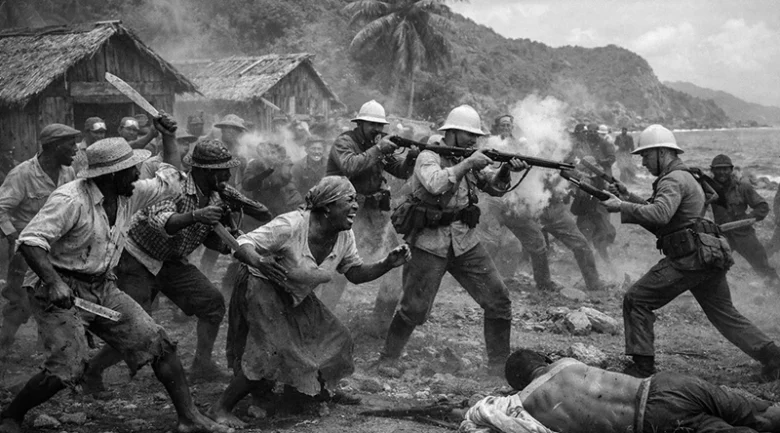
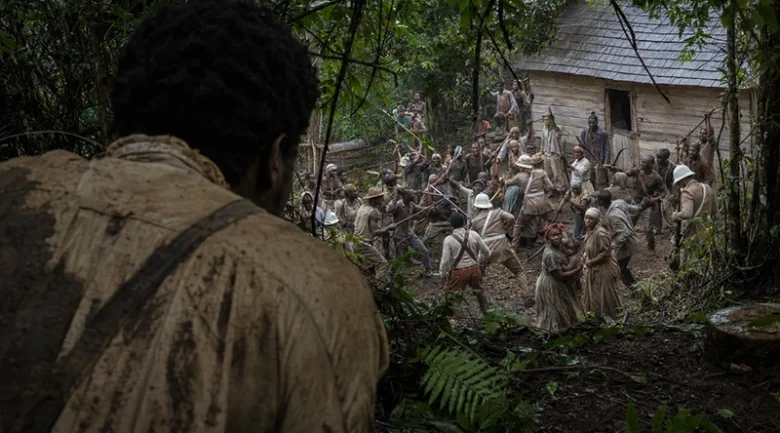
The La Plaine Land Tax Riots of 1893, often referred to in Dominica’s historical circles as the La Plaine Massacre, stand as one of the most violent and consequential clashes between the British colonial state and the Afro-Dominican peasantry. Occurring on the isolated, rugged Atlantic coast, the riots were not merely a tax revolt; they were a profound assertion of land ownership, ancestral rights, and a rejection of the New Slavery of colonial bureaucracy.
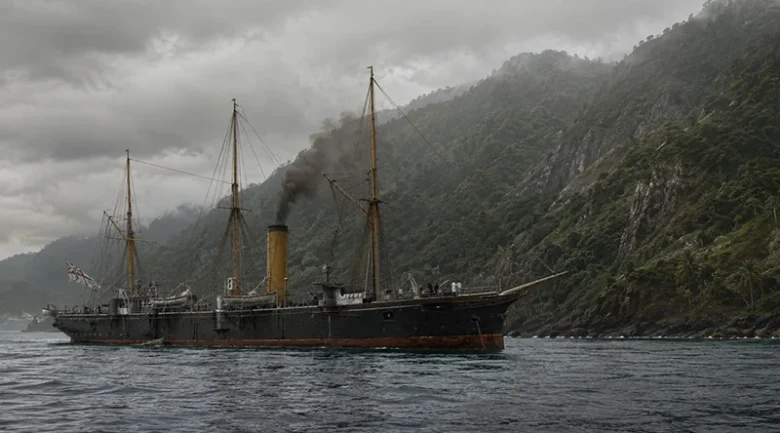
On April 13, 1893, imperial overreach turned deadly when British Royal Marines landed at Plaisance Bay from the torpedo cruiser HMS Mohawk. They marched into the hills to evict community leader Pierre Colaire, only to find themselves facing a human shield of determined villagers armed with nothing but sticks, stones, and cutlasses. Though imperial bullets left four local heroes dead in the mud, the uprising sparked an administrative wildfire. The political fallout triggered the famous Hamilton Inquiry, shattering the status quo and ultimately collapsing Dominica’s local representative assembly into direct Crown Colony rule. Ultimately, it is the epic saga of a barefoot peasantry that refused to back down, even when staring straight into the cannons of a British warship.
Land, Liberty, and the Maroon Legacy
To understand why a simple tax ledger in 1893 triggered a bloody slaughter, one must step off the coastal roads and look closely at the rugged geography and defiant lineage of the village of La Plaine.
The Geography of Isolation
In the late nineteenth century, the Au Vent (Windward) eastern coast of Dominica remained physically isolated from the administrative capital of Roseau. Absent any carriage roads, communication relied entirely on hazardous footpaths traversing the island’s central volcanic spine. This steep terrain transformed La Plaine into an autonomous frontier. The population comprised a hybrid of Maroon descendants (Neg Mawon) who had historically secured the interior, and newly emancipated people who intentionally migrated to the high woods after 1834 to escape low-wage dependency on coastal sugar estates.
The Concept of Possessory Title
To the bureaucrats in London, the vast interior of Dominica was merely “Crown Land“, the property of a distant Queen. But to the Gens Au Vent of La Plaine, the soil belonged to the calloused hands that cleared it, planted it, and kept it safe. This sense of ownership was deeply spiritual. Their beloved parish priest, Father Couturier, stood alongside them, validating their claim to the earth. When tax collectors arrived demanding hard cash for lands the British had ignored for a hundred years, the villagers didn’t just see a tax bill, they saw an underhanded imperial plot to strip them of their freedom. It was an unyielding clash between a paper title and a soil title, a ticking time bomb waiting for a spark.
The 1888 Land Tax and Sir William Haynes-Smith
By the late 1880s, the British administration of the Leeward Islands Federation, centred in Antigua, faced an acute financial crisis. Colonial administrators viewed Dominica as a fiscal strain on federal resources. To rectify this structural deficit, Governor Sir William Haynes-Smith enacted aggressive fiscal reforms, featuring a newly structured Land Tax alongside compulsory state surveys.
The Psychological and Political Insult
For the smallholders of La Plaine, the imposition of this tax represented a severe psychological and existential threat:
- Subjugation of Title: Submitting to tax payments meant legally acknowledging the British Crown as their sovereign landlord, effectively erasing their customary, post-emancipation autonomy.
- The Absence of Imperial Reciprocity: The colonial state demanded direct cash payments while offering zero public infrastructure. La Plaine lacked state-funded schools, medical facilities, and motorable roads.
- The Mechanism of Forfeiture: The statutory framework dictated that non-payment resulted in the immediate seizure and liquidation of both cultivated lands and private dwellings by Crown agents.
By 1893, these compounding grievances pushed rural districts to a breaking point. While the educated, urban, coloured political elite in Roseau actively protested the tax within the Legislative Assembly and the local press, their constitutional resistance remained decoupled from the rural peasantry, leaving isolated communities like La Plaine to confront imperial enforcement entirely alone.
The Stand of Pierre Colaire
The face of the resistance was a local man named Pierre Colaire. He was a well-respected member of the La Plaine community who refused to pay the tax on his small holding. In the eyes of the British, he was a recalcitrant squatter; in the eyes of his neighbours, he was a hero defending their common rights.
The First Attempted Eviction
In early April 1893, government bailiffs and a small detachment of police travelled from Roseau to La Plaine to serve an eviction notice on Colaire and seize his property. They were met by a wall of human resistance. The villagers, alerted by the blowing of conch shells (Lambi), swarmed the officials. They didn’t use guns; they used their sheer numbers and the Maroon Spirit to intimidate the bailiffs into retreating across the mountains.
The Escalation
Governor Haynes-Smith viewed this retreat as an intolerable insult to the authority of the Queen. He decided that La Plaine must be made an example of. He didn’t send a negotiator; he sent the military.
April 13, 1893: The Massacre
To enforce a deeply unpopular land tax, the colonial government deployed the HMS Mohawk, a British warship, to the windward coast of Dominica. On the morning of April 13, the vessel anchored off the rugged eastern cliffs, landing a heavily armed contingent of Royal Marines and bluejacket sailors to reinforce the local police. Rather than being led by Governor Sir William Haynes-Smith, who remained in the capital, the operational force was commanded on the ground by Chief Magistrate C.R. Le Hunte and Commander Edward Henry Bayley. Their immediate objective was to re-evict the local community leader, Pierre Colaire, who had defiantly re-entered his home after being forced out by authorities weeks prior.
The Human Shield
The villagers of La Plaine and neighbouring valleys like Boetica and Delices refused to allow the eviction. Under the direction of local elders, they blocked the paths with boulders and fallen trees to slow the military advance. As the British forces crossed the Sari-Sari River and marched toward Colaire’s home at Case O’Gowrie, they were met by hundreds of unified, angry citizens acting as a human shield. Pierre Colaire himself managed to slip away into the dense surrounding forest to avoid immediate capture, leaving the crowd to face the arriving troops.
The Riot Act and the Fatal Volley
The standoff quickly turned chaotic as the crowd blew conch shells, shouted, and brandished cutlasses and clubs. When the villagers began throwing a heavy barrage of stones to stop the eviction of Colaire’s family, the colonial authorities read the “Riot Act“, the legal formality permitting the use of deadly force.
The villagers stood their ground. Tensions boiled over into a physical melee, and Commander Bayley ordered his forces to fire directly into the crowd. Four Dominican villagers were killed instantly, and numerous others were severely wounded by bullets and bayonets. The crowd fought back fiercely, wounding several British personnel, including Commander Bayley himself.
While the Marines temporarily occupied the area and arrested a protesting peasant named St. Ville, the resistance was far from broken. The tragedy at La Plaine sparked a formal British parliamentary inquiry that ultimately reformed Caribbean tax collection laws and severely damaged the credibility of British Crown colony rule
The Aftermath: National Shock and the Hamilton Report
The news of the fatalities at La Plaine sent profound shockwaves through Dominica and quickly reached the British Parliament in London. The revelation that a minor, localised land tax dispute had escalated to the Royal Navy firing upon rural peasants provoked an intense public and political scandal.
The Appointment of Sir Robert Hamilton
To quiet mounting humanitarian and political criticism, the British Colonial Office appointed Sir Robert Hamilton, a seasoned colonial administrator and former Governor of Tasmania, to lead a Royal Commission of Inquiry. Arriving in late 1893, Hamilton bypassed the colonial elites in Roseau and travelled directly into the rugged eastern districts. He held extensive town hall meetings, gathering testimonies directly from the working-class Black peasantry who had fought the tax collector.
Hamilton’s Findings
Published in 1894, Hamilton’s report served as a damning indictment of over a century of British systemic neglect. Breaking rank with standard colonial attitudes, Hamilton validated the peasants’ grievances and explicitly concluded that:
- The colonial administration had completely failed to provide basic roads or infrastructure to the windward coast.
- The localized land tax was managed and executed with gross inequity.
- The deployment of the HMS Mohawk was a heavy-handed and highly regrettable escalation.
Crucially, Hamilton declared that the traditional sugar-plantation economy was dead, highlighting that independent small-scale peasant farming plots were the true baseline of the Dominican economy.
The Imperial Offer and the Crown Takeover
Though the report was deeply sympathetic to the population, the British government weaponised its developmental recommendations to strip Dominica of its political autonomy. Hamilton had recommended constructing a central roadway to open up the island’s interior for trade.
The British used this infrastructure proposal to issue the “Imperial Offer” of 1898. They offered a substantial £30,000 grant for the road and a coastal steamer, but only if the Dominica House of Assembly voted to abolish its own elective system. Lured by the desperate need for infrastructure, the local legislature capitulated and voted to dissolve itself. This effectively converted Dominica into a strict, single-chamber Crown Colony entirely controlled by British appointees, silencing the elective Dominican political voice for nearly three decades.
The Political Fallout: The Death of Democracy
The most tragic outcome of the La Plaine Riots was not the tax itself, but the systematic dismantling of the Dominican political voice.
By 1898, the British Colonial Office leveraged the island’s financial debts and the civil unrest of the riots to force a constitutional overhaul. The local legislature was pressured into dissolving its elected seats. This shifted Dominica to full Crown Colony Rule, vesting absolute administrative power in a Governor appointed by London. Dominicans would not regain the right to vote for their own legislative representatives for another 25 years.
Chronological Timeline of the La Plaine Resistance
| Event | Date | Result |
|---|---|---|
| Introduction of Land Tax | 1888 | Widespread peasant resentment across rural districts. |
| Pierre Colaire’s Defiance | January 1893 | First eviction attempt fails as villagers defend Colaire’s home. |
| HMS Mohawk Intervention | April 13, 1893 | Royal Marines land; four protestors are shot dead. |
| The Hamilton Report | 1894 | Royal Commission exposes deep British administrative negligence. |
| The Crown Colony Act | 1898 | Local assembly dissolves; full Crown rule takes effect in 1899. |
The Recalcitrant Legacy in Dominican Culture
The fiery rebellion at La Plaine forged a permanent scar on the Dominican soul, forever changing how our people view authority and the land they bleed for. In official British administrative reports, the inhabitants of the windward coast were frequently vilified as recalcitrant, stubborn, and lawless for refusing to submit to crown authority. To the children and grandchildren of Dominica, the name La Plaine became a sacred echo of the soil, a timeless anthem of small farmers standing tall, unbending against oppression.
The Martyrs of La Plaine
The four citizens who lost their lives on April 13, 1893, are widely honoured as cultural martyrs. By giving everything, they proved a core truth that still defines what it truly means to be Dominican today: that land security is the ultimate baseline of true emancipation. This deep-seated ideological connection between land ownership and personal liberty directly informed and fueled the radical “Land for the Landless” political campaigns led by leftist and agrarian reformers during the 1970s and 1980s.
Folklore and Memory
Across the windward territories, the oral history of the La Plaine tax rebellion was preserved through generations of storytelling. The historical rallying cry, the deep resonance of the conch shell blown across the valleys to mobilise the peasantry against the advancing Royal Marines, became a prominent motif. This imagery continues to serve as a powerful symbol of anti-colonial defiance within contemporary Dominican art, poetry, and political literature.
Land, Law, and the Birth of Modern Dominica
The La Plaine Riots of 1893 marked a critical turning point in Pan-Caribbean history. They represent the exact juncture where the immediate post-emancipation era of negotiation transitioned into the aggressive, bureaucratic high colonial era of Crown Colony rule. The conflict was a direct collision between two fundamentally incompatible worldviews:
- The British Imperium: A system defined strictly by written deeds, fiscal extraction, and the rigid enforcement of The Queen’s Law.
- The Dominican Peasantry: A culture rooted in independent agrarian cultivation, the historical maniel (Maroon settlement) legacy of self-reliance, and the customary right to own the soil one has labored upon.
Today, travelling through the lush agricultural valley of La Plaine means moving through a landscape that was once a literal battlefield. The enduring resilience of the district’s independent farmers is a direct legacy of their ancestors’ absolute refusal to be dispossessed. The 1893 uprising proved that Dominica’s legendary Maroon Spirit did not perish with the death of Chief Jacko in 1814. Instead, that fierce desire for absolute freedom lived on through Pierre Colaire and the unified villagers who stood their ground against the physical might of a British warship, ultimately forcing the empire to reckon with the unyielding agency of the Caribbean peasantry.


References
-
1.
The La Plaine uprising - Dominica News Online https://dominicanewsonline.com/news/homepage/news/general/the-la-paine-uprising/
-
2.
COMMENTARY: La Plaine will always be on our minds and in our hearts (DNO) https://dominicanewsonline.com/news/homepage/news/commentary-la-plaine-will-always-be-on-our-minds-and-in-our-hearts/
-
3.
http://sundominica.com/articles/paying-homage-to-the-countryside-2344/ http://sundominica.com/articles/paying-homage-to-the-countryside-2344/
-
4.
Pierre Colaire Story and the Monument Project https://www.thedominican.net/articles/colaire.htm
-
5.
Recent Fatal Disturbances in Dominica. https://api.parliament.uk/historic-hansard/lords/1893/jun/30/motion-for-an-address
-
6.
Dominica Historical Literature https://pfwpproject.files.wordpress.com/2018/07/dominica-49.pdf