

Sugar Plantations in Dominica
The history of Sugar Plantations in Dominica deviates sharply from the monotonous sugar machines of Barbados, Antigua, or St. Kitts. In the grand, blood-soaked ledger of the eighteenth-century Caribbean, sugar was the ultimate currency. To the British Empire, an island without sugar was a wasted asset. Yet, in the Nature Isle, sugar was never truly king; it was a fragile monarch constantly besieged by a vertical landscape, a fierce Maroon resistance, and a climate that seemed to conspire against the cane. This unique geography prevented the total dominance of a plantation-style economy.
While other islands were levelled into flat, emerald plains of stalks, Dominica remained a jagged, forested obstacle. This physical reality dictated a unique plantation history, one characterised by smaller estates, higher production costs, and a social structure that eventually gave way to a resilient peasantry rather than a permanent plantocracy.
The 1764 Land Sales: Designing a Plantation Society
The formal history of sugar in Dominica began in earnest after the Treaty of Paris (1763), which handed the island from French to British control. The British immediately viewed the island through the lens of mercantilism. They saw vacant land that needed to be transformed into tax-paying sugar estates.
The Commissioners for Land Sales
In 1764, the British government appointed a commission to survey the island and sell it off in lots. Unlike the French, who had been content with small coffee and cocoa farms along the coast, the British wanted Scale.
- The Sugar Lots: Flat coastal areas, particularly in the North (Portsmouth/Picard) and the South (Grand Bay/Geneva), were demarcated as prime sugar lands.
- The Cost of Entry: These lots were sold to wealthy speculators from London and established planters from older colonies like Antigua. They arrived with the Barbados Model in their heads, ready to clear the forest and install the mill.
However, the British underestimated Dominica’s verticality. Of the roughly 186,000 acres on the island, only a tiny fraction was actually suitable for the intensive, flat-land cultivation that sugar required.
The Anatomy of a Dominican Sugar Estate
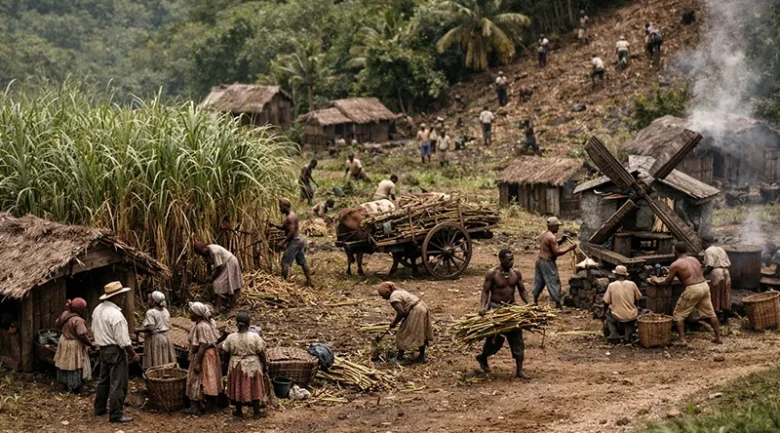
A sugar plantation was not just a farm; it was an industrial complex powered by forced labour and primitive machinery. Because of Dominica’s 365 rivers, many estates utilised water power rather than the windmills common in flatter islands.
The Industrial Core
- The Mill (The Crushing): Where the cane was squeezed between iron rollers. In Dominica, massive stone-built water wheels (many of which still stand at places like Hampstead or Rosalie) were the heart of the operation.
- The Boiling House: A hellish environment where the cane juice was clarified and boiled down in a series of giant copper kettles called the copper wall.
- The Curing House: Where the boiled syrup was placed in hogsheads (large barrels) to allow the molasses to drip out, leaving behind raw muscovado sugar.
- The Distillery (The Still House): Where the byproduct, molasses, was fermented and distilled into Rum, the secondary but vital export of the Dominican estate.
The Social Geography
The plantation was strictly segregated. The Great House (the planter’s residence) sat on the highest point for ventilation and surveillance. Below it were the overseer’s quarters, the industrial buildings, and finally, the Slave Huts, usually constructed from wattle and daub, tucked into the less fertile corners of the estate.
The Enslaved Labour Force: Life in the Cane
This 20-to-1 demographic imbalance fueled constant white paranoia, necessitating ultra-violent legal codes and military garrisons to suppress rebellion. Enslaved labour sustained a brutal plantation economy where forced manual harvesting generated immense British wealth. However, this extreme reliance on terror ultimately backfired, driving frequent, organised maroon resistance across Dominica’s mountainous terrain.
The Labor Cycle
- Holing and Planting: During the out-of-crop season, gangs of men and women dug thousands of holes by hand using heavy hoes. It was back-breaking work in the humid, tropical heat.
- The Harvest (Crop Time): From January to June, the plantation moved at a frantic pace. Cane had to be cut and processed within 24 hours of being harvested, or the sugar would ferment. This meant 18-hour days in the boiling house, often under the threat of the whip to keep the industrial line moving.
- The Provision Grounds: This is where Dominica differed. Because the terrain was so mountainous, planters couldn’t use every inch for sugar. They allowed the enslaved to cultivate provision grounds on the steep ridges above the estates. Here, they grew their own food,nyams, dasheen, and plantains. This unintentionally fostered a sense of independence and a deep knowledge of the interior landscape.
Geography as Resistance: Why Sugar Failed to Dominate
In Barbados, flat geography left escapees with nowhere to run. Conversely, Dominica’s dense interior Crown Lands offered a constant temptation. While the rugged mountains made sugar cultivation expensive, they simultaneously provided a tactical sanctuary for those refusing forced labour. This treacherous terrain enabled escaped Africans to establish permanent Maroon communities, transforming the island’s challenging topography into a powerful, natural fortress of resistance against colonial British plantation authority.
The Logistics of Transport
In a flat island, you could use ox-carts to move hogsheads of sugar to the harbor. In Dominica, an estate like Grand Fond or Rosalie was separated from the capital by sheer cliffs and mud-clogged tracks. Sugar had to be loaded onto small boats (droghers) in turbulent Atlantic surf, resulting in frequent cargo losses.
The Maroon Factor
The Maroon Chiefs (like Balla, Jacko, and Pharcel) were a heavy financial tax on Dominica’s sugar industry through systematic raids, crop destruction, and liberating laborers, severely disrupting colonial plantation profits.
- Estate Raids: Maroons would sweep down from the heights to liberate enslaved people and seize gunpowder and tools.
- Economic Insecurity: Planters had to pay for Rangers and militias to protect their crops, adding a massive security cost that planters in Antigua didn’t have to face.
The French vs. British Conflict
Dominica’s strategic geographic location between the major French strongholds of Martinique and Guadeloupe made the colony an exceptionally volatile, high-stakes battleground. This perpetual warfare between Britain and France severely undermined the island’s sugar production. Every naval clash, siege, and territorial dispute directly shattered plantation infrastructure and eroded investors’ long-term financial stability.
The ongoing military strife destabilized the sugar economy through multiple compounding factors:
- Supply Chain Rupture: Hostile naval blockades halted essential food imports, triggering severe famine among laborers and inflating the cost of basic provisions.
- Capital Asset Destruction: Invading forces intentionally burned down advanced processing factories, destroyed heavy machinery, and torched valuable, harvest-ready sugar cane fields.
- Labor Force Depletion: The chaos of wartime operations fractured plantation security, enabling thousands of enslaved workers to successfully flee into the impenetrable interior mountains.
- Exorbitant Defense Taxes: Local administrators levied heavy taxes on plantation owners to fund defensive fortifications, coastal batteries, and permanent military garrisons.
- Disrupted Export Shipping: Merchant fleets faced constant capture by enemy privateers, which halted sugar exports and caused regional insurance rates to skyrocket.
Ultimately, this relentless geopolitical conflict ensured that Dominica’s sugar industry could never achieve the seamless, highly profitable stability enjoyed by flatter, more secure British colonies. The dual pressures of external European warfare and internal slave resistance combined to make the island an exceptionally risky, economically volatile environment for plantation investments.
The Decline: From Emancipation to the Hamilton Report
Centuries of institutional vulnerability and the island’s uniquely challenging mountainous terrain combined to accelerate a protracted economic decay that ultimately rendered the entire plantation system completely unsustainable by four major factors:
Emancipation (1834)
When slavery was abolished, the labour model for sugar collapsed. Unlike the flat islands, where the freed population had no choice but to work for low wages on the estates, the Dominicans moved into the mountains. They became independent farmers on Crown Lands, leaving the sugar mills to rot.
The Sugar Duties Act (1846)
The British government removed the preferential status of colonial sugar, forcing Dominican sugar to compete in the open market with slave sugar from Cuba and Brazil. Dominica’s high-cost, water-powered mills couldn’t compete with the massive, steam-powered factories of larger territories.
The Beet Sugar Crisis
The rise of European beet sugar in the 1880s caused global cane prices to plummet, dealing a fatal blow to Dominica’s already struggling plantation economy. This devastating market shift permanently shattered profit margins, delivering the definitive final nail in the coffin for many Dominican estates.
The “Hamilton Era” Shift
By the time Sir Robert Hamilton arrived in 1893 to investigate the island’s poverty, he found the sugar industry in ruins. His report (The Hamilton Report) officially recommended that the island abandon the Sugar Obsession and pivot toward Limes and Cocoa. The great sugar estates like Hampstead, Picard, and Geneva began their transformation into citrus orchards.
The Architectural and Cultural Legacy
Today, you cannot find an active sugar industry in Dominica, but its historic ghost remains everywhere. Ruined stone mills, rusted boiling coppers, and overgrown estate walls physically haunt the landscape, while ancestral lineages directly preserve this brutal legacy.
- The Ruins: Stone chimneys and massive iron water wheels remain at Belfast, Hampstead, and Canefield. They are monuments to a vanished era.
- Place Names: Areas like Canefield, Sugar Loaf, and Pottersville are linguistic fossils of the plantation era.
- The Rum Tradition: While the sugar is gone, the distillation of rum survived. Local shrub and cask rum traditions are the direct descendants of the plantation still-house.
- The Peasantry: Most importantly, the failure of the sugar plantations allowed for the rise of the Dominican small-farmer. Because the Plantocracy failed to hold the land, Dominica became an island of independent villagers rather than a corporate agricultural colony.
Summary of the Sugar Impact
| Era | Dominant Crop | Labor Source | Major Impact |
| 1764–1783 | Sugar / Coffee | Enslaved Africans | Initial clearing of forests; construction of mills. |
| 1784–1833 | Sugar (Peak) | Enslaved Africans | Intense conflict with Maroons; high production costs. |
| 1834–1850 | Sugar (Decline) | Apprentices / Wage Labor | Flight to the interior; beginning of peasant farming. |
| 1880–1900 | Limes / Cocoa | Independent Peasants | Conversion of sugar estates to citrus; the Hamilton Report. |
Defiant Earth: Nature Broke the Plantation
In the end, the untamed geography of Dominica served as the ultimate resistance to European colonial ambitions. The sugar plantation represented a brutal, systematic attempt to impose a flat, tightly controlled European order onto a wild, vertical African-Caribbean reality. However, the island’s steep topography utterly defied this artificial structure. Impassable mountain ranges made the mass transport of harvested cane logistically impossible. At the same time, hundreds of rushing rivers actively encouraged the formation of Maroon communities by providing food, fresh water, and tactical cover. Ultimately, the very soil of Dominica rejected the destructive patterns of foreign monoculture.
Dominica’s refusal to become a subservient “Sugar Island” stands as its greatest historical victory. This environmental defiance successfully preserved the island’s pristine, dense rainforests from the widespread deforestation seen elsewhere in the Caribbean. Furthermore, it directly fostered a resilient post-emancipation culture of independent smallholder landownership among the liberated population. When the sugar industry finally collapsed under its own financial weight, it was not a tragedy, but a liberation.
The structural demise of the plantation system ensured that a more sustainable, diverse, and human-centred way of life could take root in the fertile soil. Consequently, the crumbling stone ruins and rusted coppers scattered across the modern landscape are far more than mere relics of colonial oppression.
They stand as enduring trophies of a powerful, sovereign landscape that simply could not be tamed by imperial greed.


References
-
1.
Archaeology in Dominica: Everyday Ecologies and Economies at Morne Patate https://muse.jhu.edu/book/78047
-
2.
The Garden of the World: A Historical Archaeology of Sugar Landscapes in the Eastern Caribbean https://scholarworks.umass.edu/bitstreams/fcc4e1e8-8626-4ef8-baef-2c275439e0bd/download
-
3.
An imperium in imperio: A Geospatial Analysis of Defensibility and Accessibility of Maroon Settlements in Dominica https://www.cambridge.org/core/services/aop-cambridge-core/content/view/546802B275644DA0575A0A0C419C1CFA/S0002731624000489a.pdf
-
4.
Dominica, 1826-1887 https://britishonlinearchives.com/collections/73/volumes/502/dominica-1826-1887
-
5.
Registry of Slaves of the British Caribbean 1817-1834 (Bahamas, Belize, Dominica, Jamaica, St Kitts, Trinidad and Tobago and the United Kingdom https://media.unesco.org/sites/default/files/webform/mow001/caribbean_slave_registers_rev.pdf