



Cassava in Dominica
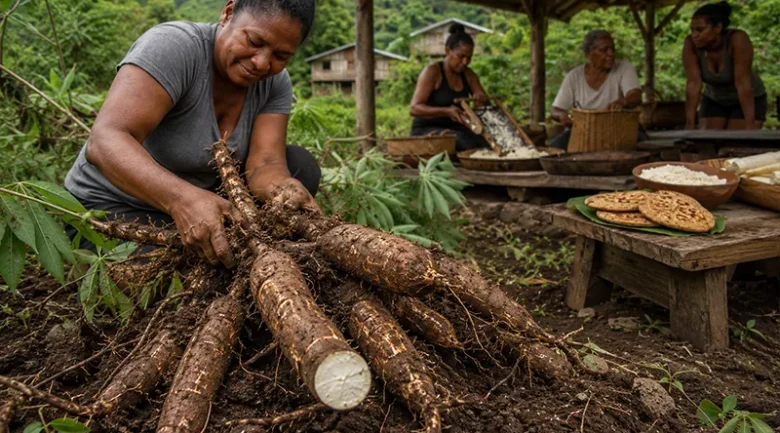
Cassava locally referred to as manioc (particularly in the Creolised French context), is a foundational root crop in the Commonwealth of Dominica. Recognized as a resilient, woody shrub, cassava represents one of the oldest continuous agricultural traditions on the island, originating long before European colonization with the island’s indigenous people, the Kalinago.
While historically overshadowed by export monocrops such as bananas in the late twentieth century, cassava has returned to the forefront of national agricultural development strategies in Dominica. Promoted by the Ministry of Blue and Green Economy, Agriculture and National Food Security and the Caribbean Agricultural Research and Development Institute (CARDI), the crop is a central pillar in the island’s thrust for climate resilience, import substitution, and rural economic empowerment. This profile provides a comprehensive review of cassava’s history, cultivation practices, processing methods, economic data, and structural limitations within Dominica.
Indigenous History and the Survival of Cassava Knowledge
Cassava originated in tropical South America, where Indigenous communities domesticated and selected the plant over thousands of years. Archaeological and botanical studies place its early development within the wider Amazonian and northern South American region. As Indigenous peoples travelled through the Caribbean basin, they carried planting material and processing knowledge into the islands.
The crop was established in the Lesser Antilles before European arrival. Kalinago communities understood that certain varieties could not be eaten safely without careful preparation. They developed methods for peeling, grating, pressing and heating the root, converting a potentially hazardous plant into durable food.
This was not a minor culinary technique. It was a highly developed food-processing system based on close observation of plant varieties, moisture, texture and heat. The knowledge allowed communities to store food, carry it during journeys and maintain supplies during periods when fresh produce was scarce.
Two broad categories are commonly recognised: sweet cassava and bitter cassava. The distinction does not mean that sweet varieties can always be eaten raw or handled casually. Both may contain cyanogenic compounds, although bitter types generally contain higher concentrations. Safe consumption depends on the variety and the preparation method.
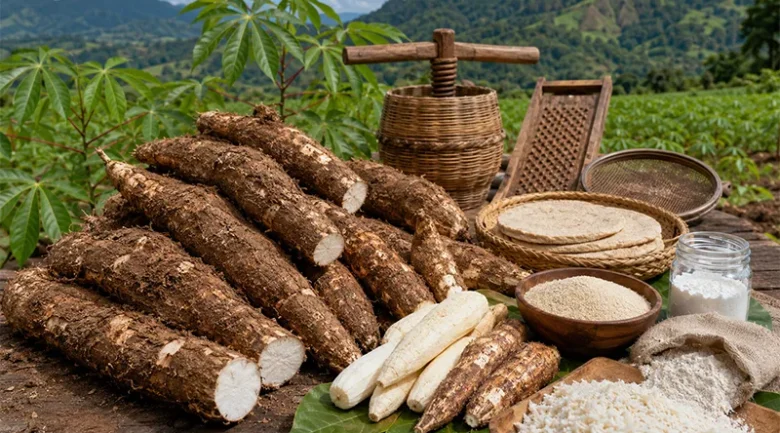
Traditional processing begins with harvested roots being peeled and washed, then the flesh is grated into a moist pulp, which is then pressed to remove liquid. In parts of the Caribbean and South America, Indigenous communities traditionally used a long woven press sometimes known as a matapi or similar local name. Pressure squeezed liquid from the grated root while leaving a drier mass suitable for sieving and heating.
Dominica practice has also used cloth bags, weights, wooden pressing arrangements and later mechanical equipment. Whatever the method, adequate pressing and heating are essential. The extracted liquid should not be casually consumed because it may contain concentrated cyanogenic compounds.
For farine, the pressed material is broken apart, sieved and roasted in a metal pan or vat. Constant stirring prevents scorching and produces dry, granular particles. Properly prepared farine stores longer than the fresh root and may be eaten with milk, water, avocado, fish, meat, vegetables or other foods.
Cassava bread follows a related process. The grated, pressed and sifted material is spread in a thin or moderately thick layer on a heated surface. The starch binds the particles as the bread cooks. Traditional plain bread may contain only cassava, while modern Dominica varieties often include coconut, ginger, sugar, cinnamon or other flavourings.
In the Kalinago Territory, these practices remained part of domestic and communal life even as imported wheat flour, rice and other foods became widely available. Production skills were often passed through families by observation rather than written recipes. The correct texture of the pulp, the required pressure, the baking surface temperature, and the proper turning time were learned through repeated practice.
Cassava also supported mobility. A dry bread that resists spoilage is useful for hunting, fishing, travel and periods of uncertain harvest. Before refrigeration and modern packaging, that durability gave it an advantage over many fresh roots.
European colonisation disrupted Indigenous communities across the Caribbean, but it did not erase the crop. Colonists adopted cassava as a practical local food, while enslaved Africans incorporated it into new Caribbean food systems. Indigenous and African processing traditions met within plantation settlements, provision grounds, villages and markets.
In Dominica, the continued presence of the Kalinago population gave the crop a particularly direct cultural line. The techniques used today have changed with metal graters, powered machinery and modern ovens, but the basic sequence remains recognisably Indigenous: peel, wash, grate, press, sift and heat.
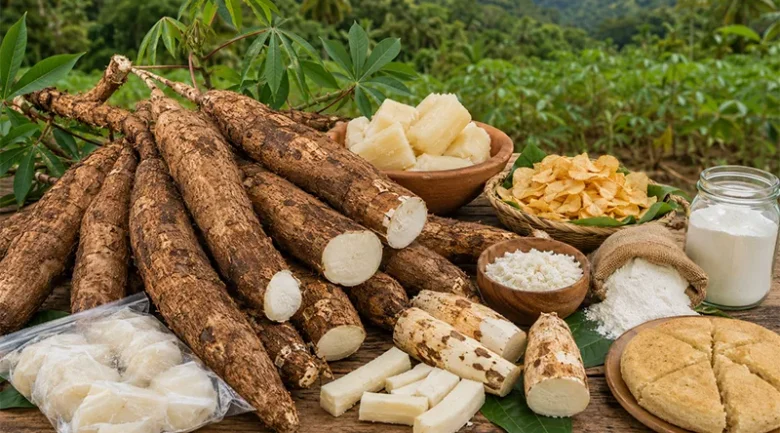
Cassava gradually became part of the wider Dominica diet without losing its association with the Kalinago Territory. Fresh roots were cooked in soups, stews and provision plates. Farine entered household food storage. Bread became a recognisable speciality sold to residents and visitors.
The crop’s historical value should not be reduced to a tourism performance. Cassava processing preserved technical knowledge developed before colonial rule. It demonstrates Indigenous skill in plant selection, food chemistry and storage, even though those systems were developed without modern laboratory terminology. That history is increasingly relevant as Dominica gives more attention to Indigenous identity, resilient agriculture and locally produced food.
Cassava also provides material for school programmes. Students can learn about Indigenous history, plant propagation, food safety, climate adaptation and small-business development through a single crop. A school plot linked to supervised processing can connect agriculture with science, culture and entrepreneurship.
Its survival in Dominica represents adaptation rather than frozen tradition. Coconut-flavoured bread, packaged farine, mechanical graters and branded products show how old knowledge can respond to modern markets. Care is still needed so that commercial promotion recognises the Kalinago origins of the practices and does not remove the community from its own agricultural heritage.
Cultivation Methods, Farm Structure and Production Statistics
Cassava is a woody perennial shrub commonly managed as an annual or short-duration crop. Farmers do not normally plant it from botanical seed. Instead, mature stems are cut into sections containing several nodes. These cuttings are placed upright, angled or horizontally in prepared soil, depending on local practice, moisture and field conditions.
New shoots emerge from the nodes while roots develop below ground. Some roots enlarge as storage organs rich in starch. Harvest generally takes place several months after planting, with timing influenced by variety, soil, rainfall, intended use and market demand.
In Dominica, small farmers often grow the crop within mixed holdings rather than in extensive pure stands. A plot may also contain plantain, dasheen, tannia, yam, sweet potato, pigeon peas, fruit trees or vegetables. Mixed production spreads risk and gives households food or income at different times of the year.
Cassava performs best in loose, well-drained soil that allows the roots to expand. Heavy waterlogged ground may restrict development and encourage rotting. Dominica’s volcanic soils can support good growth, but rainfall and slope must be managed carefully. Raised mounds, ridges or well-drained beds may be used where excess moisture is a concern. The crop has a reputation for tolerating poor soil, but that does not mean it produces high yields without nutrients. Continuous harvesting removes substantial quantities of potassium and other minerals. Repeated cultivation without soil improvement can weaken fertility and reduce root size. Farmers may use compost, animal manure, crop residues or commercial fertiliser according to availability and cost. Weed control is particularly important during early growth, before the plant’s canopy shades the soil. Once established, cassava competes more effectively with weeds.
Planting material determines much of the crop’s performance. Cuttings should come from healthy, mature stems free of visible disease and severe insect damage. Very old, dried or damaged stems may produce weak establishment. Reusing material from infected fields can spread disease from one planting cycle to another.
CARDI has supported improved production practices in Dominica through training, demonstration plots and farmer field schools. Work has included attention to planting density, variety selection, pest observation, harvesting and value-added processing. Such support matters because many producers historically relied on inherited techniques without access to structured crop records or formal trials.
Dominica’s published data confirm that production is small but variable. The Agricultural Statistics Report for 2007 to 2011 recorded:
- 121 tonnes in 2007, valued at approximately EC$1.12 million
- 261 tonnes in 2008, valued at approximately EC$2.53 million
- around 130 tonnes in 2009, based on the published series
- a lower estimated quantity in 2010
- 87 tonnes in 2011, valued at approximately EC$835,000
The scanned table is difficult to read in places, so the middle-year figures should be checked against the Central Statistical Office’s original dataset before being used for financial calculations. The clear direction is that national output remained in the low hundreds of tonnes and moved sharply from year to year.
CARDI’s later regional work described Dominica production as under 1,000 tonnes annually. That estimate is consistent with an industry dominated by small farms, household plots and limited processing rather than commercial plantations.
To place the figures in context, Dominica’s total root-crop production was reported at 24,239 tonnes in 2007 and 49,634 tonnes in 2011. Cassava therefore represented only a small fraction of the root-crop category. Dasheen alone accounted for tens of thousands of tonnes in some years, showing the difference between the island’s principal root crops and its much smaller cassava sector.
The monetary figures require caution. An estimated farm-gate or production value is not the same as retail sales revenue. It may also reflect assumed prices rather than documented transactions for every kilogram. Informal household use, direct roadside sales and unrecorded exchanges can be missed.
Production estimates may understate cultivation in the Kalinago Territory and other communities where roots are consumed at home or processed without passing through formal wholesale channels. A household may harvest several plants for bread or farine without reporting a commercial sale.
The 1995 Agricultural Census remains one of the broadest examinations of Dominican farming. It covered rural farms across the island and used full enumeration for larger holdings together with sampling for farms below five acres. The report itself acknowledged weaknesses in the agricultural information system and the long gap since the previous successful census in 1960-1961. Those limitations remain relevant. Minor crops are harder to measure than bananas, plantains or major roots because they may be scattered through mixed plots. Production can also be harvested gradually, making it difficult for farmers to recall annual quantities accurately.
CARDI’s 2019 survey provides critical baseline data revealing that cassava accounts for 75 to 100 percent of total agricultural income for 39 percent of participating producers. This high-income concentration emphasises the crop’s disproportionate economic importance to individual smallholder households despite its low national volume. Market demand remains highly fragmented due to the total absence of centralised processing facilities, resulting in small-scale production tailored to localised informal markets, bakeries, and roadside venues. The operational framework is defined by manual harvesting techniques that require significant physical labour to extract root clusters from steep, high-moisture slopes, a process in which structural root breakage frequently compromises overall yield.
Freshly dug cassava has a notoriously short shelf-life, with internal spoilage and bacterial rot kicking in within just 24 to 48 hours. To buy more time, farmers use a clever hack called “field storage,” leaving the mature roots buried alive in the ground until a buyer is lined up. However, this open-ended storage strategy comes with a massive catch. If left underground too long, the roots turn woody, grow oversized, and become prime targets for rot, burrowing rodents, hungry insects, and unpredictable weather events that can wipe out the entire block.
Dominica’s primary agricultural risks, excessive moisture, hurricanes, landslides, and surface runoff on hillside plots, constantly threaten these vulnerable fields. Strong winds easily snap stems and strip leaves, while waterlogged soils cause severe root damage. Fortunately, cassava recovers from total defoliation better than most vegetables, and its underground roots are naturally protected from destructive winds, making the crop a vital food security buffer in disaster-resilient farming systems. Nevertheless, catastrophic storms introduce severe supply chain bottlenecks, as blocked roadway networks and shattered processing equipment regularly prevent farmers from utilizing an otherwise salvageable underground harvest.
Biosecurity remains a critical concern for the industry, particularly regarding the informal movement of planting material that can covertly transport invisible mites, whiteflies, mealybugs, and pathogens. To protect local fields, agricultural and quarantine authorities must strictly manage the entry and evaluation of new varieties rather than relying on unverified foreign cuttings. Stabilising the industry requires establishing localised trials to determine realistic yield benchmarks under unique Dominica soil and rainfall conditions. Ultimately, building a robust commercial market depends on implementing disciplined production schedules and staggered planting agreements between farmers and processors to prevent immediate market gluts, crashing prices, and widespread post-harvest spoilage.
Traditional and Commercial Processing
The processing of bitter cassava remains heavily anchored in traditional Kalinago techniques, though modern material upgrades (such as stainless-steel platins and commercial mechanical graters) have been integrated to scale up production.
The Cassava Value Chain Steps
The preparation of cassava products involves several sequential stages:
- Peeling and Washing: Tubers are manually peeled to remove the brown bark-like outer skin and the white inner cortex, which contains the highest concentration of toxic glucosides.
- Grating: The peeled white tubers are grated into a fine, wet pulp. While traditionally performed using hand-punched tin sheets, most modern operations utilize motorized, gasoline-powered mechanical rotary graters.
- Squeezing/Pressing: The wet pulp is placed in a matapi (a long, woven basket tube that contracts when stretched vertically) or a modern mechanical jack press to squeeze out the liquid. This liquid is highly toxic but contains valuable starch, known in Dominica Creole as mouchas. The starch is allowed to settle out of the liquid, dried, and set aside.
- Sifting: The dried, compacted cake of pressed cassava is broken down and rubbed through a woven mesh sifter known as a hebichet. This separates the fibre from the fine meal.
- Thermal Conversion (Cooking and Baking):
- Cassava Bread (Kasal): The sifted meal, often enriched with dried starch (mouchas), grated coconut, ginger, or salt, is spread in a thin layer onto a hot, circular cast-iron plate called a platin. Heated by an open wood fire, the starch gelatinizes within 10 to 15 minutes, binding the meal into a flat, round bread.
- Farine: The meal is placed into a large, heated metal vat and continuously stirred and tossed using a flat wooden paddle. This slow roasting dehydrates the meal into dry, crunchy, cream-colored granules that can be stored in airtight containers for years without spoiling.
Market Pricing and Economic Indicators
Cassava in Dominica has transitioned from a purely subsistence crop to a highly commercialized commodity. As of mid-2026, market data indicates strong demand for fresh tubers, dried processed flour (farine), and value-added cassava breads.
Market Prices (2026 Estimates)
Under the current national fiscal policies, locally harvested crops remain exempt from domestic sales tax (VAT), maintaining cost stability for consumers at local market depots.
| Product Type | Unit of Measure | Domestic Price (XCD) | Equivalent Price (USD) |
| Fresh Tuber (Farm-gate) | Per Pound (lb) | $1.50 – $2.50 | $0.55 – $0.92 |
| Fresh Tuber (Retail) | Per Pound (lb) | $2.50 – $4.00 | $0.92 – $1.48 |
| Fresh Tuber (Wholesale Bulk) | Per Kilogram (kg) | $1.38 – $4.56 | $0.51 – $1.69 |
| Processed Farine | Per Pound (lb) | $12.00 – $16.00 | $4.44 – $5.92 |
| Cassava Bread (Plain, Small) | Per Plate (approx. 8″) | $6.00 – $8.00 | $2.22 – $2.96 |
| Specialty Cassava Bread | Per Plate (with coconut/ginger) | $10.00 – $14.00 | $3.70 – $5.18 |
Data compiled from local market monitoring, the Roseau Market Authority, and regional agricultural trade databases.
National Production Metrics
Dominica’s national production of cassava is characterized by highly decentralized, smallholder plots.
- Acreage: It is estimated that approximately 120 to 140 acres are dedicated to active cassava cultivation island-wide. While the largest concentration is within the Saint David Parish (covering the Kalinago Territory and Good Hope), production has expanded into non-traditional agricultural belts such as Calibishie and Portsmouth.
- Annual Yield: Average yields on traditional un-irrigated smallholder plots range from 6,000 to 10,000 pounds per acre (roughly 6.7 to 11.2 metric tons per hectare). This is significantly lower than commercial yield targets under intensive farming systems (which can exceed 20,000 pounds per acre) due to limited fertilizer inputs, mechanical constraints, and the reliance on traditional heirloom cultivars.
- National Volume: Total annual production of fresh cassava in Dominica is estimated at 800 to 1,100 metric tons. Much of this volume is retained within rural households or converted directly into value-added products (farine and bread) rather than entering formal fresh export streams.
Agro-Processing, Value Addition, and Export Development
Value addition is the primary driver of profitability in Dominica’s cassava sector. Raw cassava is bulky, highly perishable, and prone to rapid post-harvest physiological deterioration (typically spoiling within 48 hours of harvest). Converting the tuber into stable dehydrated forms is therefore essential.
Culinary Innovation in the Kalinago Territory
The Easy Side Cassava Bakery and Daniel’s Cassava Bakery, both operating in the Kalinago Territory, have spearheaded commercial innovations in cassava bread. Traditionally restricted to plain or lightly salted formats, modern cassava bread now features diverse fillings:
- Sweet options including chocolate, raisins, and local shredded coconut.
- Savory options featuring saltfish (salted cod), smoked herring, and cheese.
To make these products more accessible, bakers have set up mobile platins at the Roseau Market, allowing consumers to customize their toppings and have the bread baked on-site.
Institutional Initiatives
The Government of Dominica, supported by international agencies, has invested in strengthening the cassava value chain:
- The Multi-purpose Agro-processing Facility Project: Backed by the European Union (EU) and the Caribbean Development Bank (CDB), this initiative aims to establish a national facility to standardise value-added agricultural outputs, including gluten-free cassava flours and packaged mixes for both regional and European export.
- Technology Upgrades (CARDI and FAO): Development programs have focused on replacing old, non-food-grade presses and graters with modern, hygienic stainless-steel equipment. This has drastically reduced pressing times from upwards of six hours to less than one hour, improving sanitisation and food safety standards.
- Introduction of New Varieties: Under joint projects with the International Center for Tropical Agriculture (CIAT), tissue culture laboratories have introduced four sweet cassava varieties to diversify the domestic gene pool and improve resistance to pests and root diseases.
Technical Constraints and Structural Challenges
Despite the crop’s massive potential as an import substitute for wheat flour, the commercial expansion of Dominica’s cassava industry faces several persistent bottlenecks:
- High Labor Costs: From manual land preparation on steep, rocky hillsides to the tedious peeling and pressing process, cassava farming in Dominica remains highly labor-intensive. The high cost of local farm labor directly inflates the production cost per pound.
- Limited Mechanization: Due to the island’s steep, volcanic topography, large-scale mechanized planting and harvesting machinery cannot be easily deployed. Most work is still carried out manually with cutlasses and hoes.
- Post-Harvest Deterioration: The absence of cold-storage transport and processing infrastructure at farm gates results in significant post-harvest losses. If farmers cannot quickly transport their harvest to a bakery or market, the tubers lose value rapidly.
- Demographic Shifts: The traditional labor-intensive knowledge of cassava processing is concentrated among older generations. Attracting younger Dominicans to the agricultural sector requires modernizing processing facilities and transforming farming from arduous manual labor into a technology-driven agribusiness.


References
-
1.
CARDI Small Scale Cassava Production in Dominica Manual https://www.cardi.org/wp-content/uploads/2021/12/Small-Scale-Cassava-Production-in-Dominica_Final-21.07.2021.pdf
-
2.
MoA Holds Cassava Development Workshop https://news.gov.dm/news/news-items/moa-holds-cassava-development-workshop
-
3.
https://www.cardi.org/blog/cassava-production-on-the-rise-in-dominica/ https://www.cardi.org/blog/cassava-production-on-the-rise-in-dominica/
-
4.
Kalinago Cassava Documentary https://www.youtube.com/watch?v=hZlDXxH1ic0
-
5.
Cassava Subsector to see significant development says Drigo https://dominicanewsonline.com/news/homepage/news/agriculture/cassava-subsector-to-see-significant-development-says-drigo/
-
6.
Kalinago Territory, Dominica: Indigenous Food & Culture Tour! https://davidsbeenhere.com/2024/07/25/kalinago-territory-dominica-indigenous-food-amp-culture-tour/
-
7.
$31.9 Million Allocation for Agricultural Resilience: GIS https://news.gov.dm/news/news-items/31-9-million-for-agriculture
-
8.
FAO Second Country Report on the State of Dominica's Plant Genetic Resources https://www.fao.org/4/i1500e/Dominica.pdf
-
9.
Ti Vilaj Kweyol’s Cassava House displays crop’s versatility https://dominicanewsonline.com/news/homepage/homepage-carousel/ti-vilaj-kweyols-cassava-house-displays-crops-versatility/