

Maroon Trials of Dominica (1813–1814)
The Maroon Trials of Dominica (1813–1814) represent one of the most remarkable legal and social archives of slave resistance in the entire Atlantic world. Held in Roseau at the violent climax of the Second Maroon War, these trials were an attempt by the British plantocracy to legally dismantle what they termed an imperium in imperio, a sovereign, self-governing Black state thriving inside the island’s mountainous interior.
While intended as a mechanism of imperial terror, the trial records achieved the exact opposite for modern history: they preserved the actual, unfiltered voices, social structures, and economic networks of the Dominican Neg Mawon.
The Catalyst: Governor Ainslie’s Total War
By 1813, the British colonial administration was in a state of panic. Following the 1807 abolition of the transatlantic slave trade, planters could no longer import new labourers; the escape of an enslaved person to the mountains was now a catastrophic financial loss. Under the supreme leadership of Chief Jacko, the Maroon population had swelled to thousands, systematically raiding coastal estates and choking the colony’s infrastructure.
In response, the British Crown appointed Governor George Ainslie, a notoriously brutal military careerist. Ainslie declared martial law and launched a genocidal, scorched-earth campaign. He deployed the Black Rangers (paramilitary units of armed enslaved trackers) into the rainforests of Dominica to systematically burn Maroon provision grounds, drop defensive blockades, and hunt down the families of the high woods.
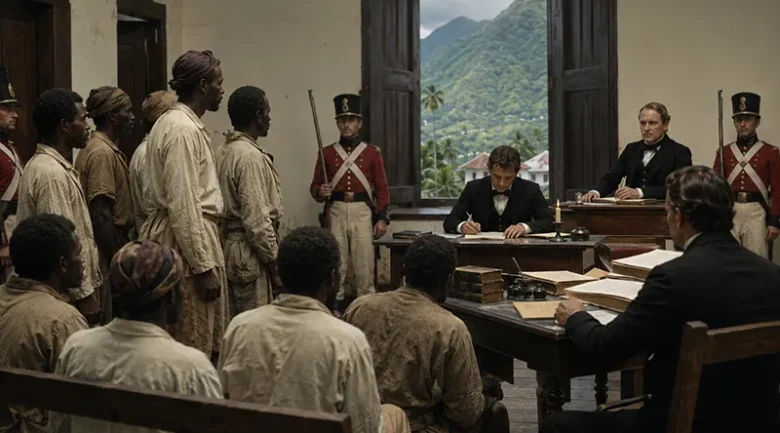
As hundreds of Maroons were systematically starved out, captured, or betrayed, they were marched down the mountains in chains to face a specially convened slave court in Roseau.
The Mechanics of the Trials
The trials were not fair judicial proceedings; they were arbitrary instruments of colonial counter-insurgency.
- The Court: The captured rebels were tried under the draconian slave codes of Dominica before a panel of white planters, magistrates, and the island’s ruthless Provost Marshal, James Laing.
- The Rights: The accused had no legal representation, no right to a jury of their peers, and their testimonies were heavily filtered through colonial scribes.
- The Title’s Origin: The historical memory of these trials was brought to light in modern historiography by author Polly Pattullo in her seminal work, “Your Time Is Done Now.” The title itself is pulled directly from the trial minutes of an enslaved plantation labourer named Peter. When tried for executing the Hillsborough Estate revolt and deliberately misleading Governor Ainslie’s troops in the woods, Peter defiantly looked at his judges and told them their era of white supremacy was drawing to an end.
Historical Revelations: What the Testimony Exposed
Because the magistrates meticulously recorded the interrogations to map out the interior strongholds, the trial transcripts inadvertently exposed a sophisticated, deeply integrated Afro-Caribbean society that the white plantocracy had spent decades trying to deny.
The Black Economy and Plantation Networks
The trials shattered the colonial myth that the Maroons were completely isolated, wild forest fugitives. The testimonies revealed an intricate, highly organized maritime and terrestrial trade network between the Maroons and the enslaved workforce remaining on the plantations.
Maroons routinely snuck onto estates at night, exchanging wild game, mountain-grown provisions, and woven baskets for essential supplies like gunpowder, lead bullets, salt, and iron tools.
Lifespans of Freedom
The court records astounded British officials by revealing the sheer durability of the Maroon state. Multiple captured individuals testified that they had been living in absolute freedom in the mountains for thirty to forty years. They had raised entire generations of children who had never known a master, possessed their own judicial systems, and practised specialised high-altitude agriculture.
Spiritual Solidarity
The trials highlighted the role of Obeah and West African spiritual systems in maintaining military morale. Enslaved plantation cooks and domestic servants testified that they used spiritual divination to monitor police movements, passing critical intelligence up to commanders like Chief Jacko and Chief Nycko before the Black Rangers could strike.
Sentences and Imperial Executions
The punishments handed down by the court were designed to project an absolute, terrifying psychological dominance over Dominica’s remaining labour force.
Of the hundreds tried, dozens of high-profile Maroon captains and plantation conspirators were sentenced to public execution. They were hanged, decapitated, or broken on the wheel at the Old Market Square in Roseau. Their severed heads were spiked on wooden poles along the coastal highways and outside major sugar estates to serve as graphic warnings.
For those not sentenced to death, the court ordered banishment. Hundreds of Dominican Maroons were permanently deported, sold to harsher slave markets in the non-British Caribbean, or sent to penal colonies as far away as West Africa.
The Fall of Governor Ainslie
While the trials successfully broke the back of organised, large-scale armed marronage in Dominica, the sheer sadism of the proceedings ultimately backfired on the colonial administration.
When copies of the trial minutes and descriptions of Governor Ainslie’s “sanguinary” methods reached London, British human rights abolitionists and the British press (The Times) were deeply horrified. Parliament was already fiercely debating the total abolition of slavery, and Ainslie’s state-sanctioned torture was seen as an international embarrassment.
In late 1814, the British Colonial Office intervened, abruptly sacking Governor Ainslie and recalling him to England in disgrace. While London did not question the institution of slavery itself, they deeply objected to the barbaric overreaches of the local Dominican plantocracy.
Historical Summary
| Dimension of the Trials | Imperial Intention (1813–1814) | Historic Reality & Legacy |
| Primary Objective | Liquidate the Maroon state and terrify plantation laborers. | Preserved the authentic voices, strategies, and lineage of Dominican resistance. |
| Judicial Outcome | Mass executions at Roseau Old Market and global banishment. | Triggered an international human rights scandal that resulted in the removal of Governor Ainslie. |
| Societal Reconsideration | Framed Maroons as lawless, disorganized bandits. | Proved the existence of a highly sophisticated, self-sustaining “Black Economy” and parallel state. |
Today, the transcripts of the Maroon Trials stand alongside the Dominica Museum archives as an invaluable testament to human resilience. They provide undeniable proof that the ancestors of modern Dominicans successfully rejected the parameters of white supremacy, choosing instead to build an alternative, sovereign society in the high woods.


References
-
1.
Your time is done now | Slavery, Resistance, and Defeat: the Maroon Trials of Dominica (1813-1814) https://dokumen.pub/your-time-is-done-now-slavery-resistance-and-defeat-the-maroon-trials-of-dominica-1813-1814-1583675582-9781583675588.html
-
2.
“A Place of Refuge to Republicans and Royalists”: The French Revolution in British Dominica https://www.cambridge.org/core/journals/journal-of-british-studies/article/place-of-refuge-to-republicans-and-royalists-the-french-revolution-in-british-dominica/25F4CEF27A430F4653C59D16174A9DE7
-
3.
Major Events in our Constitutional Development – Part 2 https://sundominica.com/articles/major-events-in-our-constitutional-development-par-1714/