


Squatting in Dominica
Squatting in Dominica refers to the unauthorised occupation and use of land or real property without the formal consent of the legal titleholder. Within the Commonwealth of Dominica, informal settlements and the cultivation of undocumented land plots are rooted in the island’s unique post-colonial history, rugged agrarian geography, and legislative evolution. Far from being a simple matter of trespassing, the issue of squatting sits at the center of a major legal dichotomy between two competing pieces of legislation: the Real Property Limitation Act (RPLA) and the Title by Registration Act (TRA). This tension has transformed squatting into a highly complex area of Dominican property law, directly impacting land ownership rights, state housing policies, and the rights of the vast Dominican diaspora.
The Legal Framework: Adverse Possession and the 12-Year Rule
The primary statutory mechanism governing the rights of informal occupiers in Dominica is the Real Property Limitation Act (RPLA). Under this statute, Dominica recognises the common-law doctrine of adverse possession, colloquially known as squatter’s rights.
The RPLA establishes a clear statutory limitation period of 12 years. If a person occupies private land continuously, openly, and without the owner’s permission for 12 years or more without the rightful owner filing a formal legal objection or eviction notice, the legal owner is barred from bringing an action in court to recover the land. Essentially, after 12 years of uninterrupted possession, the original owner’s legal title is extinguished, and the squatter acquires what the law terms a possessory title.
To successfully assert a claim of adverse possession in a Dominican court, an occupier’s presence must meet three strict legal criteria:
- Physical Possession (Factum Possessionis): The occupation must be actual, visible, and continuous. Occasional or seasonal use of the land, such as planting crops for only a few weeks out of the year, does not constitute sufficient physical possession. Enclosing the land with a fence or clearing it for permanent cultivation are considered the strongest forms of physical possession.
- Intention to Possess (Animus Possidendi): The squatter must demonstrate a clear intention from the outset to claim exclusive control of the land and exclude all others, including the true owner. It does not matter if the squatter entered the land under a mistaken belief that it was theirs.
- Inconsistent Use: The squatter’s use of the property must actively conflict with the original purpose for which the rightful owner was holding the land.
The Legislative Conflict: The RPLA vs. The TRA
For over a century, Dominica’s legal system faced an internal crisis due to a direct conflict between the RPLA and the Title by Registration Act (TRA). Passed shortly after the RPLA, the TRA introduced a land registration system designed to provide a “Certificate of Title” guaranteeing indefeasible ownership. Under the TRA, once a landowner held a registered certificate, their ownership was supposed to be absolute and unchallengeable in a court of law.
This created a massive legal loophole: could a squatter who had occupied land for 12 years under the RPLA defeat a registered certificate holder under the TRA? For decades, lower courts in Dominica leaned toward protecting the registered owner, ruling that a squatter could not claim title unless they had formally applied to register their claim under Section 33 of the TRA.
This legal standoff was definitively resolved by the Caribbean Court of Justice (CCJ), Dominica’s highest appellate court, in the landmark case of David George v Albert Guye. The dispute centred on a narrow strip of land in Portsmouth, adjacent to his business, that George had occupied for over 12 years. Albert Guye held a formal registered Certificate of Title issued in 1995 but failed to file a claim to evict George until 2007.
The CCJ majority overturned previous rulings from the Eastern Caribbean Supreme Court and sided with the squatter. The CCJ affirmed that the indefeasibility of a Certificate of Title in Dominica is not absolute. The TRA explicitly contains a carve-out exception for situations where an owner’s title has been superseded by a title acquired through adverse possession under the RPLA. A landowner who remains dormant and allows an individual to squat on their land for more than 12 years loses the right to evict them, meaning the squatter’s possessory right supersedes the registered certificate.
Socioeconomic Impact and Government Action
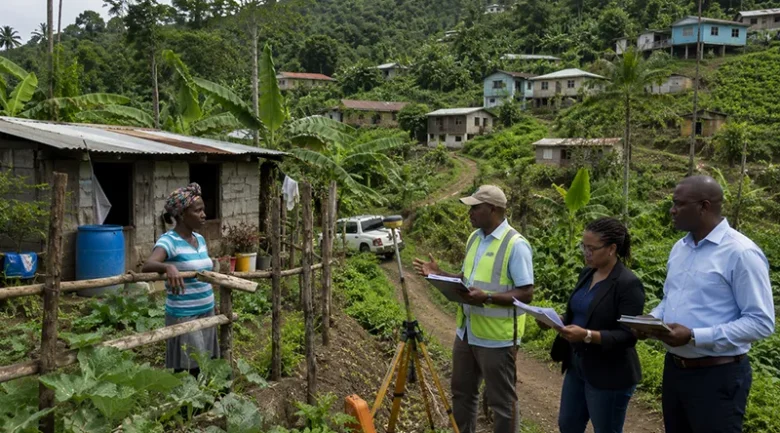
In terms of social demographics, squatting in Dominica manifests in both rural and peri-urban environments. In rural areas, historical shifts in the banana and citrus industries led to large estates being abandoned by their owners, prompting local farmers to occupy and cultivate the land informally to secure a livelihood. In urban peripheries, particularly around Roseau and Portsmouth, informal housing settlements emerged as families migrated toward commercial centres in search of employment but lacked the capital to purchase formal real estate.
Recognising that mass evictions would trigger severe social unrest and exacerbate poverty, the Government of Dominica established the Squatter Regularization Programme, managed under the Housing Division. Under this initiative, the state identifies long-standing informal settlements located on state-owned land (Crown land). Rather than displacing these communities, the government regularises the settlements by surveying the plots, installing basic infrastructure (such as electricity, roads, and standpipes), and giving the occupiers the opportunity to purchase the land at a heavily subsidised rate, historically as low as $1.00 XCD per square foot. This program has successfully transitioned thousands of marginalised families from illegal occupiers to legitimate, tax-paying landowners, enabling them to secure formal mortgages and improve their housing structures.
The Diaspora Vulnerability Factor
The enforcement of adverse possession laws creates a unique structural vulnerability for Dominica’s extensive diaspora population. Thousands of born Dominicans reside permanently in the United States, Canada, the United Kingdom, and neighbouring Caribbean islands. Many of these overseas citizens inherit family land or purchase plots with the intention of building retirement homes or holding the property as a long-term investment.
Because diaspora owners are physically absent from the island for years at a time, their properties are prime targets for opportunistic squatting. Under the RPLA, if an absent owner relies on informal family word-of-mouth to watch over a property, and an unauthorized person moves onto the land, fences it off, and cultivates it for 12 continuous years, the overseas owner can return to find themselves legally locked out of their own property.
Legal experts consistently urge diaspora landowners to take active, formal steps to protect their assets. This includes appointing formal legal representatives via a registered Power of Attorney, executing structured, written lease or license agreements if allowing someone to caretake the land, and ensuring that any signs of unauthorized encroachment are met with immediate, documented legal objections before the 12-year statutory limitation period expires.


References
-
1.
CCJ Upholds Squatter’s Rights in Dominica Land Dispute https://dominicanewsonline.com/news/homepage/news/ccj-upholds-squatters-rights-in-dominica-land-dispute/
-
2.
State Lands Act (Chapter 53:01) https://faolex.fao.org/docs/pdf/dmi13240.pdf
-
3.
Ministry of Housing and Urban Development Mandate https://housing.gov.dm/en/about/mandate
-
4.
Selling, Leasing and Squatting on State Lands https://sundominica.com/articles/selling-leasing-and-squatting-on-state-lands-1110/
-
5.
Squatter Regularisation Programme Touches the Lives of over 500 Families https://dominicanewsonline.com/news/homepage/news/economy-development/squatter-regularisation-programme-touches-the-lives-of-over-500-families/
-
6.
Legislation and Planning in Dominica https://www.cdema.org/virtuallibrary/index.php/charim-hbook/country-data/countrydocs-dom/dominica-legislation