
Free People of Colour in Dominica

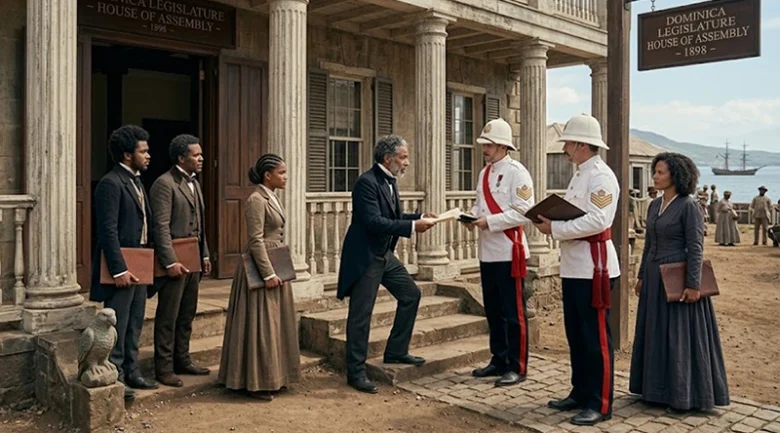
The Free People of Colour in Dominica represented a singular phenomenon in the British West Indies, a class of people who successfully navigated the narrow, dangerous straits between the white plantocracy and the enslaved majority to eventually seize the reins of the colonial state. In a society designed to be a binary of black and white, they were the third way. This demographic used education, property, and strategic legal battles to dismantle the very racial hierarchy that sought to exclude them.
The Architecture of the Middle Class
The origins of the Free People of Colour (often referred to as Gens de Couleur Libres due to Dominica’s French heritage) were rooted in the complex, often coercive, intimate entanglements of the plantation economy. They were primarily the offspring of white European men and enslaved or free African women.
Unlike other islands where this group remained socially paralysed, in Dominica, they benefited from the island’s frequent handovers between France and Britain. This imperial instability allowed them to accumulate property and rights that were harder to obtain in more settled colonies. By the late 1700s, they weren’t just a small fringe; they were a growing economic force of small-scale planters, merchants, and skilled tradespeople.
The Three-Tiered Social Pyramid
The Dominican social structure was not a simple top-down line, but a precarious pyramid where the middle tier acted as both a buffer and a threat to the top.
- The White Elite: At the summit, holding the Grand House and the legislative vote.
- The Free People of Colour: The burgeoning middle, often wealthier and better educated than the poor whites, but legally restricted in their civil rights.
- The Enslaved Majority: The labour engine of the island, whose subversion and marronage created the constant state of anxiety that the upper two tiers had to manage.
The 1831 Brown Privilege Bill: A Quiet Revolution
For decades, the plantocracy used the law to hobble the Free People of Colour. They passed acts limiting the amount of land a person of colour could inherit and restricting their testimony in court. However, the Dominican Free Browns were exceptionally litigious and organised.
In 1831, three years before the total abolition of slavery, the Dominican legislature was forced to adopt the Brown Privilege Act. This was a landmark piece of legislation that granted Free People of Colour full civil rights, including the right to vote and sit in the House of Assembly. This was not a gift from the British; it was a surrender by the plantocracy, who realised they needed the Browns as allies to help manage the impending chaos of Emancipation.
The Mulatto Oligarchy: 1838–1898
Following Emancipation in 1834, the white plantocracy began to flee the island, unable to survive without coerced labour. Into this vacuum stepped the Free People of Colour. Over a 60-year period, Dominica became the only British colony where the legislature was controlled by a majority of Black and Mixed-race men.
This group, often called the Mulatto Oligarchy, governed with a focus that was distinctly different from their white predecessors:
- Education: They prioritized the funding of schools for the formerly enslaved.
- Civil Rights: They pushed for legal reforms that protected smallholders.
- Political Resistance: They frequently clashed with British-appointed Governors, asserting a form of proto-nationalism that predated modern independence movements by over a century.
The 1898 Coup: The Empire Strikes Back
The British Colonial Office in London viewed the Black-controlled parliament of Dominica with profound racist anxiety. They feared that if Dominica succeeded as a self-governing Black state, it would inspire similar movements across the empire.
In 1898, the British staged a constitutional coup. Using the excuse of financial instability (caused largely by falling global sugar prices), they dissolved the Dominican House of Assembly and imposed Crown Colony Rule. This stripped the local elite of their power and returned the island to direct, authoritarian rule from London. It was a calculated reset designed to put the Free People of Colour back in their place.
Legacy: The Intellectual Bedrock of Dominica
The era of the Free People of Colour left an indelible mark on the Dominican psyche. They were the bridge between the old plantation world and the modern Caribbean state.
The Rise of the Professional Class
Because the 1898 coup blocked their path to political power, the descendants of this class pivoted toward the professions. They became the island’s doctors, lawyers, and teachers. This intellectual tradition ensured that, even under Crown Colony rule, Dominica maintained a highly educated vanguard that would eventually lead the island to independence in 1978.
The Cultural Hybrid
This class was the primary custodian of Dominica’s French-Kweyol heritage. While the British tried to Anglicise the island, the Free People of Colour maintained their Catholicism and their Kweyol language, ensuring that Dominica’s unique cultural identity remained distinct from its neighbours.
The Unfinished Bridge
The story of the Free People of Colour in Dominica is a narrative of brilliance caught in the gears of a fading empire. They were the proof that a post-racial, meritocratic society was possible in the Caribbean, long before the colonizers were ready to admit it.
The resonance they leave behind is one of strategic resilience. They did not just survive slavery; they outstudied and outbought the system that created them. While the 1898 coup attempted to erase their political achievements, it could not erase the precedent they set. They proved that in the “Nature Isle,” power does not always belong to those with the oldest names or the whitest skin, but to those who can navigate the steep, rugged terrain of history with their dignity and their intellect intact. The modern Dominican state, with its fierce spirit of independence and its deep-seated respect for the mountain farmer and the educated leader alike, is the true house that the Free People of Colour built.


References
-
1.
The Forgotten Generations: Dominica https://theforgottengenerations.com/home/north-america/dominica/
-
2.
In the forests of freedom: the fighting Maroons of Dominica https://www.academia.edu/92721305/In_the_forests_of_freedom_the_fighting_Maroons_of_Dominica