


Mosquitoes of Dominica
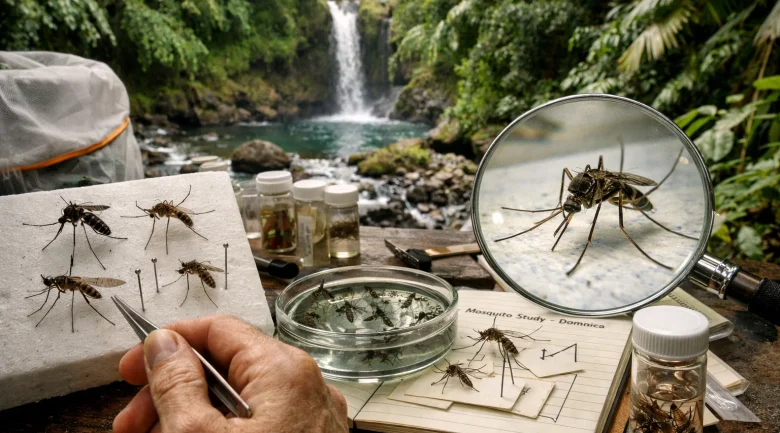
The 1966 publication of “Mosquitoes of Dominica” by Alan Stone and Kenneth L. Knight remains a cornerstone of Antillean entomology. Produced as part of the Bredin-Archbold-Smithsonian Biological Survey, this document transitioned the study of Dominican Diptera from anecdotal observations into a rigorous, scientifically mapped discipline. By identifying exactly 22 species across several distinct genera, Stone and Knight provided the island with an invaluable baseline for ecological conservation and public health.
The 22 Species of the Nature Isle
The researchers documented a diverse array of species, ranging from urban-adapted vectors to deep-forest specialists that inhabit the island’s mountainous interior. Below is the complete list of the 22 species identified in the 1966 survey:
- Anopheles aquasalis (Curry): A coastal marsh-dweller historically significant as a potential malaria vector in the Portsmouth and northern wetland regions of Dominica.
- Anopheles argyritarsis (Robineau-Desvoidy): Primarily found in sunlit ground pools; this species represents the complexity of the island’s freshwater breeding site diversity.
- Aedes aegypti (Linnaeus): The primary urban vector for Dengue and Yellow Fever, noted for its strong association with human-made water containers in Roseau.
- Aedes busckii (Coquillett): An endemic Caribbean species that prefers breeding in the leaf axils of plants and the fallen husks of cacao pods.
- Aedes tortilis (Theobald): Often found in temporary ground pools following heavy tropical rains; known for its aggressive biting habits in coastal areas.
- Culex declarator (Dyar & Knab): A widespread species found in various stagnant water sources, contributing to the general biomass of the island’s forest floor.
- Culex inflictus (Theobald): Prefers shaded ground pools and crab holes; this species highlights the specialized niche of Dominica’s coastal swamp ecosystems.
- Culex nigripalpus (Theobald): A major vector of encephalitis in the region, identified by Stone and Knight as a significant public health concern.
- Culex pipiens quinquefasciatus (Say): The common house mosquito, ubiquitous in urban centers and notorious for breeding in highly polluted or stagnant water sources.
- Culex secundus (Bonne-Wepster & Bonne): A forest-dwelling species documented in the high-humidity interior, contributing to the complexity of the Nature Isle food web.
- Culex janitor (Theobald): Frequently discovered in the water-filled holes of land crabs, showcasing the intricate relationship between the island’s crustacea and insects.
- Culex idottus (Dyar): A relatively rare find during the survey, typically associated with the dense vegetation of the island’s riverine systems.
- Culex duplicator (Dyar & Knab): Documented in the 1960s for its presence in temporary pools, reflecting the impact of seasonal rainfall patterns.
- Deinocerites magnus (Theobald): Specialized for life in crab holes; these mosquitoes possess long antennae and are strictly adapted to coastal saline environments.
- Mansonia titillans (Walker): Unique for its larvae that attach to the roots of floating aquatic plants to breathe, found in slow-moving estuaries.
- Psorophora ferox (Humboldt): Known as the white-footed woods mosquito, it is a fierce biter typically encountered in the shaded, damp forest interior.
- Uranotaenia lowii (Theobald): A small, strikingly colored mosquito that feeds primarily on amphibians, reinforcing the island’s One Health connectivity with frogs.
- Uranotaenia cooki (Root): Identified in specialized marshy habitats; this species is rarely seen due to its specific environmental requirements and non-human diet.
- Wyeomyia pertineans (Williston): The most common sylvan mosquito, breeding almost exclusively in the water held by bromeliads and other tropical epiphytes.
- Wyeomyia grayii (Theobald): Another bromeliad specialist, its presence highlights the incredible biodiversity found within the canopy layers of the Dominican rainforests.
- Wyeomyia complosa (Dyar): Documented during the survey for its intricate larval development within the leaf axils of native mountain palms and flora.
- Sayomyia dominicensis (Now renamed/classified): At the time of publication, it represented the broader taxonomic efforts to resolve the island’s unique insect fauna.
Ecological Significance and Vector Dynamics
Stone and Knight’s research revealed that Dominica’s mosquito population reflects its rugged geography. The high degree of phytotelmata (plant-held water) in the interior cloud forests creates a sanctuary for the Wyeomyia genus, while the coastal marshes support the Anopheles and Deinocerites species.
- Niche Specialization: The study proved that most Dominican mosquitoes are sylvan, meaning they live in the forest and do not interact with humans.
- Biogeographical Bridge: By documenting these 22 species, Stone and Knight showed that Dominica serves as a vital bridge for species moving between the Greater Antilles and South America.
- Baseline for 2026: Currently, these records allow the Ministry of Health to track the arrival of invasive species. If a mosquito is found today that is not on this list, it is an immediate red flag for biosecurity.
Public Health and the One Health Legacy
For the Chief Veterinary Officer (CVO) and the health authorities, “Mosquitoes of Dominica” remains a vital tactical manual. The identification of Aedes aegypti and Culex nigripalpus enabled the government to design targeted vector control programs focused on specific breeding behaviours.
The legacy of this research is felt most clearly in the Waitukubuli National Trail, where hikers can enjoy the emerald canopy, knowing that the vast majority of the island’s mosquitoes are harmless forest-dwelling species. The 1966 study turned the nuisance of the mosquito into a sophisticated map of the island’s health, ensuring that even the smallest inhabitants are respected as part of the Nature Isle’s delicate balance.


References
-
1.
Stone, A., & Knight, K. L. (1966): Mosquitoes of Dominica (Diptera: Culicidae) https://repository.si.edu/handle/10088/10041
-
2.
Survey of Mosquitoes and Larvae in Dominica, W.I. https://dominica.tamu.edu/wp-content/uploads/sites/54/2017/09/Mann_Alyssa_2011.pdf