



Aedes Busckii (Coquillett)
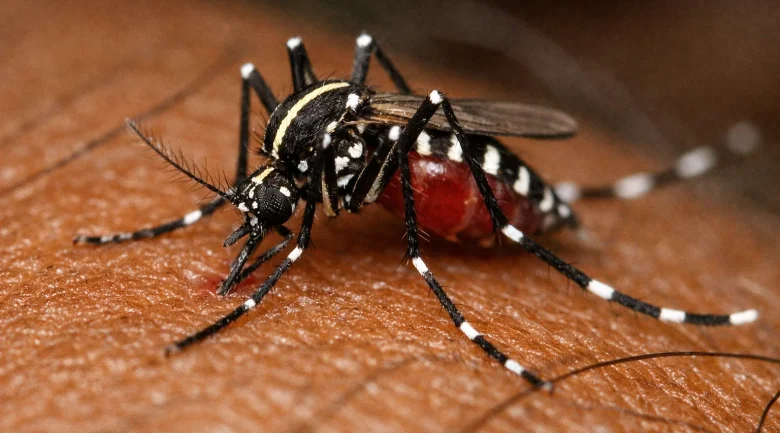
Aedes busckii (Coquillett) is a mosquito species within the family Culicidae that is endemic to the Lesser Antilles, including Dominica. Unlike the invasive and urban-dwelling Aedes aegypti, Aedes busckii is a primary forest mosquito. It represents a significant element of the island’s indigenous dipteran fauna, occupying specialised ecological niches within the montane and rain forest ecosystems.
Taxonomy and Identification
First described by Coquillett in 1906, the species was named in honor of the entomologist August Busck, who collected specimens during early biological surveys of the West Indies.
- Morphology: Aedes busckii is a medium-sized mosquito. It is characterized by its dark, almost black, integument and distinctive white scale patterns.
- Distinctive Markings: The scutum (back) features a narrow, median longitudinal line of golden-yellow or white scales, which distinguishes it from the lyre-shaped markings of Aedes aegypti. The legs are dark with narrow white bands at the bases of the tarsal segments.
- Subgenus: It is classified within the subgenus Howardina, a group largely restricted to the Caribbean basin and known for breeding in phytotelmata (water-holding plants).
Habitat and Ecological Distribution in Dominica
In Dominica, Aedes busckii is widely distributed throughout the island’s interior, particularly in areas of high humidity and undisturbed vegetation.
- Primary Habitats: It is most frequently encountered in the Morne Trois Pitons National Park, the Central Forest Reserve, and the Northern Forest Reserve.
- Breeding Sites (Phytotelmata): The larvae of A. busckii are specialized for life in natural water containers. Common breeding sites include:
- Tree Holes: Water-filled cavities in Gommier (Dacryodes excelsa) and Chataignier (Sloanea berteriana) trees.
- Bamboo Stumps: Naturally occurring or cut bamboo nodes that collect rainwater.
- Bromeliads: The water-holding axils of various epiphytic bromeliads common in the Dominican canopy.
- Cacao Pods: Discarded or rotting cacao pods in agricultural areas bordering forest lines.
Behavior and Feeding Patterns
The behavior of Aedes busckii in Dominica differs significantly from urban mosquito species.
- Biting Habitats: It is primarily a diurnal (daytime) biter. In the shade of the rainforest canopy, it can be active throughout the day, though peaks are often observed in the early morning.
- Host Preference: While it primarily feeds on forest wildlife (birds and small mammals), it is highly anthropophilic (attracted to humans) when hikers or forestry workers enter its habitat. It is often described as a persistent biter in the Dominican backcountry.
- Flight Range: The species has a relatively short flight range, seldom venturing far from the shaded forest environments where its breeding sites are located.
Public Health Status
Aedes busckii is not considered a primary vector for major human epidemics in Dominica.
- Arboviral Transmission: While it belongs to the Aedes genus, there is no documented evidence in Dominica that A. busckii plays a role in the transmission of Dengue, Chikungunya, or Zika. Its lack of association with urban environments limits its contact with infected human populations.
- Veterinary Significance: Research into its potential as a vector for avian malaria or other wildlife-specific pathogens in the Lesser Antilles is ongoing, particularly regarding its impact on native bird species like the Sisserou (Amazona imperalis).
- Surveillance: The Environmental Health Unit monitors A. busckii populations primarily to distinguish them from Aedes aegypti during rural entomological surveys.
Conservation and Biodiversity
As a regional endemic, Aedes busckii is a component of Dominica’s unique biodiversity. It serves as:
- Prey: A food source for forest-dwelling insectivores, including the Antillean Crested Hummingbird and various species of Dominican bats (Chiroptera).
- Biological Indicator: Its presence in high densities is often indicative of a healthy, moisture-rich forest environment with sufficient tree-cavity availability.


References
-
1.
The Mosquitoes of Dominica (Diptera: Culicidae) https://www.govinfo.gov/content/pkg/GOVPUB-SI-PURL-gpo19184/pdf/GOVPUB-SI-PURL-gpo19184.pdf
-
2.
Aedes busckii (Coquillett, 1906) https://www.dutchcaribbeanspecies.org/linnaeus_ng/app/views/species/nsr_taxon.php?id=178622
-
3.
Survey of the Breeding Habitats of Mosquitoes at Springfield Research Station https://dominica.tamu.edu/wp-content/uploads/sites/54/2017/09/Null_Sarah.pdf
-
4.
Survey of Mosquitoes and Larvae in Dominica, WI https://dominica.tamu.edu/wp-content/uploads/sites/54/2017/09/Mann_Alyssa_2011.pdf