



Chikungunya in Dominica
Chikungunya is an insect-borne viral disease in Dominica that has been a major historical and ongoing public health challenge within the state’s epidemiological framework. The disease is caused by the chikungunya virus (CHIKV), an RNA virus of the genus Alphavirus transmitted primarily by the bite of the Aedes aegypti mosquito. First introduced to the island as an explosive epidemic, the virus rapidly saturated all seven health districts due to an immunologically naive population. While the acute epidemic phase was formally declared over following aggressive regional and local intervention, the pathogen has transitioned into a seasonally stabilised arboviral threat. It continues to be actively monitored alongside dengue and Zika under national clinical surveillance and environmental sanitation laws.
Timeline of Introduction and the 2013–2015 Epidemic
The introduction of the chikungunya virus to Dominica followed a classic pattern of rapid vector-borne expansion across a vulnerable, non-immune population.
Index Importation and Outbreak Wave
The presence of the virus on the island began with an imported case in December 2013. A 65-year-old female resident of Good Hope, located on the windward coast within the Saint David Parish, returned from a trip to the neighboring island of Saint Martin. She began experiencing clinical symptoms on December 15, 2013.
The Caribbean Public Health Agency (CARPHA) reference laboratory provided formal diagnostic confirmation on January 15, 2014. Shortly thereafter, on January 25, 2014, CARPHA verified that autochthonous (local) transmission had been established, triggering a nationwide public health response by the Ministry of Health.
Epidemiological Curve and Clusters
Following local establishment, the virus spread rapidly across the island’s mountainous terrain, establishing distinct geographic transmission clusters:
- The Early Clusters: Spatial and temporal clustering analysis identified two major initial epicenters: the urban/suburban community of Bath Estate and Elmshall within the Saint George Parish, and the northeastern rural communities of Wesley and Woodford Hill within the Saint Andrew Parish.
- Epidemic Peak: Case counts accelerated through the spring and summer months of 2014, driven by high vector densities within residential water storage areas.
- Total Infection Burden: By the time transmission waned, health authorities had officially documented at least 3,771 suspected and confirmed cases across the island. Public health officials acknowledged that the true burden was substantially higher, as a significant portion of the population managed mild symptoms at home without presenting to primary health clinics.
- Declaration of Termination: Following strict guidelines from the World Health Organization (WHO), which require two maximum incubation periods (24 days) to pass without a newly diagnosed case, the Ministry of Health officially declared the epidemic over on January 23, 2015, after documenting 50 consecutive days with no new cases.
Demographic Variations
Clinical registry data compiled during the primary transmission cycle indicated a pronounced gender disparity. Out of the first 500 cases mapped, approximately 60% occurred in females, yielding a female-to-male odds ratio of 1.6. This imbalance was most pronounced in the 20–39 and 40–59 age groups. This variation is widely attributed to domestic exposure patterns, as the Aedes aegypti mosquito breeds heavily in stagnant water vessels situated near residential structures.
Clinical Manifestations and Chronic Sequel
Public health tracking distinguishes chikungunya from other circulating arboviruses by its high clinical manifestation rate (roughly 72% to 97% of infected individuals develop symptoms) and its capacity to cause long-term, debilitating joint complications.
Acute Phase Symptoms
The acute onset of the disease mimics dengue fever but is distinctly characterized by severe, often immobilizing articular pain. The classic clinical presentation documented across district health centers includes:
- Sudden onset of high fever (typically exceeding 39°C or 102°F).
- Severe polyarthralgia (pain affecting multiple joints), predominantly targeting the wrists, ankles, knuckles, and feet.
- Maculopapular rash, typically appearing two to five days after fever onset.
- Secondary manifestations such as intense myalgia (muscle pain), retro-orbital headaches, nausea, and non-purulent conjunctivitis.
Chronic Post-Viral Arthralgia
While the acute febrile stage typically resolves within 7 to 10 days, a hallmark of the disease in Dominica is its chronic phase. The virus frequently causes long-term joint stiffness, tenosynovitis, and persistent arthralgia that can last for months or even several years after the initial infection. This chronic sequel has had a measurable impact on the agricultural and labour workforce across the island, requiring ongoing physical therapy and pain management strategies within primary health networks.
Diagnostic Standards and Institutional Legislation
The clinical management and tracking of Chikungunya in Dominica are governed by strict protocols to ensure diagnostic precision. This framework prevents misidentification with clinically similar, co-circulating flaviviruses like dengue or Zika.
Molecular Differentiation and Diagnostic Protocols
Because serological evaluations (IgM testing) often cross-react across different viral families, definitive pathogen identification requires molecular diagnostics. Under quality metrics standardised by the Medical Laboratories Act 2024, patient blood samples collected at the community level are stabilised and fast-tracked to the central laboratory at the Dominica China Friendship Hospital (DCFH) in Goodwill. The facility utilises real-time Reverse Transcription Polymerase Chain Reaction (RT-PCR) assays, supported by the regional CARPHA network, to achieve definitive viral identification during the early acute phase.
Clinical Governance of Post-Viral Rheumatism
Managing the long-term, debilitating arthralgia and rheumatic complications characteristic of Chikungunya requires specialised clinical oversight. Under the professional standards enforced by the Medical Profession Act 2026, general practitioners and internal medicine clinicians registered with the Dominica Medical Council must adhere to evidence-based management guidelines. This statutory oversight ensures standardised care for post-viral autoimmune conditions across rural health districts by strictly regulating the prescription of systemic corticosteroids, except when clinically indicated, to avoid adverse long-term outcomes.
Vector Control and Environmental Suppression
The Environmental Health Unit conducts continuous vector suppression campaigns using an integrated vector management strategy designed to eliminate the Aedes aegypti mosquito across its life cycle.
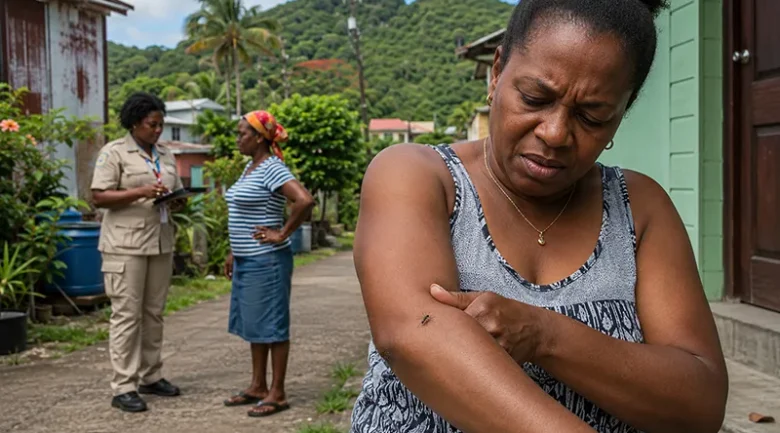
- Source Reduction and Statutory Inspections: Environmental Health Officers conduct scheduled house-to-house inspections across all parishes. Under local public health regulations, property owners are legally required to manage domestic water catchments. This includes keeping water storage drums and barrels tightly sealed, treating domestic cisterns, clearing blocked roof guttering, and eliminating artificial water receptacles such as discarded tires or unsealed flower vases.
- Chemical Invalidation: In response to localised spikes in reported febrile illnesses or elevated larval index readings, vector control units deploy targeted ultra-low volume (ULV) thermal fogging. This measure suppresses adult mosquito populations within specific high-risk communities.
- Public Health Education: National health promotion teams lead community outreach initiatives that advocate for personal protective measures. These include the consistent use of insect repellents containing DEET, Picardin, or IR3535, the installation of mesh screens on windows and doors, and the distribution of insecticide-treated bed nets for vulnerable populations, including infants and bedridden individuals.


