



Aedes Aegypti
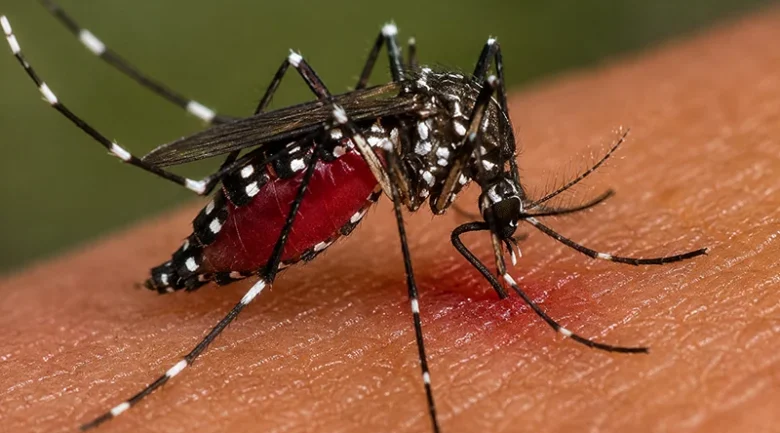
The Aedes aegypti is a highly adapted, invasive mosquito species within the family Culicidae and is the primary vector for several significant arboviral diseases in the Commonwealth of Dominica. Unlike native “forest” mosquitoes, Aedes aegypti is a synanthropic species, meaning it lives in close association with human populations. In Dominica, it is the focal point of national public health initiatives due to its role in transmitting Dengue, Chikungunya, and Zika viruses.
Taxonomy and Physical Identification
Aedes aegypti is easily distinguished from other mosquitoes in Dominica by its striking coloration and specific markings.
- Morphology: It is a small, dark mosquito characterized by white lyre-shaped markings on the dorsal surface of the thorax.
- Legs: The legs are banded with white scales, giving them a striped appearance.
- Behavioral Identification: Unlike many native species that bite at night, Aedes aegypti is primarily a day-biter, with peak activity periods in the early morning and shortly before sunset.
Habitat and Domestic Adaptation
Within Dominica, Aedes aegypti has successfully adapted to human-modified microclimates. The vector is completely absent from the deep primary rainforests of the Morne Trois Pitons National Park and preferentially colonises high-density coastal settlements, including Roseau, Portsmouth, and Grand Bay. This urbanised preference directly facilitates the transmission cascades of endemic arboviruses, including Dengue, Chikungunya, and Zika.
Breeding Ecology
The species functions as a highly opportunistic container breeder. Within the domestic Dominican landscape, the Environmental Health Unit classifies the primary breeding vectors as follows:
- Water Storage: Uncovered 55-gallon drums used for rainwater harvesting.
- Refuse: Discarded tires, plastic containers, and coconut shells.
- Domestic Items: Flowerpot saucers, blocked roof gutters, and pet water bowls.
The survival secret of the Aedes aegypti lies in the incredible biology of its eggs, which are completely desiccation-resistant. When the sun dries out a container, the eggs don’t die. They lock in their moisture, clinging to the dry plastic or rubber walls for months at a time like tiny, sleeping time bombs. The moment the skies open and the heavy tropical rainy season rolls in from June to December, these dry eggs are instantly flooded with fresh water, hatching into swarms of larvae within mere minutes and sending a fresh wave of vector-borne illness washing over the coastal communities.
Public Health Impact in Dominica
The Ministry of Health, Wellness and Social Services classifies Aedes aegypti as the most dangerous insect vector on the island due to the perennial threat of disease outbreaks.
Vector for Arboviruses
- Dengue Fever: Endemic to Dominica. The mosquito transmits all four serotypes of the Dengue virus. Major outbreaks historically correlate with years of high rainfall.
- Chikungunya: First detected in Dominica in late 2013, the virus spread rapidly through the Aedes aegypti population, leading to a national health emergency in 2014.
- Zika Virus: Confirmed in Dominica in 2016. Surveillance remains active to monitor for associated neurological complications.
Entomological Indices
The Environmental Health Department uses two primary indices to measure the risk of an outbreak in Dominican communities:
- House Index (HI): The percentage of houses found infested with larvae/pupae.
- Breteaus Index (BI): The number of positive containers per 100 houses inspected.
National Control and Management
The Government of Dominica employs a multi-tiered strategy for the management of Aedes aegypti, as outlined in the national vector control protocols.
Chemical Intervention
- Adulticiding: The use of fogging trucks (thermal or ULV spraying) to kill adult mosquitoes during suspected outbreaks.
- Larviciding: Applying chemical agents (such as Temephos) to standing water that cannot be drained.
Biological Control
In Dominica’s rural communities, the use of copepods (small crustaceans) and larvivorous fish in large water storage tanks has been encouraged to consume mosquito larvae naturally.
Legislative Enforcement
Under the Public Health Act, health inspectors in Dominica have the legal authority to enter premises to inspect for mosquito breeding. Property owners who fail to remediate breeding sites after a warning may be issued a Nuisance Notice and face fines.


References
-
1.
1966 study by Stone and Knight: Mosquitoes of Dominica https://www.govinfo.gov/content/pkg/GOVPUB-SI-PURL-gpo19184/pdf/GOVPUB-SI-PURL-gpo19184.pdf
-
2.
Survey of Mosquitoes and Larvae in Dominica, WI https://dominica.tamu.edu/wp-content/uploads/sites/54/2017/09/Mann_Alyssa_2011.pdf
-
3.
Taxonomic Inventory: The Mosquito Taxonomic Inventory by John N. Belkin (1968) https://mosquito-taxonomic-inventory.myspecies.info/sites/mosquito-taxonomic-inventory.info/files/Belkin%201968_0.pdf
-
4.
Dominica under threat from vector-borne diseases https://dominicanewsonline.com/news/homepage/news/health/dominica-under-threat-from-vector-borne-diseases/
This photo is Aedes albopictus, not aegypti. The back has one white stripe in the middle and not two curved lines.