

Black Power in Dominica
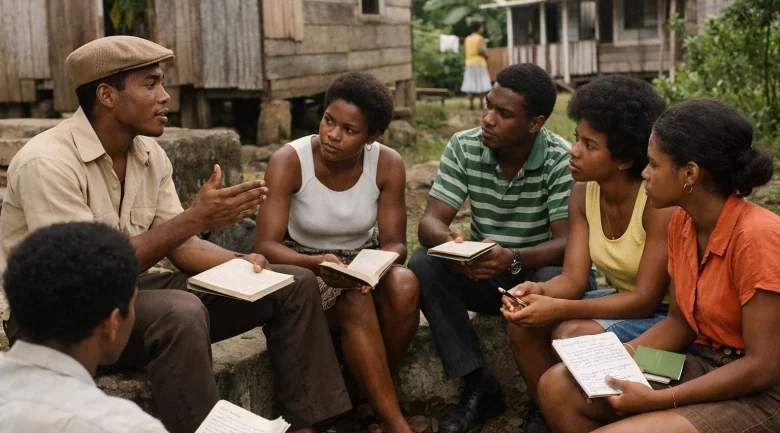
Dominica’s Black Power movement arose as a significant political and cultural force during the late 1960s and 1970s, driven by worldwide anti-colonial currents and local demands for dignity, equity and national self-determination. Black Power on the island was not a single organisation or ideology. It was a constellation of activists, study groups, cultural movements, publications, and informal networks that challenged inherited colonial authority and questioned whether political self-rule had translated into genuine liberation for the majority.
In Dominica, the movement was deeply rooted in lived experience. It grew from frustrations with economic dependency, land inequality, racialised social hierarchies, and the continued dominance of colonial law, church authority, and elite governance. Its influence reached politics, policing, law, culture, and international relations, leaving an imprint that remains visible decades later.
Global currents and Caribbean linkages
Dominican Black Power developed within a broader Caribbean and African-diaspora environment of resistance. Across the Atlantic world, newly independent societies were reassessing the meaning of freedom and confronting the persistence of racial and economic control. The U.S. Black Power and Civil Rights movement, African liberation struggles, and socialist experiments in Cuba and elsewhere provided intellectual and organisational reference points.
Within the Caribbean, Trinidad and Tobago’s 1970 uprising resonated strongly, demonstrating how youth, workers, and intellectuals could challenge entrenched power. Jamaican Rastafari philosophy, with its critique of Babylon and emphasis on African redemption, also shaped Dominican consciousness. These influences did not arrive as replicas. They were filtered through Dominica’s small-island realities, where politics, family ties, and daily life were closely intertwined.
Conditions that gave rise to the movement
By the late 1960s, Dominica remained under British administration, with independence still a decade away. The economy was narrow and vulnerable, dominated by agriculture and export dependence. Youth unemployment was high, migration was common, and political power was concentrated among a small professional and landowning class.
Education expanded during this period, producing a generation of students capable of critical analysis but often excluded from decision-making. Secondary schools in Roseau became spaces for political discussion, where Africa, socialism, and Caribbean identity were openly debated. Policing practices, land ownership, and the distribution of economic opportunity became flashpoints. These conditions produced a movement that framed inequality not as accidental, but as structural and racialised.
The Genesis: The Sir George Williams Affair (1969)
The catalyst for the Dominican Black Power movement occurred thousands of miles away in Montreal, Canada. In 1969, a group of Caribbean students at Sir George Williams University (now Concordia) occupied the university’s computer centre to protest racial discrimination by a biology professor. This event, known as the Sir George Williams Affair, involved several young Dominicans who would become the architects of the island’s radical future.
- Rosie Douglas: Perhaps the most famous figure of this era, Roosevelt “Rosie” Douglas was a charismatic son of a wealthy Dominican businessman. His involvement in the Montreal protests, subsequent 18-month imprisonment, and deportation back to Dominica transformed him into a “Caribbean Che Guevara.” He brought back a militant Pan-Africanism that challenged the Old Guard of Dominican politics.
- Anne Cools: Another prominent figure in the Montreal incident, Cools (who later became a Canadian Senator), worked alongside Douglas, representing the intellectual and female leadership that characterised the early movement.
The return of these radicalised students coincided with a growing dissatisfaction among the youth in Roseau and rural villages. They saw the freedom granted by British colonial structures as a facade that maintained white and light-skinned elite control over the island’s land and resources.
The Rise of Radical Organisations
By the early 1970s, the movement had crystallised into several influential organisations that challenged the status quo of the Dominica Labour Party (DLP) under Patrick John.
Movement for a New Dominica (MND)
The Movement for a New Dominica was the movement’s intellectual and grassroots powerhouse. Comprising teachers, students, and rural activists, the MND rejected the top-down approach of traditional parties. They focused on:
- Participatory Democracy: Establishing Village Councils that gave power to the people rather than centrally appointed officials.
- Economic Sovereignty: Advocating for land reform and the formation of agricultural cooperatives to break the dominance of foreign-owned estates.
- Cultural Decolonisation: Promoting the use of Kwéyòl and the celebration of African heritage, which had been marginalised by the colonial education system.
The Popular Independence Committee (PIC)
Led by Rosie Douglas upon his return, the Popular Independence Committee focused on achieving full political independence from Britain. They argued that statehood (the intermediate step Dominica was in at the time) was merely colonialism in a new dress. The PIC was instrumental in radicalising the working class and the unemployed youth in Roseau, organising massive protests of consciousness that often clashed with the police.
Key Figures and Their Impact
The movement was driven by a cadre of intellectuals and activists who risked imprisonment and death to advocate for a Black Dominica.
- Desmond Trotter (Ras Kabinda): A civil servant and activist, Trotter became a martyr for the movement when he was framed for the 1974 murder of white American tourist John Jirasek. His trial was a global cause célèbre, drawing support from figures like Angela Davis. The Free Desmond Trotter campaign unified the Black Power and emerging Rastafarian movements, proving that the state was willing to use judicial violence to suppress radical dissent.
- Pierre Charles: A youth leader who would later become Prime Minister, Pierre Charles was the bridge between the radical street movements and the formal political system. He led the National Youth Council, ensuring that the energy of the Black Power era was funnelled into sustainable social programs.
- Dr. William Emmanuel “Para” Riviere: An academic and historian, Riviere provided the ideological framework for the movement, authoring critiques of the plantation economy and the mental slavery that persisted after the abolition of physical slavery.
The Intersection of Black Power and Rastafari: The “Dread” Era
A unique feature of the movement in the Commonwealth of Dominica was the emergence of the Dreads. By the mid-1970s, many Black Power activists had adopted the aesthetics and spiritual tenets of Rastafari, creating a militant, agrarian-focused subculture. This fusion terrified the established elite, leading to the infamous Dread Act of 1974.
- The Dread Act: Officially the Prohibited and Unlawful Societies and Associations Act of 1974, this law made it legal for any citizen to kill a Dread found in their home and criminalised the wearing of knotted hair.
- Impact of the Crackdown: The Act forced many activists into the hills (the rainforest interior), where they established the self-sufficient Ital agricultural communities that still exist today. Its effects were immediate and far-reaching. Rastafari communities were targeted, families were displaced, and fear spread well beyond activists themselves. The law also reshaped public debate, forcing citizens to confront questions about constitutional rights, state power, and the limits of authority in a society approaching independence.
The persecution of the Dreads is now viewed as a dark chapter of state-sanctioned racial and ideological cleansing, the memory of which continues to fuel calls for reparations.
International solidarity and diaspora networks
Black Power in Dominica resonated strongly within Caribbean and African-diaspora communities abroad. Activists in the United Kingdom, Canada, and the United States organised campaigns in support of Dominican radicals, particularly following the Trotter conviction. Figures such as Walter Rodney framed events in Dominica as part of a broader regional pattern of repression against Black consciousness movements.
Diaspora organisations, student groups, and human-rights advocates amplified Dominican voices on the international stage. This external pressure constrained the government’s actions and embedded the island’s struggle within a global conversation about race, justice, and post-colonial governance.
The 1979 uprising and political shift
By the late 1970s, dissatisfaction with governance extended beyond Black Power networks. Economic hardship, allegations of corruption, and political fatigue culminated in the May 29th 1979 Uprising, which led to the collapse of the Patrick John administration. During this upheaval, imprisoned activists were released or escaped, and earlier decisions associated with repression were reassessed.
The interim government that followed granted pardons and acquittals, including in the Trotter case, acknowledging the political dimensions of earlier prosecutions. While Black Power did not become a governing force, its critique of authority and inequality helped reshape public consciousness and weaken the legitimacy of authoritarian rule.
Cultural legacy and long-term influence
After 1979, organised Black Power activism diminished, but its cultural impact endured. Rastafari presence became a permanent feature of Dominican society, influencing music, language, visual art, and religious life. Ideas once marginal entered mainstream discussion, including critiques of colonial history, land ownership, and racial hierarchy.
Former activists moved into diverse paths: cultural work, community leadership, diaspora engagement, and, in some cases, formal politics. The movement’s emphasis on African identity and self-worth continued to inform national culture, even as political strategies evolved.
Reassessment and historical memory
Black Power in Dominica remains contested in public memory. Some regard it as a necessary rupture that exposed injustice and expanded political imagination. Others emphasise the fear, instability, and economic disruption associated with the period. These debates reflect broader tensions in post-colonial societies grappling with how to interpret radical challenge and state response.
What is widely accepted is that the movement altered the trajectory of Dominican political life. It tested the limits of authority, reshaped legal and cultural norms, and linked the island’s experience to global struggles for dignity and self-determination.
Legacy and Impact: Dominica, a Decade of Now
The Black Power movement did not fail; it evolved. When the Patrick John administration collapsed in 1979 following mass protests and the devastation of Hurricane David, the radicals of the 1970s were the ones who stepped into the vacuum.
- Political Dominance: The modern DLP of the 21st century is largely built on the bones of the 1970s radical movement. Former activists like Rosie Douglas and Pierre Charles served as Prime Ministers, institutionalising the movement’s focus on social welfare and regional integration.
- Cultural Sovereignty: The movement’s push for African pride led to the elevation of the National Cultural Council. Today, Dominica is considered the Cultural Capital of the Eastern Caribbean, with its World Creole Music Festival and Kwéyòl language preservation programs directly tracing their lineage to Black Power ideology.
- Land and Agriculture: The focus on the small farmer as the backbone of the nation, a core MND tenet, remains the island’s primary economic philosophy, especially as it moves toward climate resilience in the next decade.
- Reparatory Justice: The movement’s focus on the mental scars of colonialism has matured into the national Reparations Committee, which actively seeks compensation from former colonial powers for the generational trauma of the plantation system and the 1970s crackdowns.
The Black Power movement in the Commonwealth of Dominica was the crucible in which the modern Dominican identity was forged. It transformed a colonial outpost into a nation that prides itself on its Nature Island status, its revolutionary history, and its unwavering commitment to Black self-determination.


References
-
1.
The Relationship Between Black Consciousness Movements and Class https://digitalcommons.usf.edu/cgi/viewcontent.cgi?article=1559
-
2.
Rosie Douglas: A Caribbean Radical and Pan-Africanist – The Guardian https://www.theguardian.com/news/2000/oct/05/guardianobituaries.pollypattullo
-
3.
RCMP Records: The Surveillance of Roosevelt “Rosie” Douglas – CityNews https://kitchener.citynews.ca/2023/02/26/black-activist-who-became-pm-of-dominica-was-target-of-rcmp-dirty-tricks-documents-6613145/
-
4.
Beginning of the Movement · History of The Rastafarians https://domfari.omeka.net/exhibits/show/rastahistory/beginning-of-the-movement
-
5.
Dominica's Harsh Law Against Black Guerrillas Stirs Concern https://www.nytimes.com/1975/01/06/archives/dominicas-harsh-law-against-black-guerrillas-stirs-concern.html
-
6.
The Rise & Fall of Patrick John https://sundominica.com/articles/the-rise-fall-of-patrick-john-6277/
-
7.
Caribbean Black Power: From Slogan to Practical Politics https://www.freedomarchives.org/Documents/Finder/Black%20Liberation%20Disk/Black%20Power!/SugahData/Essays/Thomas.S.pdf