

Social Welfare in Dominica
Social Welfare refers to the state-led system of social protection, financial assistance, and community-based services in Dominica that supports the most vulnerable segments of the population. Operating primarily under the jurisdiction of the Ministry of Health, Wellness and Social Services, the system serves as a safety net against economic shocks, chronic poverty, and the physical limitations associated with aging or disability. The framework has evolved significantly from its colonial origins into a modern, multi-tiered structure comprising contributory social insurance, non-contributory public assistance, and specialised care programs. Today, social welfare in the Commonwealth of Dominica is increasingly integrated with the national mandate for climate resilience, utilising digital infrastructure to ensure the continuity of support following natural disasters.
Historical Development and Legal Foundations
The formalisation of social welfare in Dominica followed the broader Caribbean transition from colonial “poor relief” to structured social protection. In the early 20th century, aid was largely discretionary and administered through religious organisations or colonial boards with limited resources. The contemporary era began with the passage of the Social Security Act (Chapter 31:01), which established the Dominica Social Security (DSS) in 1976. This marked a shift toward a contributory system where the labour force funded its own future protections against sickness and old age.
While contributory social insurance is rigidly anchored in statutory law, non-contributory social assistance operates through a distinct, policy-driven architecture:
- The Public Assistance Programme (PAP): Rather than originating from a modern standalone welfare statute, the state’s non-contributory cash transfers are rooted in older colonial-era provisions and are currently administered as an executive, policy-driven cabinet programme under the Ministry responsible for social justice.
- The Children and Young Persons Act (Chapter 37:50): This statutory instrument complements policy frameworks by codifying the legal rights, safety parameters, and state protection protocols for minors facing systemic neglect.
By the late 2020s, these dual structural tracks were operationally integrated into the National Resilience Development Strategy (NRDS) 2030. This contemporary framework rebrands social protection as a critical component of human capital preservation, directly complementing the structural goals of the nation’s Climate Resilience and Recovery Plan (CRRP).
Administrative Oversight
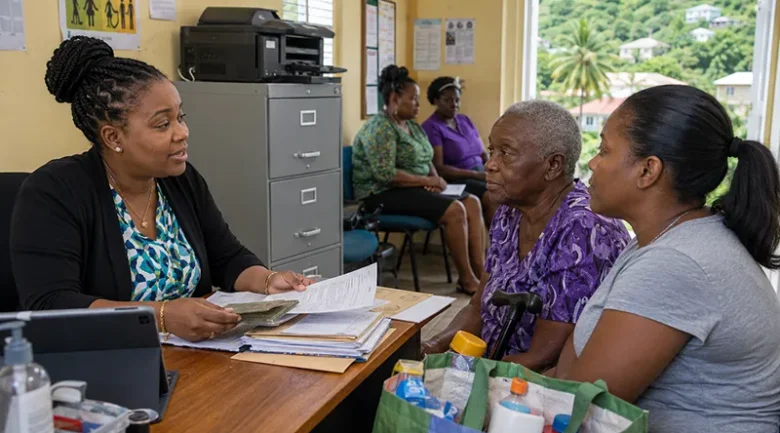
The executive implementation and operational monitoring of non-contributory social protection policy is directed by the Social Welfare Division, a specialised department operating under the Ministry of Health, Wellness and Social Services. To optimise resource distribution across distinct vulnerability sectors, the division’s casework is organised into precise functional branches. The administration of the Public Assistance Programme (PAP), the state’s primary non-contributory vehicle for direct cash transfers to the indigent and elderly, is managed through integrated family and community services frameworks. Field officers within this division execute mandatory, structured home visits to conduct comprehensive socio-economic audits of an applicant’s household dependency ratios and living conditions before monthly fiscal aid is authorised.
Statutory domestic interventions, child welfare tracking, and legal advocacy are centralised under the Child Protection Unit (Police). This specialised unit manages crisis resolution, foster care placements, and court-ordered family mediations. Administrative delivery is decentralised across Dominica’s parishes, placing field-based Welfare Officers directly within remote areas including the indigenous Kalinago Territory and the elevated interior of Saint Joseph parish. This parish-level matrix enables the division to bypass geographic insulation barriers, adapting case-management intervention criteria to the specific economic volatilities characterising rural agricultural and coastal communities.
The Dominica Social Security (DSS)
The Dominica Social Security (DSS) is the largest and most influential component of the national social welfare landscape. As a statutory body, it manages a “pay-as-you-go” contributory fund where both employers and employees contribute a percentage of insurable earnings. This fund provides a range of benefits that act as a primary defence against loss of income.
Contributory Benefit Categories
The DSS provides three main tiers of benefits to its contributors:
- Short-Term Benefits: These include Sickness Benefit for temporary incapacity, Maternity Benefit (including both an allowance for time away from work and a one-time grant), and Funeral Grants to assist families with burial costs.
- Long-Term Benefits (Pensions): The Age Pension is the most significant, providing monthly payments for life once a contributor reaches the retirement age of 65. Other long-term benefits include Invalidity Pensions for those permanently unable to work and Survivor’s Pensions for the dependents of deceased contributors.
- Employment Injury Benefits: This provides coverage for medical expenses and lost wages resulting specifically from workplace accidents or illnesses.
The Non-Contributory Social Pension
Recognising that a significant portion of the older generation worked in the informal agricultural or domestic sectors without making formal contributions, the government introduced the Non-Contributory Social Pension. This welfare intervention provides a monthly stipend to individuals over 70 who do not qualify for a regular DSS pension, ensuring a basic level of dignity for the elderly poor.
Public Assistance and Poverty Alleviation
Non-contributory social assistance, colloquially referred to as “the Welfare,” targets marginalised citizens operating outside the formal economic sector who lack the independent means to sustain themselves. The monthly cash transfers under the Public Assistance Programme (PAP) provide a standardised stipend to low-income geriatric cohorts, severely disabled individuals, and households with high indices of extreme poverty.
To complement direct fiscal transfers, the state administers a structured framework for Emergency and Disaster Relief. Dominica’s extreme vulnerability to catastrophic meteorological events demands an elastic social safety net capable of rapid, macro-scale escalation during national crises. Contemporary crisis interventions are managed via specialised digital electronic vouchers and standardised Emergency Food Baskets. Dispatched by the Social Welfare Division in direct coordination with localised village councils, these decentralised distribution networks bypass physical market and infrastructure failures, preserving baseline nutritional security for vulnerable demographics during severe climate shocks.
The “Yes We Care” Program
One of the most distinct features of social welfare in Dominica is the Yes We Care Programme. Launched as a direct intervention for the indigent elderly and persons with disabilities, this program acknowledges that financial aid alone is often insufficient for those living without family support.
Under this initiative, trained caregivers are employed by the state to visit recipients in their homes. Their responsibilities include personal grooming and hygiene, cleaning the recipient’s living environment, preparing nutritious meals, and monitoring their medical condition. By providing this level of home-based care, the program significantly reduces the burden on the national hospital system and allows the elderly to “age in place” with dignity. Today, the program has been expanded to include more rigorous training for caregivers in geriatric health and emergency response.
Child and Family Welfare Systems
The welfare of children is managed through a combination of protective services and educational support. When a child’s home environment is deemed unsafe, the Social Welfare Division administers Foster Care programs, where vetted foster parents receive a state allowance to provide a stable home for minors. In cases where foster care is not possible, residential facilities like the CHANCE program provide holistic development and psychological support.
To ensure that poverty does not become a barrier to education, the state manages two critical supplementary welfare programs:
- School Feeding Program: This ensures that students in primary schools across the island receive a hot, nutritious meal daily, which has been shown to improve attendance and cognitive performance.
- Education Trust Fund: This fund provides grants for the purchase of school uniforms, textbooks, and transportation costs for secondary school students from low-income households.
Support for Persons with Disabilities
Social welfare for Persons with Disabilities (PWDs) in Dominica is a collaborative effort between the government and non-governmental organisations, such as the Dominica Association of Persons with Disabilities (DAPD). The state provides direct financial aid through the Monthly Cash Transfer for those unable to seek traditional employment.
Furthermore, the government provides annual subsidies to organisations that offer vocational training and assistive devices. The Alpha Centre, which focuses on children with developmental disabilities, receives state support to provide specialised education that would otherwise be unaffordable for many families. Accessibility standards in public buildings have been strengthened as part of the broader social resilience mandate, ensuring that PWDs can access welfare offices and health clinics without physical barriers.
Healthcare as a Welfare Pillar
In Dominica, the primary healthcare system acts as a massive “in-kind” welfare benefit. Healthcare is heavily subsidised, and for many, it is free at the point of delivery.
- Village Health Clinics: With a network of over 50 health centres, basic medical care is accessible in nearly every community.
- Exemptions: Children under 18 and adults over 60 are generally exempt from most fees at public health facilities, including the Dominica China Friendship Hospital.
- Chronic Disease Support: The state provides free or low-cost medication for chronic non-communicable diseases (CNCDs) like hypertension and diabetes, which disproportionately affect the welfare-dependent population.
Non-Governmental and Faith-Based Welfare
The formal state system is supplemented by a long-standing tradition of private and religious philanthropy. The Dominica Infirmary and the Grotto Home for the Homeless are prime examples of “public-private partnerships” in welfare. These residential facilities receive government subsidies but rely heavily on private donations and church-led fundraising to operate.
Organisations like the Dominica Red Cross and the St. Vincent de Paul Society provide crucial “gap-filling” services, such as distributing clothing, providing mobile medical units, and offering temporary housing for the destitute. This civil society layer is essential for reaching individuals who may fall through the cracks of the formal bureaucratic system.
Resilience and Digital Transformation
The most significant change to social welfare in Dominica in recent years is the implementation of the Social Protection Management Information System (SPMIS). This digital platform serves as a centralised database for all welfare recipients across the island.
The SPMIS allows for:
- Adaptive Social Protection: The system can automatically trigger increased payments or emergency vouchers when a specific weather event (such as a Category 3 hurricane) is recorded.
- Efficiency and Accuracy: By using biometric data and unique identifiers, the system reduces “double-dipping” and ensures that aid reaches those who truly meet the indigent criteria.
- Continuity of Care: Because the data is stored in a secure cloud environment, social workers can access recipient records even if a local office is destroyed in a disaster, allowing welfare services to resume immediately.
Current Challenges and Future Outlook
The social welfare system faces several structural pressures. Dominica has one of the highest centenarian rates per capita in the world, which, while a testament to the success of public health, places an increasing financial burden on the DSS and the “Yes We Care” program. The ageing population requires more intensive medical care and longer-term pension payouts.
Additionally, the Brain Drain of young professionals to North America and Europe reduces the contributory base of the Social Security fund. Fiscal sustainability remains a constant concern, as the state must balance high social spending with the need for infrastructure investment. The future of social welfare in Dominica lies in the continued professionalisation of social work, the expansion of mental health support, and the refinement of adaptive social protection models that can withstand the increasing frequency of climate events.


