




Rural Villages in Dominica
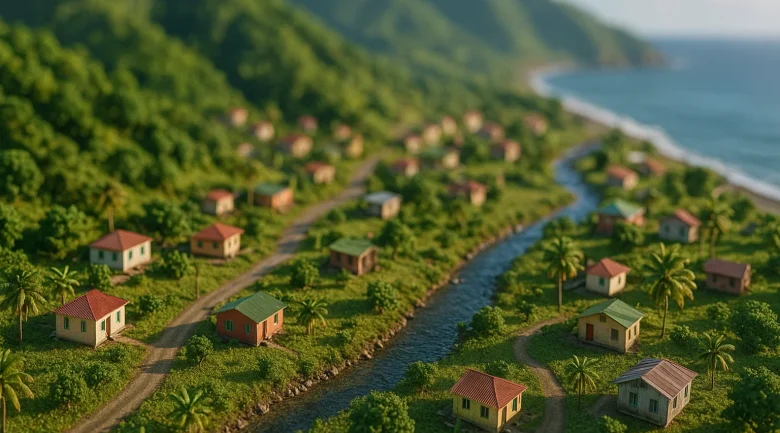
From crop cultivation to community festivals, much of Dominica’s social and economic life can be traced to the influence of rural villages spread across the island’s interior and coastal areas. They span coastal, mid-elevation, and interior zones, often accessible only by narrow roads or trails. Many villages maintain traditional livelihoods, strong social ties, and distinct local identities, while facing challenges such as migration, inadequate infrastructure, and climate vulnerability.
Patterns, Economy, and Community Life
Dominica’s rural settlements fall broadly into coastal villages and interior or mountainous villages. Coastal communities like San Sauveur, Bioche, Soufrière, and Scotts Head rely heavily on fishing, tourism, and export farming. Interior villages such as Laudat, Petit Soufrière, and Morne Rachette rely more heavily on subsistence farming, forest resources, and eco-tourism trails.
Agriculture is foundational: root crops (dasheen, yams), plantains, bananas (especially historically), and fruits remain staples. In coastal areas, small-scale fishing (line, nets) and crafts support household income. Tourism increasingly supplements income: guesthouses, guiding, ecotourism amenities, and access to scenic features (beaches, hiking trails, waterfalls). For example, Rosalie is known for its scenic coast, a famous turtle-watching beach at Rosalie Bay, and is within a mile of a rainforest, as well as the award-winning Rosalie Bay Eco Resort & Spa, which promotes nature tourism.
Cultural life is vibrant: village councils manage local infrastructure, and social events centre on church festivals, music, Creole celebrations, and storytelling. Rural communities preserve Creole traditions, traditional herbal medicine knowledge, and communal resource sharing.
Population drift is common: younger generations migrate to Roseau or overseas for education and jobs, leaving higher proportions of elders in villages. Remittances often sustain local economies, funding housing, schooling, and improvements.
Public services in rural areas include village-level primary schools, occasional health centres or clinics, small public markets, and limited commerce. However, access to secondary schools, hospitals, and specialist services requires travel to district centres. Infrastructure, including roads, bridges, communications, and electrification, varies in quality and is vulnerable to storm damage.
Village Examples
Below are several illustrative rural villages, which you might already have individual pages for or could link to:
- Calibishie: A northeast coastal village in Saint Andrew Parish. Famous for its palm-fringed beaches, rainforest proximity, and namesake “net of reefs” from Kalinago language. Farming and fishing remain the economic mainstays; tourism is growing.
- Grand Bay (South City)/ Berekua: The largest village in Saint Patrick Parish, with ~2,288 people in 2010. Known as a cultural centre (“South City”), it hosts Radio En Ba Mango, local arts, and serves as a hub for neighbouring rural communities.
- Marigot: Largest community in Saint Andrew Parish (pop. ~2,676 in 2001). Home to the Marigot fisheries complex and in proximity to the Douglas-Charles Airport. Settled by Antiguans and Montserratians, the local dialect Kokoy is common.
- Laudat: A cool, misty interior village perched ~1,200 feet above sea level. It is the access point for Boiling Lake, Titou Gorge, and other rainforest attractions. Its terrain and rainfall make it unique among rural villages.
- Petit Soufrière: A remote village in Saint David Parish, upland from the coast on steep slopes. Historically developed by small farmers (not plantations). Relies on subsistence farming and trails for connection.
- Morne Rachette: West coast village in Saint Joseph Parish on the slopes above Coulibistrie. Named after the prickly pear cactus in French, it lies on high terrain overlooking Batalie Bay.
- Dublanc: Situated between Picard and Bioche on the west coast. Population 423 (2001). Many residents farm and fish; local amenities include a primary school, small churches, and basic services.
- Delices: Southeast village between La Plaine and Petite Savanne. It is renowned for its scenic environment, local waterfalls (including Victoria Falls), and its potential for eco-tourism.
- Wotten Waven: A less developed village known for hot springs and healing waters. Featured in travel journalism as a hidden, personality-rich community in southern Dominica.
These examples illustrate the range of environments, economies, and accessibility across rural Dominica.
Challenges & Opportunities
Many rural roads suffer from landslides, washouts, or limited maintenance. Bridges and river crossings can become impassable during heavy rain, isolating communities. Remote villages struggle with internet connectivity, which limits educational and business opportunities.
Health facilities in rural villages are basic; residents must travel for diagnostics, specialist care, and hospital services. Schools often lack secondary grades, forcing youth to travel. Utilities, electricity, clean water, and sanitation are intermittently available in some villages.
Hurricane exposure, erosion, flooding, and landslides pose threats to housing, farmland, and access roads. Climate change amplifies these threats. Some villages are rebuilding with climate resilience in mind.
Agriculture is vulnerable to price fluctuations, pests, and loss of preferential trade. Tourism offers opportunities but often requires external investment, marketing, and infrastructure. Sustainable practices, agro-processing, and value-adding (cocoa, spices, seamoss) are promising but require training and market access.
Rural villages are custodians of Creole, local customs, crafts, and Indigenous knowledge in the Kalinago Territory. Preserving this cultural heritage in the face of migration and modernisation is both a challenge and a strength.
Strategic Priorities & Policy Directions
To support rural village vitality, priorities include:
- Upgrading rural roads, bridges, and digital connectivity.
- Strengthening rural health and education networks to bring essential services closer.
- Encouraging agroecological farming, food security, and value chains for local crops.
- Promoting community-based tourism, support for guesthouses, trails, and cultural experiences.
- Investing in climate-resilient infrastructure (floodproof roads, reinforced homes).
- Supporting village councils, co-operative models, and microfinance to boost local development.
Dominica’s National Resilience Development Strategy 2030 includes measures to support rural infrastructure, disaster risk reduction in villages, and agricultural diversification.


