




1985 General Elections in Dominica
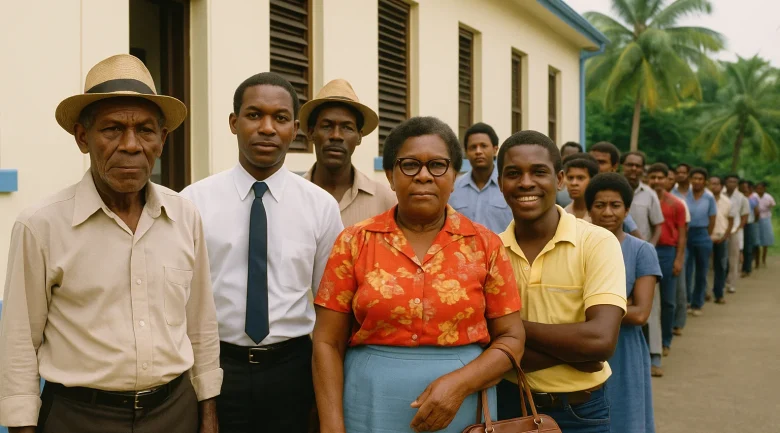
The 1985 General Elections in Dominica were held on July 1, 1985, marking the country’s second general election since independence. Citizens elected 21 members to the House of Assembly, continuing the democratic tradition established in the 1970s. The contest took place amid debates on economic performance, rural development, and government integrity. The ruling Dominica Freedom Party (DFP), led by Dame Mary Eugenia Charles, sought to consolidate the gains of its first term. The main opposition, the Dominica Labour Party (DLP), attempted to reclaim dominance after its 1980 defeat. The election recorded a voter turnout of approximately 74.6%, reflecting steady civic engagement.
Political Context of the 1985 General Elections
By mid-1985, Dominica had largely stabilised following the social turbulence and reconstruction period of the early 1980s. Prime MinisterMary Eugenia Charles led a government that emphasised the rule of law, fiscal restraint, and foreign investment, especially through assistance from Canada, the United States, and regional partners. The DFP’s first term was characterised by the rebuilding of schools, hospitals, and feeder roads destroyed in the May 29th 1979 Uprising and the aftermath of Hurricane David.
The Dominica Labour Party, now under restructured leadership, sought to mobilize rural support by promising renewed investment in agriculture, youth employment, and small business development. Public debate also included the challenges of declining banana prices, emigration of skilled workers, and frustration over limited wage growth in the public sector.
Participating Political Parties and Leaders
Several political entities contested the 1985 elections, though three major forces dominated the political field:
- Dominica Freedom Party (DFP), led by Mary Eugenia Charles, promotes continued stability, fiscal prudence, and modernisation.
- Dominica Labour Party (DLP), emphasising economic redistribution, cooperative farming, and improved labour protections.
- United Dominica Labour Party (UDLP), fielding a smaller slate but attracting attention through populist grassroots rhetoric.
The DFP campaigned under the slogan of integrity and continuity. The DLP appealed to workers’ frustrations and urged a return to the values of social solidarity. The UDLP focused on limited but highly localised contests, particularly in rural northern constituencies.
Election Results Overview
| Party | Votes | % | Seats | Seat Change |
|---|---|---|---|---|
| Dominica Freedom Party (DFP) | 17,327 | 56.8% | 15 | –1 |
| Dominica Labour Party (DLP) | 12,545 | 41.2% | 5 | +4 |
| United Dominica Labour Party (UDLP) | 662 | 2.0% | 1 | +1 |
| Total valid votes | 30,534 | 100% | 21 | |
| Registered voters / turnout | 40,916 / 74.6% |
The Dominica Freedom Party maintained its parliamentary majority, winning 15 of 21 seats and securing a second consecutive term for Prime Minister Eugenia Charles. The Dominica Labour Party improved its standing, capturing five seats, while the United Dominica Labour Party claimed one. The results confirmed the electorate’s preference for continuity but revealed a modest resurgence of the DLP, particularly in central and southern constituencies.
Constituency-Level Results
While detailed constituency-level data is extensive, here is a snapshot of selected constituencies:
These results reflect the widespread support for the DFP across various regions.
Notable Outcomes and Analysis
The 1985 elections represented continuity rather than change. The DFP’s reduced majority indicated the opposition’s recovery, but not enough to unseat the ruling administration. Rural constituencies dependent on agriculture remained strongly loyal to the DFP, reflecting the government’s investment in feeder roads, community centres, and disaster-recovery schemes.
The Dominica Labour Party regained relevance through disciplined organising and renewed messaging under younger leadership, while the UDLP’s single seat demonstrated fragmentation within the broader Labour movement. Eugenia Charles’s reelection as Prime Minister marked the first time in Dominica’s history that a sitting Prime Minister successfully completed a full term and won reelection.
Electoral Integrity and Observations
The Electoral Office reported a smooth voting process, minimal irregularities, and timely ballot counting. International observers from regional organisations described the poll as peaceful and credible. Voter turnout of over 74% reflected strong engagement despite voter fatigue and mid-term economic constraints. Analysts noted that the absence of major disputes reinforced Dominica’s reputation for democratic resilience amid instability elsewhere in the Caribbean.
The 1985 results also highlighted the evolution of political professionalism, better-organised campaigns, clearer manifestos, and enhanced local representation. The DFP’s second term would later influence constitutional debates, economic liberalisation, and foreign investment policy into the 1990s.


