




Artificial Intelligence (AI) in Dominica
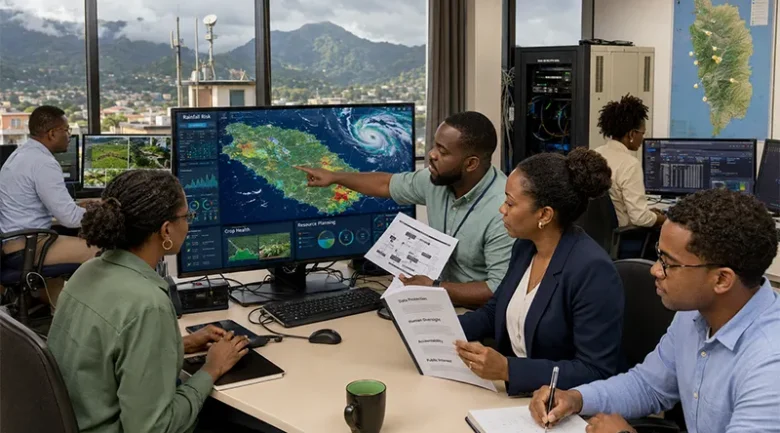
The integration, governance, and application of Artificial Intelligence (AI) in Dominica represent an emerging component of the nation’s broader structural shift toward a digitized economy. Positioned uniquely as a Small Island Developing State (SIDS) facing extreme exposure to climate volatility, the Commonwealth of Dominica has shifted its approach to machine learning, automated data processing, and predictive analytics from speculative concepts to targeted programmatic frameworks.
Currently, the country operates without a single, independent statutory framework or centralized regulatory body dedicated strictly to artificial intelligence (AI). Instead, the deployment of automated systems, data clearing houses, and algorithmic workflows is managed through overlapping policies, primarily administered by the Ministry of Public Works, Public Utilities and the Digital Economy in Roseau. These initiatives are executionally tied to international development programs, most notably the World Bank-funded Caribbean Digital Transformation Project (CARDTP).
Institutional Governance and Strategy Foundations
Rather than crafting isolated digital protocols, the state has integrated advanced computing strategies directly into its macro-level modernization agendas. This structural approach ensures that data tools remain aligned with national infrastructure baselines and regional treaty obligations within the Organisation of Eastern Caribbean States (OECS).
The Ministry Mandate and Digital Policy
The formal architecture for digital transformation is directed by the Ministry of Public Works, Public Utilities and the Digital Economy. The ministry’s mandate includes:
- Building modern public sector data management systems.
- Formulating public-private telecommunications partnerships to improve fiber-optic reliability.
- Translating raw transactional and geographical data into actionable planning parameters.
The foundational policy document guiding this work is the National Digital Transformation Strategy. Developed in partnership with the United Nations Development Programme (UNDP), this strategy establishes an integrated approach divided into three foundational domains: People, Business, and Government.
Within this matrix, AI is positioned as an advanced analytics layer. For instance, once basic data collection is established across public frameworks, machine learning models can be layered on top to optimize the distribution of public resources, forecast fiscal revenue trends, and flag structural operational bottlenecks in real time.
The Caribbean Digital Transformation Project (CARDTP)
The capital required to establish the data infrastructure for advanced computing is largely provided by CARDTP, a US$94 million regional initiative funded by the World Bank. Dominica’s national allocation under this project focuses on upgrading telecommunications infrastructure, implementing nation-wide e-government systems, and training local workers.
The program supports the creation of the National Agricultural Management Information System (NAMIS) and the Health Management Information System (HMIS). These systems serve as centralized data repositories, providing the clean, standardized, and longitudinal datasets necessary to train machine learning algorithms effectively without the risk of severe data fragmentation.
Legislative Status and Data Protection Challenges
A primary operational constraint to deploying Artificial Intelligence in Dominica is the current state of national and regional data privacy legislation. Because AI systems rely on processing vast amounts of data, their use requires robust legal frameworks to ensure transparency, accountability, and the protection of citizen privacy.
Statutory Gaps and Existing E-Commerce Frameworks
Dominica lacks specific statutory laws governing algorithmic accountability, deepfake regulation, or automatic profiling. Instead, automated systems are regulated under foundational e-commerce laws passed by the House of Assembly:
- The Electronic Transactions Act: Provides the legal basis for digital transactions, recognising automated electronic agents as valid mechanisms for contract formation.
- The Electronic Evidence Act: Establishes the conditions under which computer-generated data and digital records are admissible in judicial proceedings, an increasingly critical requirement as automated audit trails become common in corporate and public accounting.
Harmonization of OECS Data Governance
To bridge existing legislative gaps, Dominica works alongside the OECS Commission, the Eastern Caribbean Central Bank (ECCB), and international consultants to draft harmonized data governance frameworks.
This regional effort addresses several critical legal components:
- Cross-Border Data Flows: Establishing secure protocols for sharing analytical models within the Eastern Caribbean without violating national sovereignty.
- Anonymization Mandates: Requiring that public datasets used to train predictive algorithms, particularly in public health and financial tracking, undergo strict anonymisation to prevent the re-identification of individual Dominican citizens.
- Cybersecurity Standards: Aligning national defense systems with regional Computer Incident Response Teams (CIRTs) to safeguard machine learning infrastructure from external network intrusions and data poisoning attacks.
Targeted Sectoral Implementations
The applied deployment of Artificial Intelligence in Dominica is shaped by the island’s physical geography, environmental vulnerabilities, and economic reliance on natural resources. Rather than focusing on heavy industrial automation, local applications target climate adaptation, sustainable agriculture, and ecological preservation.
Climate Resilience and Automated Early Warning Networks
Under its Climate Resilience and Recovery Plan (CRRP), Dominica has committed to building the world’s first fully climate-resilient nation. Advanced computing tools are increasingly critical to this effort, particularly in modelling environmental hazards and managing disaster responses:
Flash-Flood Prediction
By placing automated hydrologic sensors within high-risk water catchments, such as the Roseau, Layou, and multi-branched Caribbean Sea watersheds, real-time flow rates are cross-referenced with atmospheric radar data. Machine learning algorithms analyze these inputs to project downstream surges, automatically alerting disaster management personnel and local communities before physical flooding begins.
Geohazard Assessment
The island’s steep, volcanic topography is highly prone to massive landslides during intense rainfall events. Algorithms train on high-resolution LiDAR scans, satellite imagery, and soil saturation index data to map physical changes in terrain, helping structural engineers avoid high-risk zones when planning new infrastructure.
Climate-Smart Agriculture and Predictive Agri-Analytics
Agriculture remains an economic and social pillar of rural Dominica. The integration of climate-smart techniques and digital tracking offers a strategic path to mitigate crop losses, improve food security, and optimize local supply chains:
Pathogen Detection
To combat destructive regional plant pathologies, Extension officers and local farmers conduct field monitoring to log anomalies. Early-stage detection efforts target widespread threats, such as Black Sigatoka in banana crops or Citrus Greening disease, allowing the Ministry of Agriculture to deploy targeted quarantine protocols and treatments that limit crop losses.
Harvest Yield Forecasting
By integrating historical weather data from local meteorological stations with spatial crop tracking in the National Agricultural Market Information System (NAMIS), predictive tracking helps estimate the seasonal availability of staple root crops like dasheen (taro), yams, and sweet potatoes. This allows the Ministry of Agriculture to forecast market gluts or shortages, stabilising local food pricing and providing precise data to regional export partners.
Ecological Conservation and Sustainable Eco-Tourism
Dominica’s tourism strategy is built on its “Nature Island” brand, prioritising low-impact eco-tourism over mass-market cruise and resort travel. AI applications focus on preserving biodiversity and managing visitor impacts sustainably:
Wildlife Acoustic Monitoring
In partnership with international scientific organisations such as the Caribaea Initiative, the Forestry, Wildlife & Parks Division deploys solar-powered acoustic recording devices across the Morne Diablotin National Park region. Machine learning models analyse these recordings to identify the distinct vocalisations of endangered endemic species, namely the Sisserou Parrot (Amazona imperialis) and the Red-necked Jaco (Amazona arausiaca), providing conservationists with non-disruptive population census data.
Visitor Volume Management
Park authorities actively track tourist traffic patterns along high-density eco-trails, such as the arduous Boiling Lake trail and the Trafalgar Falls site. By monitoring visitation rates alongside trail infrastructure metrics, land management agencies can execute targeted trail maintenance and mitigate environmental degradation to protect fragile rainforest ecosystems from the footprints of overtourism.
Workforce Readiness, Digital Skills, and Labor Logistics
A primary obstacle to expanding Artificial Intelligence in Dominica is the domestic shortage of advanced software engineering talent and specialized data scientists. The government has focused heavily on digital upskilling to ensure the local workforce can participate in a technology-driven global economy.
The “Work Online Dominica” Program
Administered as a collaborative initiative between the Digital Economy Ministry, the UNDP, and IsraAID, Work Online Dominica serves as a vital tool for human capital development. This intensive 12-week training program is specifically designed to transition unemployed and underemployed Dominican citizens into the international remote digital workforce.
The curriculum focuses on building practical digital skills:
- Virtual Assistance and Operations: Training workers to use automated business tools, scheduling algorithms, and digital communication platforms.
- Data Entry and Processing: Preparing data workers to clean, label, and structure unorganised data is a fundamental step for training global machine learning models.
- Digital Content and Strategy: Teaching participants to use generative content tools responsibly to support global e-commerce and marketing tasks.
By early 2025, the program celebrated the graduation of its fifth cohort, which introduced a sustainable peer-to-peer mentoring model where past graduates return to train incoming students. This approach helps build a self-sustaining tech community, providing alternative employment paths that diversify the local economy away from a reliance on seasonal agriculture and traditional tourism.
Academic Integration and Institutional Limitations
At the tertiary level, the Dominica State College (DSC) in Stock Farm offers foundational courses in Information and Communications Technology (ICT) and computer science. However, advanced curricula in machine learning architecture, neural network configuration, and big data engineering are limited by institutional budget constraints and a lack of specialized hardware.
To bypass these limitations, the country relies on regional partnerships with the University of the West Indies (UWI) Open Campus and international scholarships to provide advanced technical training for top-tier Dominican students.
Economic Challenges and the Tech Infrastructure Divide
For Dominica to fully capitalize on data-driven technologies, several structural challenges within its physical and economic infrastructure must be addressed.
The Broadband Connectivity Gap
While urban centres like Roseau and Portsmouth benefit from high-speed fibre-optic connectivity, remote rural villages, particularly along the rugged eastern coast and within parts of the Kalinago Territory, frequently experience lower bandwidth and less reliable internet access. Because modern AI applications rely heavily on cloud computing, uneven internet infrastructure limits the adoption of these technologies among rural smallholders and micro-enterprises. CARDTP’s “last-mile” broadband initiatives are designed to bridge this gap by extending high-speed connectivity to underserved interior and rural communities.
High Capital Costs and Energy Constraints
Deploying local data centers to process large datasets is an energy-intensive and expensive undertaking. Dominica’s current electricity costs, which rely primarily on imported diesel fuel, are among the highest in the Caribbean region.
This financial burden makes the local hosting of advanced computing infrastructure economically impractical. However, the ongoing development of the Geothermal Power Project in the Roseau Valley offers a potential long-term solution. By introducing a reliable source of clean, low-cost baseload electricity, the geothermal project could create the ideal economic conditions to support localised data centres and specialised high-performance computing facilities.
Future Outlook and Policy Recommendations
The future of Artificial Intelligence in Dominica depends on the strategic development of targeted policies that balance technological innovation with ethical protections and risk management. As the country expands its digital infrastructure, establishing clear guidelines for data use will be essential to building public trust and attracting sustainable technology investments.
Priority Policy Objectives
To maximize the benefits of data-driven systems while mitigating associated risks, the following strategic goals are critical:
- Drafting Updated Data Protection Acts: Enacting comprehensive national data protection laws that define clear standards for user consent, data retention, and the fair use of personal information in automated public registries.
- Expanding Technical Training: Incorporating applied data science and basic programming concepts into primary and secondary school curricula to prepare the next generation for a digital workforce.
- Fostering Regional Technology Collaborations: Working closely with OECS neighbors to pool public computing resources, standardizing data definitions across islands to decrease deployment costs and build shared regional resilience.
By focusing on high-impact, practical applications tailored to its ecological and economic realities, Dominica can leverage advanced digital tools to strengthen its climate resilience, improve food security, and create new opportunities for its citizens in the global digital economy.


References
-
1.
AI Governance Caribbean: Country Rankings on Caribbean AI https://www.caribbeanai.org/ai-caribbean-blog/ai-governance-caribbean
-
2.
‘Responsible’ AI soon to be incorporated into CXC standards, say officials https://dominicanewsonline.com/news/homepage/news/responsible-ai-soon-to-be-incorporated-into-cxc-standards-say-officials/
-
3.
Dominica Policy Signals on the AI Assessment Board (AABoard) https://www.aaboard.org/policies/AAB-POLICY-DOMINICA
-
4.
Dominica AI World Metrics https://aiworld.eu/geo/dominica
-
5.
AI Playbook for Dominica: The Nature Isle Goes Digital via Jamaica A https://jamaicaartificialintelligence.org/playbook-dominica.html
-
6.
Artificial Intelligence Expert Training in Roseau Dominica https://unichrone.com/dm/artificial-intelligence-expert-training/roseau