




DHIS2 (District Health Information Software 2) in Dominica
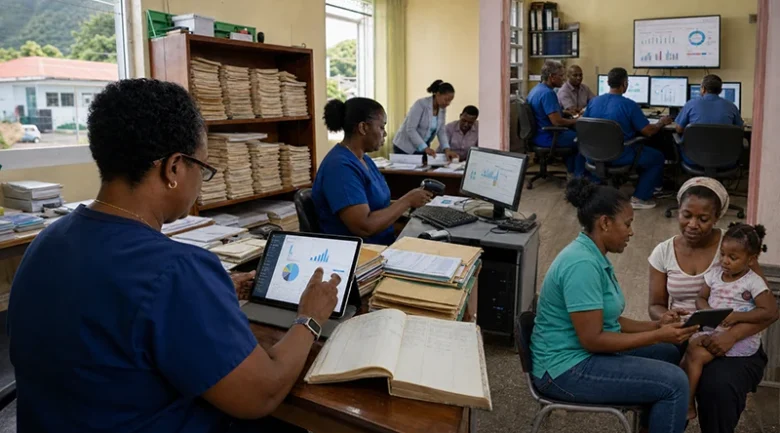
The implementation of DHIS2 (District Health Information Software 2) in Dominica marks a historic departure from the paper-based era of the island’s public health system. For decades, the country managed fragmented health data recorded in physical ledgers that were often as disconnected as the volcanic peaks defining the landscape.
Following the cataclysmic lessons of the 2017 hurricane season and subsequent global health shocks, the Dominica government opted for a sovereign technological path. Instead of purchasing proprietary electronic medical record systems from foreign conglomerates, the state invested in this open-source, flexible platform. It now serves as the digital foundation for national health resilience, tracking approximately 66,205 citizens with unprecedented precision. This transition reflects a commitment to technological sovereignty, ensuring that health information remains a public good managed through localized, resilient digital infrastructure.
Currently, the DHIS2 platform functions as the “National Pulse,” adapted to the specific nuances of a small island developing state (SIDS). A robust legislative framework secures the system’s integrity, specifically the Medical Laboratories Act 2024 and the Medical Profession Act 2026, which mandate that every byte of data is accurate, secure, and legally protected. With 82% of the population using the internet and a statistical performance score of 40.7, the nation is building a digital health ecosystem that thrives in clinical complexity and environmental adversity.
Architectural Philosophy and Technological Sovereignty
The utilisation of DHIS2 in Dominica is rooted in a philosophy of technological sovereignty, prioritising an “Offline-First” logic to accommodate rugged geography. The system operates on a hybrid cloud architecture, mirroring data across local high-security servers and encrypted cloud backups. This ensures that if a storm physically isolates the island, localised servers allow clinics to continue functioning. Reporting timeliness across the health districts reached 94.5% by early 2026, up from a baseline of 78% in 2024.
The platform’s modularity allows for the triangulation of aggregate and individual data. Nurses in remote villages utilise ruggedised tablets to enter patient vitals; these devices store data with military-grade encryption and initiate a “Delta-Sync” when a signal is detected at a Smart Health Centre. This infrastructure is engineered to survive the Atlantic hurricane season, ensuring that the 100% electricity access is achieved. In 2023, that translated into consistent access to life-saving information. The strategic selection of DHIS2 was based on six core advantages:
- Open-Source Adaptability: Modification of source code to include local cultural and demographic identifiers.
- Cost-Efficiency: Redirecting licensing fees toward the hiring of district Data Stewards.
- Global Community: Tapping into a network of 80+ countries for real-time security patches.
- Interoperability: Seamless communication with Laboratory Information Systems (LIS) via standardized APIs.
- Offline Capability: Ensuring continuity of care during landslides or internet outages.
- Scalability: Expansion from HIV and TB tracking to include Non-Communicable Diseases (NCDs) surveillance.
Legislative Guardrails and Data Security
A digital health system is only as trustworthy as the laws protecting it. While the Medical Profession Act 2026 provides the mandate for confidentiality, the implementation of role-based access control (RBAC) is managed within the Health Management Information System (HMIS), which utilizes the DHIS2 platform to unify patient records and disease surveillance.
Furthermore, the Medical Laboratories Act 2024 has professionalised the data. By establishing the Medical Laboratories Council, the act mandates that all labs adhere to ISO 15189 standards, ensuring that diagnostics in Portsmouth maintain the same accuracy as those in Roseau. Under these mandates, every record edit leaves an immutable audit trail, making unauthorised access a criminal offense. The 2024 Act specifically targets Diagnostic Variance through standardised terminology. To maintain trust, current security protocols include:
- Biometric Multi-Factor Authentication: Fingerprint and PIN requirements for all practitioners.
- Mandatory Audit Trails: Legal penalties for unauthorized record viewing under the 2026 Act.
- End-to-End Encryption: Utilisation of AES-256 for data at rest and TLS 1.3 for transit.
- Anonymized Research Tier: Enabling epidemiological study without compromising individual identities.
- Digital Health Passports: Secure, QR-coded summaries for citizen travel and private care.
- Automated Breach Detection: AI monitoring for unusual login patterns or mass data requests.
The DHIS2 Tracker and Individual Patient Journeys
The DHIS2 Tracker module follows the “Individual Journey,” providing a continuum of care essential for the island’s 96% DPT immunization coverage. In maternal health, the system monitors the Maternal Mortality Ratio, which improved to 32.4 per 100,000 in 2026. Each expectant mother is assigned a unique “National Health ID,” supporting a 0.0% transmission rate for mother-to-child HIV and Syphilis, a global benchmark for EMTCT validation.
The Tracker serves as a primary tool against Chronic Non-Communicable Diseases, which account for approximately 75% to 80% of national mortality. The system monitors the “Cascade of Care” for cardiovascular diseases and Diabetes. Since the 2025 rollout of the DOTS-Digital program, the loss-to-follow-up rate for chronic patients decreased to 3.8%. The module tracks six critical clinical milestones:
- Antenatal Booking: Full tracking of maternal vitals and infectious disease status.
- Growth Monitoring: Identifying pediatric obesity trends (currently 59% overweight/obese for those over 15).
- Immunization Schedule: Real-time alerts for missed childhood doses.
- Lab Integration: Automatic result pulling from ISO 15189 compliant facilities.
- Referral Tracking: Ensuring specialist continuity from rural clinics to the DCFH.
- Treatment Compliance: Monitoring pharmaceutical pick-up rates.
Climate-Health Resilience and Predictive Epidemiology
The DHIS2 implementation is unique due to its integration with Geographic Information Systems (GIS) and meteorological data. Recognising that environmental factors influence local health, the 2025 “Climate-Health Resilience Initiative” enables predictive modelling. By overlaying rainfall data with syndromic fever clusters, the system predicts Leptospirosis outbreaks up to 10 days in advance.
The system monitors the heat index to protect elderly citizens. “Heat Alerts” generated by DHIS2 are routed to district nurses in high-risk coastal zones, facilitating proactive home visits. This data-driven prophylaxis is a cornerstone of the 2030 Health Resilience Roadmap. The GIS and Climate module currently monitors six variables:
- Temperature (Maximum/Minimum): Identifying heatwave thresholds.
- Relative Humidity: Determining the “feels like” Heat Index for automated alerts.
- Precipitation (Rainfall): Predicting spikes in vector-borne diseases like Dengue.
- Aerosol Optical Depth (Saharan Dust): Warnings for patients with asthma and respiratory conditions.
- Wind Speed/Direction: Modeling the dispersal of airborne pollutants.
- Vegetation Indices (NDVI): Assessing environmental changes impacting disease habitats.
Human-Digital Interface and Professional Empowerment
A critical component of this framework is the focus on the human-digital interface. The Medical Profession Act 2026 reconstituted the Medical Board into the Dominica Medical Council, which mandates “Digital Health Literacy” for licensed practitioners. The system automates routine reporting, allowing District Health Teams to focus on patient counselling. If the DHIS2 dashboard indicates that 38.8% of women in a parish are affected by obesity, nurses can launch community-specific interventions under the National Nutrition Policy 2022–2032. This policy also tracks the impact of sugar-sweetened beverage (SSB) taxes. The human-centred design focuses on:
- Reduced Paperwork: Automation of Monthly Statistical Reports for the National Epidemiology Unit.
- Clinical Decision Support: Immediate alerts for dangerous vital sign thresholds.
- Digital Health Scouts: Utilizing volunteers to feed basic wellness data into the system.
- Nurse-Led Research: Enabling practitioners to track clinical success rates.
- Patient Engagement: Sharing digital charts to foster collaborative care.
- Peer-to-Peer Support: Integrated Tele-Health consults via the DHIS2 platform.
Strategic Roadmap and Universal Integration
The final pillar of the digital strategy is the push toward a Universal Patient Record (UPR). While the public sector is digitised, the 2026–2030 phase involves bridging the gap with the private sector. The roadmap includes integrating private pharmacies and laboratories to ensure the National Health ID is a comprehensive record of well-being.
Dominica is also a regional leader within the OECS, sharing its DHIS2 configuration and legislative templates to help build a regional Syndromic Surveillance network. With population growth at -0.5%, a portable digital health identity is viewed as a matter of national security. Strategic milestones for 2030 include:
- Private Sector Bridge: Standardized APIs for private clinic data integration.
- Pharmacy Inventory Linkage: Real-time tracking to prevent pharmaceutical “stock-outs.”
- Genomic Data Tiers: Storing localized genetic markers for hereditary Caribbean conditions.
- Regional Data Sharing: Real-time outbreak tracking across the Eastern Caribbean.
- Patient Portal 2.0: A citizen-owned app for viewing lab results and appointments.
- AI Policy Making: Using “Big Data” to optimize the construction of future Resilience Health Centres.
The Breath of a Digital Nation
Our collective safety rests on community dedication supported by legislative strength. By embracing digital innovation, Dominica’s health framework creates an enduring shield, protecting Dominica through effort. By moving beyond the fragmented, paper-based systems of the past, the nation has constructed a biological firewall that is both transparent and highly accountable. The successful implementation of the National Immunisation Registry and the strict enforcement of the Medical Profession Act 2026 have restored public confidence, ensuring that the progress made since the 1970s is never eroded by misinformation or logistical failures.
Ultimately, the invisible architecture of immunity that now blankets the island is the most significant legacy of its modern health reforms, guaranteeing that future generations will grow up in a land where the historical terrors of Yellow Fever and Polio are nothing more than distant memories recorded in the archives of a resilient people.


References
-
1.
The History of HISP https://dhis2.org/hisp-history/
- 2.
-
3.
The DHIS2 Open Source Software Platform: Evolution Over Time and Space https://www.researchgate.net/publication/316619278_The_DHIS2_Open_Source_Software_Platform_Evolution_Over_Time_and_Space
-
4.
Digital Transformation Project Launches Health Management & Information System (HM&IS) for Dominica https://pressroom.oecs.int/digital-transformation-project-launches-health-management--information-system-hmis-for-dominica
-
5.
PAHO continues to support Dominica in Digital Health Surveillance https://www.paho.org/en/news/25-8-2025-paho-continues-support-dominica-digital-health-surveillance
-
6.
PAHO/WHO and Dominica advance health sector priorities with new cooperation strategy and laboratory strengthening efforts https://www.paho.org/en/news/11-2-2026-pahowho-and-dominica-advance-health-sector-priorities-new-cooperation-strategy-and
-
7.
National Digital Health Transformation Strategy https://www.unicef.org/lebanon/media/13696/file/Digital%20health%20transformation%20strategy%20EN.pdf
-
8.
Health Management and Information System (HMIS) Implementation in Dominica https://digitaldominica.wordpress.com/2025/07/08/health-management-and-information-system-hmis-implementation-in-dominica/