




Telemedicine in Dominica
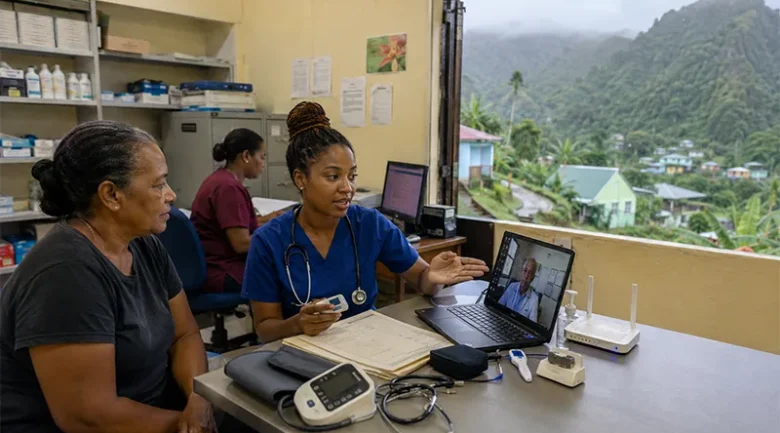
In the Commonwealth of Dominica, telemedicine and remote healthcare delivery are rapidly expanding and a fundamental component of the public healthcare system. The integration of telehealth services is explicitly designed to bridge geographical barriers, connecting patients residing in rural health districts to specialised medical practitioners stationed at the central tertiary hospitals. The comprehensive transition toward a digitized healthcare framework is primarily driven by extensive, state-led infrastructural overhauls, which are heavily supported by international financial institutions, working alongside targeted, innovative private-sector direct health models. As a small island developing state with mountainous terrain that can complicate physical travel during extreme weather events, the establishment of a robust digital health ecosystem is viewed as a critical pillar of national climate resilience and public health security.
The Strategic Imperative for Digital Health
Historically, the management of patient data and the coordination of clinical care across the island relied almost entirely on decentralized, paper-based administrative systems. This traditional framework frequently resulted in fragmented patient histories, logistical delays in the transfer of physical medical records between community clinics and central hospitals, and significant administrative burdens on healthcare professionals. Furthermore, the vulnerability of physical documents to catastrophic weather events underscored the urgent necessity for a sovereign, secure, and geographically resilient digital health infrastructure. Recognising these profound structural limitations, government authorities and regional healthcare planners initiated a comprehensive modernisation strategy to overhaul the technological foundations of the medical sector.
Currently, the concept of telemedicine in this jurisdiction extends far beyond simple video consultations between a doctor and a patient. It encompasses a highly integrated digital ecosystem that includes the electronic management of medical records, automated epidemiological surveillance, digital prescription tracking, and real-time clinical interoperability. This holistic approach ensures that a patient receiving initial triage at a rural primary care facility can have their diagnostic data instantaneously reviewed by a specialized consultant located in the capital, thereby drastically reducing the time required to initiate critical therapeutic interventions.
The Caribbean Digital Transformation Project (CARDTP)
The modernization of the public health technological infrastructure is heavily anchored by the Caribbean Digital Transformation Project. The Caribbean Digital Transformation Project is a US$ 28 million project financed by the World Bank Group. This ambitious initiative was implemented by the Government of Dominica due to the recognition of the critical role that digital technologies and solutions play in strengthening the island’s and its inhabitants’ climate resilience. The project also emphasizes the profound importance of integration with the global digital economy.
To establish the physical backbone required for high-definition telemedicine and uninterrupted data transfer, the government engaged in a strategic partnership with Digicel. This partnership is designed to connect all government service locations, including government offices, schools, hospitals, and health centres, to high-speed connectivity delivered via modern fibre-optic networks. Recognising the island’s susceptibility to natural disasters, the network is intentionally designed to provide multiple layers of redundant connectivity. This critical redundancy includes underground and overhead fibre cables, microwave transmission systems, and satellite uplinks deployed at key locations. Furthermore, the overarching government connectivity project includes the development of a highly secure primary data center to host the government cloud and associated applications, as well as a completely separate secondary location to serve as a fail-safe backup site.
Institutional Infrastructure
The most significant clinical manifestation of the national digital transformation strategy is the formal launch of the Health Management & Information System (HMIS). This comprehensive software platform is actively revolutionising the way healthcare services are managed, tracked, and delivered across the entire island. The HMIS acts as the central digital hub for healthcare in the nation, bringing together the three primary hospitals and over fifty individual health centres under a single, secure digital umbrella. By ensuring that every part of the decentralised medical network works in harmony, the system is designed to deliver vastly improved outcomes for both patients and clinical providers.
Clinical Modules and Patient-Centric Features
The architecture of the HMIS has been thoughtfully designed to streamline civilian interactions with the healthcare system, make them more convenient, and ensure greater responsiveness to urgent needs. The platform incorporates several core modules that fundamentally alter the patient experience:
- Patient Registration: The system aims to eliminate long administrative lines at physical clinics. Whether it is for a routine outpatient consultation or an emergency hospital admission, registering is now simple and fast, and can be completed directly from a patient’s personal device at any time.
- Appointment Booking: The platform allows citizens to manage their healthcare scheduling autonomously. Patients possess the ability to securely book, view, or reschedule their medical appointments online, receiving immediate, real-time confirmation of their clinical slots.
- Admission Management: Recognizing that every second matters during critical medical emergencies, the HMIS incorporates protocols that ensure significantly faster inpatient admissions. This efficiency guarantees that trauma patients or those experiencing acute medical crises receive direct care when it matters most, bypassing traditional bureaucratic delays.
- Prescription Management: The pharmacological distribution chain has been entirely digitized. Medications prescribed by physicians are now tracked and managed electronically across the network, profoundly minimizing dispensing errors, preventing adverse drug interactions, and heavily improving overall patient safety.
- Digital Health Records: Perhaps the most critical feature is the establishment of universal electronic health histories. Patients can access their medical history anytime and anywhere, while their highly sensitive clinical information is securely stored and easily shared with authorized medical providers to support coordinated, multi-disciplinary care.
Empowering Healthcare Professionals and Administrators
Beyond improving civilian access, the HMIS is fundamentally transforming the operational environment for medical practitioners. Doctors, specialist nurses, and hospital administrators now possess immediate access to real-time clinical data, enabling vastly superior diagnostic decisions and the formulation of highly effective, evidence-based treatment plans. The system actively automates numerous routine administrative tasks, meaning providers experience less paperwork and can dedicate significantly more time to direct patient care.
At the macroeconomic and epidemiological levels, healthcare leaders and Ministry officials can utilise the system’s powerful analytics engines to track widespread disease trends, monitor localised outbreaks, allocate financial and physical resources effectively, and improve long-term service delivery. The network’s profound interoperability ensures that providers across the island can seamlessly share critical diagnostic imaging and laboratory results. This ensures continuity of care regardless of where a patient physically travels within the national borders. Ultimately, the HMIS enforces consistent clinical standards and drastically reduces human error, successfully raising the overall baseline quality of public healthcare.
Private Sector Telemedicine and Direct Primary Care
Parallel to the massive structural investments made by the state, the private medical sector has rapidly adapted to shifting consumer demands by offering highly independent, agile telemedicine solutions. These private models are specifically designed to provide immediate, unrestricted access to general practitioners without the bureaucratic friction commonly associated with public wards.
The Direct Primary Care Model: Pitons Health
A leading example of private-sector innovation in this space is Pitons Health, a medical practice that operates a Direct Primary Care (DPC) model. Direct Primary Care is characterised as a revolutionary healthcare model that fundamentally places the patient and their doctor back in direct control of complex healthcare decisions. The facility circumvents the traditional complexities of medical insurance pathways by completely removing the insurance middleman. Instead, patients maintain a direct financial and clinical relationship with their healthcare provider.
This operational model utilizes a simple, transparent monthly membership fee with no hidden costs, surprise clinical bills, copays, or complex deductibles. Historically, the clinic offered a regular enrollment fee of $200 ECD, alongside highly transparent ongoing monthly pricing. Through this membership, individuals gain unlimited primary care services that can be accessed in person, or remotely by phone, text, or secure video chat. This guarantees exceptional convenience and direct availability. The practice ensures that members do not suffer from long delays, offering same or next-day appointments and even executing house calls when medically necessary.
The clinical operations at Pitons Health are overseen by professionals such as Dr. Litonya Honore, who received medical training at the All Saints University School of Medicine and the Dominica China Friendship Hospital. The practice is certified by the Caribbean Association of Medical Councils. The remote and in-person services cover a broad spectrum of medical needs, including urgent care for minor injuries, wound care, and management of acute illnesses. Furthermore, the telemedicine platform provides vital ongoing support for complex mental health requirements, continuous medication management, specialist referral coordination, and dedicated chronic disease care focusing on women’s health, men’s health, and healthy ageing.
Corporate Insurance Integration and Claims Processing
The widespread adoption of telemedicine has compelled major regional medical insurance conglomerates to formally integrate digital health consultations into their rigid coverage frameworks and reimbursement algorithms. This shift represents a significant maturation of the digital health economy, legitimizing remote care as a financially viable alternative to traditional in-office visits.
Sagicor’s Telemedicine Programme
Sagicor, a prominent regional insurer, formally announced that it honors claims specifically related to telemedicine. The corporation strictly defines telemedicine as the practice of remote consultations conducted by verified medical practitioners who actively utilize clinical solutions supported by technology. To facilitate this, the insurer launched a phased programme designed to make modern healthcare significantly more convenient and accessible for its corporate and individual clients.
To maintain quality assurance and prevent billing fraud, the programme initially involves a specific, vetted pool of local health and medical providers who have been formally onboarded to offer reimbursable telemedicine services. The specialized network includes practitioners covering various disciplines, such as internal medicine (Dr. Portia Meade), gynecology (Dr. Curvin Ferreira), general practice (Dr. Victor Emanuel, Dr. Samuel Christian), neonatology and child care (Dr. Seannel David), functional medicine (Dr. Alisha Honore-Felix), ophthalmology (Dr. Benet Henry), and psychology (Shoyea-Gaye Grant-Massicotte).
The administrative guidelines governing these remote interactions are stringent. A verified telemedicine consultation is treated similarly to a standard office visit for policy limits, meaning the same guidelines that govern the legal contract with the insured individual strictly apply. However, because the interaction is entirely remote, patients cannot utilize traditional physical payment infrastructure. The CariCare card requires a swipe on a machine at the provider’s office; therefore, patients cannot use it for remote sessions.
Instead, the financial protocol dictates that payments must be made in full directly to the clinical provider before any medical services are formally received. The medical provider determines the acceptable payment option, which typically involves a secure credit card transaction or a direct electronic bank transfer. Following the remote consultation via telephone or videoconference, the physician generates an official e-receipt, which must explicitly include the terminology “Telemedicine services”. The physician then emails a validated claim form alongside the e-receipt to the insured patient. The patient completes the required member section of the documentation and submits all supporting electronic files to Sagicor for final financial reimbursement.
Regulatory Environment, Data Sovereignty, and Regional Integration
The rapid expansion of both public and private digital health platforms requires a robust, modernised legislative environment to protect extremely sensitive civilian medical data. Uniquely and securely identifying residents through a modernised digital ID is considered fundamental to enable seamless access to digital services across both the public and private sectors. Because the historical ID ecosystem was fragmented, comprehensive legal and regulatory reforms across key areas of the digital economy are a top priority.
These enabling environment improvements are recognised as a critical first step toward removing administrative roadblocks and improving the widespread adoption of digital health services among private individuals and commercial businesses. To support the improved management of digital risks, structural projects actively bolster national cybersecurity policy, technological capacity, and long-term planning tools within the region. This ensures that malicious actors cannot compromise the integrity of the centralised health management databases.
Furthermore, the modernisation of telehealth is deeply guided by broader regional strategies to create highly resilient, patient-centred health systems across the entire Caribbean basin. Projects like CARDTP aim to foster deep regional integration and cooperation to capture the vital economies of scale required to create a more competitive, seamless regional digital market. The deployment of core infrastructure and platforms prepares the government for far deeper interconnectivity and the seamless interoperability of data and information systems across international borders. This strategic interoperability is designed to smooth the complex administration of regional medical trade, immigration health checks, and cross-border continuity of care, ensuring that citizens retain secure access to their health profiles whether they are consulting a local physician or a specialist in a neighbouring territory.
Through global development teams, forward-thinking state rules, and flexible private companies, telemedicine has shifted from a concept into a vital medical resource. It highlights the country’s drive to use digital tools to keep citizens safe and healthy. This network securely transmits patient information across borders, ensuring your vaccination records, lab test results, and health summaries remain fully accessible whenever you travel or transfer to expert hospitals across the Caribbean.


