

Vaccination in Dominica
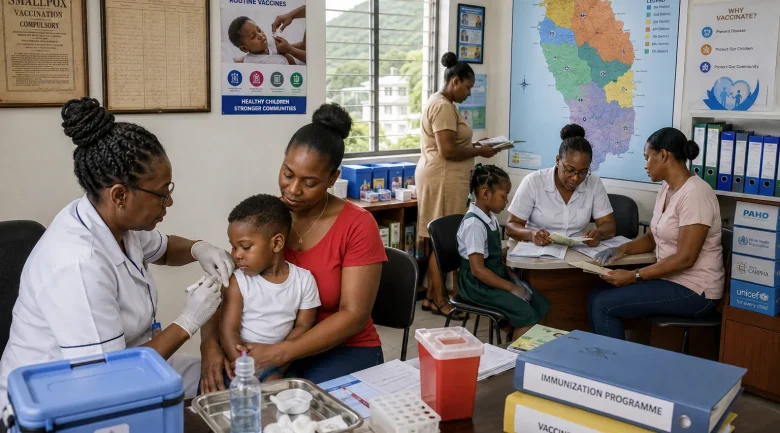
Vaccination in Dominica has a long history, beginning with compulsory smallpox vaccination under colonial law and later shifting to a modern, primary healthcare-based Expanded Programme on Immunisation. The legal record shows a legacy smallpox-focused Compulsory Vaccination Act originally enacted in 1922 and later consolidated in 1991, while later education rules required proof of age-appropriate immunization for school or early-childhood entry. The modern programme sits inside a seven-district public health system and has been shaped by regional institutions, especially the Ministry of Health, Wellness and Social Services, the Pan American Health Organization (PAHO), the World Health Organization, the Caribbean Public Health Agency, and UNICEF.
The Colonial Crucible: Early Vaccination Efforts (1760–1950)
Tracing Dominica’s immunisation journey from coercive, colonial-era smallpox control to a modern public health infrastructure, highlighting how major historical milestones and environmental crises shaped the nation’s routine healthcare delivery system.
Early Smallpox Control and Dr. James Clark (1790s–1800s)
Long before the formal establishment of a Ministry of Health, vaccination in Dominica was a matter of survival for the colonial military and the enslaved workforce. The most significant early threat was Smallpox (Variola major). In the late 1700s, the concept of “variolation”, the deliberate infection of a person with smallpox material to induce a milder case, was practised with varying degrees of success and high risk.
The turning point came with the work of Dr. James Clark, a prominent British physician in Dominica in the 1790s. Dr. Clark’s records indicate that during the smallpox epidemics of 1793–1796, mortality rates among the unimmunized were staggering, often exceeding 30%. When Edward Jenner’s cowpox vaccine became available in the early 19th century, Dominica was among the early Caribbean adopters, recognising that a healthy workforce was essential for the plantation economy. However, these early efforts were fragmented, often restricted to the urban centre of Roseau and to military outposts such as Fort Shirley, leaving the rural and Kalinago populations largely vulnerable.
The Compulsory Vaccination Act of 1922
The earliest clearly documented vaccination law specific to Dominica is the Compulsory Vaccination Act, whose authorized version identifies Act 1 of 1922, later amended in 1932, 1933, 1939, and 1990 and consolidated in 1991. It empowered the minister to declare compulsory vaccination areas, required parents to take children for vaccination within months of birth, created registration and certification procedures, authorized repeated penalties for non-compliance, and barred unvaccinated children in those areas from school attendance. The law was explicitly about smallpox vaccination; it also allowed compulsory adult vaccination in the event of a smallpox outbreak. That matters historically because it shows that vaccination in Dominica began as a coercive, outbreak-oriented, smallpox-centred public health measure, not as the broader life-course immunization system seen today.
The Modern EPI Era, Disease Elimination
The modern era emerged through the regional Expanded Programme on Immunization and Dominica’s district primary healthcare model. PAHO’s 2007 country profile described a country divided into seven health districts grouped into two administrative regions, with 44 Type I clinics and one Type III health centre per district. In that same profile, Dominica’s immunisation programme was described as an established public health function, and by the early 2000s it had already moved from a smallpox-and-school-entry model to broad protection against childhood vaccine-preventable diseases. PAHO also reported that Dominica’s immunization programme was comprehensively evaluated in 2004 and that a five-year plan was developed.
The measles-rubella elimination period was especially important. PAHO’s 2007 profile reports that, as part of the regional rubella-elimination effort, 21,172 persons aged 12–35 years received MMR in 2000, representing 94.1% of the target population, and that 99.2% of children aged 1–5 years received a second MMR dose. Later CARICOM/PAHO reporting for Dominica stated that there had been no confirmed measles cases since 1990, no congenital rubella syndrome since 1994, and no rubella since 2000. A minor historical inconsistency remains: PAHO’s 2007 profile says the last measles case was in 1991, while the 2016 Caribbean EPI report says there had been no confirmed measles since 1990. The safest reading is that endemic measles disappeared in Dominica around 1990–1991, but the exact last-case year should be treated as a source discrepancy.
By the mid-2000s, Dominica had incorporated combination vaccines and was operating at very high routine coverage. PAHO recorded 2005 coverage at 98% for BCG, 98% for OPV3, 98% for DPT, and 100% for MMR. The 2012 Health in the Americas profile later reported 99.4% DPT3 coverage and 100% MMR coverage in 2009. A 2016 Caribbean EPI report showed that MMR1 coverage during 2012–2015 ranged from 94% to 99% and MMR2 from 89% to 94%, with 2015 values reported as 97% and 95% respectively. The same report noted a rapid house-to-house coverage monitoring exercise in all seven health districts in 2015: 886 eligible houses were visited, 821 households or children were fully immunized, and 6% had not completed MMR but were later vaccinated. This period marks the high-water line of Dominica’s documented routine immunization performance.
Hurricane Maria and the Post-COVID Strain
Hurricane Maria was then a turning point. In October 2017, PAHO reported that all vaccines in Dominica had been lost because power outages interrupted the cold chain, and that support was being mobilised to replace the vaccines and repair the chain. WHO/UNICEF estimates show the immediate programmatic impact: DTP3 and Pol3 both dropped from 99% in 2016 to 91% in 2017, while MCV1 fell from 96% to 77% and MCV2 from 92% to 81%. HepB birth-dose performance was particularly weak around the same time: WHO/UNICEF estimated 23% in 2017 and attached an explanatory note referencing stockout conditions after Hurricane Maria. Dominica did recover substantially by 2019, but the hurricane exposed the dependence of island immunization systems on electricity, transport, storage, and rapid procurement support.
The next inflection came with HPV and then COVID-19. Dominica introduced HPV vaccine in 2019, and PAHO later described the launch as highly successful, with introductory coverage of roughly 92% of adolescents. COVID-19 vaccination began in 2021, first with AstraZeneca/Oxford and later with other products, as documented in official and near-official sources. Yet the pandemic also damaged routine confidence. By 2024, Dominica’s EPI manager told PAHO that the country had once enjoyed decades of 95% or higher coverage across antigens, but that negative publicity after COVID had contributed to a steep decline, bringing 2022 coverage into the 80–88% range. The historical arc is therefore not linear progress; it is progress, disruption, recovery, then renewed strain.
The timeline below brings those milestones together. It uses only dates that were either explicit in official sources or clearly documented in a regional report; where an exact year could not be verified, the report flags that uncertainty in the tables and text rather than guessing.
The Birth of the Expanded Programme on Immunisation (EPI)
The modern era of vaccination in Dominica truly began in the mid-1970s. Following the 1974 World Health Assembly resolution to launch the Expanded Programme on Immunisation (EPI) globally, Dominica, with the support of the Pan American Health Organization and the World Health Organization (WHO), began formalising its national schedule.
Prior to the 1970s, pediatric immunisation in Dominica was limited primarily to the BCG and Smallpox vaccines. The implementation of the Expanded Programme on Immunization (EPI) in 1977 standardized the country’s vaccination schedule, systematically targeting six primary pathologies: Diphtheria, Pertussis, Tetanus, Measles, Poliomyelitis, and Tuberculosis. Backed by UNICEF, the Ministry constructed a specialised “Cold Chain” infrastructure. This network utilises automated refrigeration units to maintain a static temperature range of 2°C to 8°C from the point of entry at Douglas-Charles Airport to decentralised primary care networks like the Grand Fond Health Centre.
The foundational pillars of the Dominican EPI are built upon six critical organizational and strategic partnerships:
- Ministry of Health, Wellness, and Social Services: The central authority responsible for procurement, distribution, and the training of the island’s 52 health district teams.
- Pan American Health Organization (PAHO): Providing technical expertise, the Revolving Fund for vaccine procurement, and standardized guidelines for Caribbean-specific disease threats.
- UNICEF: Supporting the physical infrastructure of the cold chain and community outreach programs focused on pediatric health.
- World Health Organization (WHO): Setting global benchmarks for vaccine safety, efficacy, and the validation of disease elimination (such as the 1994 certification of the Americas as Polio-free).
- Caribbean Public Health Agency (CARPHA): Serving as the regional laboratory hub for testing and verifying vaccine-preventable disease outbreaks.
- The Gavi Alliance: Assisting with the financing and introduction of new and underused vaccines, such as the HPV and Rotavirus vaccines, in the 21st century.
The Evolution of the Vaccine Portfolio
As medical science advanced, so did the complexity and efficacy of the vaccines available to Dominicans. The portfolio has shifted from single-antigen shots to sophisticated multivalent formulations that reduce the injection burden on infants.
In the 1980s and 90s, the primary focus was on the Triple Vaccine (DPT) and the Oral Polio Vaccine (OPV). Dominica celebrated a historic milestone in 1982, when the last cases of locally transmitted Polio were recorded in the region. By the early 2000s, the Ministry of Health introduced the Pentavalent vaccine, which combined DPT with Hepatitis B and Haemophilus influenzae type b (Hib). This was a revolutionary step, as Hib was a leading cause of bacterial meningitis and pneumonia in Dominican children.
The most recent leap occurred in January 2026, when Dominica officially transitioned to the Hexavalent (6-in-1) vaccine. This formulation adds the Inactivated Polio Vaccine (IPV) into the single shot, providing protection against six major diseases simultaneously. Additionally, the introduction of the 20-valent Pneumococcal Conjugate Vaccine (PCV-20) in late 2025 has provided the broadest coverage yet against the strains of pneumonia most common in the Eastern Caribbean. This constant evolution is tracked with precision; the National Immunisation Registry currently shows that the adoption of multivalent vaccines has improved second and third-dose compliance by approximately 18% compared to the 2010 baseline.
Vaccines and schedule change
The 2020 PAHO EPI country report gives the clearest official picture of Dominica’s infant and child schedule in the sources retrieved. It shows BCG from birth through the first year if needed, pediatric hepatitis B at birth, DTP-Hib-HepB at 2, 4, and 6 months, IPV at 2 months, OPV at 4 and 6 months plus boosters at 18 months, 3 years, and 10–12 years, MMR at 12 and 18 months, DTP boosters at 18 months and 3 years, and Td at 10–12 years. PAHO’s later brochures for Dominica show a broader life-course structure that includes pregnant women, health workers, adults, and older persons, especially for influenza and COVID-19, and note that pregnant women may receive vaccines such as influenza, tetanus, pertussis, hepatitis B, and COVID-19 after consultation with providers.
A practical way to read schedule change in Dominica is by vaccine generation. The first generation was the classic EPI package already in place by the 1980s and early 1990s: BCG, DTP, polio, and measles/MMR. The second generation came with MMR2 and catch-up rubella elimination activities in 2000–2001. The third generation arrived in 2006 with Hib, HepB, and pentavalent vaccine. The fourth generation was the polio endgame transition, with IPV introduced in September 2015 and fully rolled out in 2016, followed later by a second IPV dose in 2021. The fifth generation was adolescent and adult life-course expansion: HPV in 2019 and COVID-19 vaccination from 2021 onward.
| Vaccine or vaccine group | Earliest documented national introduction in retrieved official sources | Schedule or formulation documented in retrieved official sources | Key note |
|---|---|---|---|
| BCG | Exact introduction year not verified | Birth through first year if missed | Longstanding routine vaccine; exact start date not found in retrieved public sources. |
| DTP / OPV | Exact introduction year not verified | DTP boosters at 18 months and 3 years; OPV at 4 and 6 months plus 18 months, 3 years, and 10–12 years in 2020 profile | Clearly in routine use long before 2020; exact introduction year not confirmed. |
| MMR1 | 1989 | 12 months | Measles control and later elimination strategy. |
| MMR2 | 2001 | 18 months | Earlier second-dose scheduling was a regional elimination priority. |
| Hib | 2006 | Via combination vaccine at 2, 4, 6 months | Introduced with pentavalent expansion. |
| HepB | 2006 | Birth dose plus infant combination series | HepB birth dose later became a monitored regional EMTCT-plus indicator. |
| Pentavalent | 2006 | DTP-Hib-HepB at 2, 4, 6 months | Combination vaccine reduced injections and aligned infant visits. |
| IPV | September 2015 introduction; full rollout 2016 | At least one dose in 2015–2016; 2-month dose shown in 2020 schedule | Part of the regional polio endgame. |
| IPV2 | 2021 | Second IPV dose introduced in 2021 | WHO/UNICEF note documents the change. |
| HPV | 2019 | Adolescent programme; exact national age wording in retrieved official schedule not fully visible | PAHO described introductory coverage of about 92% of adolescents. |
| COVID-19 vaccines | 2021 | Life-course use in adults and risk groups; boosters from late 2021 | First COVAX delivery was AstraZeneca; official sources reviewed clearly also document Pfizer and Sinopharm in later use. |
| Influenza | Introduction year not specified in retrieved official country report | Included in later life-course brochures for children, pregnant women, adults, health workers, older adults | In use, but exact start year not visible in retrieved sources. |
| PCV, rotavirus, Tdap, yellow fever | Public introduction year not verified | Not clearly shown as routine childhood doses in the retrieved Dominica-specific schedule pages | Official country report left introduction year blank; status should be treated as not fully verified from the sources reviewed. |
Legislative Guardrails: The Acts of 2024 and 2026
The clinical success of vaccination across Dominica is fundamentally inseparable from the modern laws built to protect it. Today, the administration of vaccines is a highly regulated safeguard for public safety. The Medical Laboratories Act 2024 and the Medical Profession Act 2026 work hand in hand, serving as the hidden operating system that ensures the island’s biological security.
The Medical Laboratories Act 2024 completely modernised the diagnostic side of local medicine. Before any public immunization drive can be safely monitored, the Ministry of Health must ensure that local labs can flawlessly track down and identify invading pathogens. Under this law, all labs, whether public hospital facilities or private clinics, must pursue ISO 15189 accreditation. This baseline means that when a technician tests a child’s blood for Measles antibodies or Polio immunity, the results are scientifically flawless, providing critical data when the island had to verify its measles-free status during regional outbreaks.
Meanwhile, the Medical Profession Act 2026 focuses on the healthcare workers themselves. Overseen by the newly empowered Dominica Medical Council, the law ensures that every professional updating a patient’s permanent digital health card is fully licensed and vetted, thereby eliminating the threat of fraudulent data entries. Crucially, the law mandates that all frontline vaccinators, from village health visitors to urban paediatricians, complete annual Continuing Medical Education (CME) specifically covering vaccine safety and Adverse Events Following Immunisation (AEFI). This legal rigour has restored deep public trust, ensuring the country’s medical shield remains unbroken even after severe hurricane disruptions.
Digital Transformation: The NIR
In the decade following Hurricane Maria (2017), which destroyed countless paper-based “Yellow Books,” Dominica committed to a total digital transformation of its health data. Today, the National Immunisation Registry (NIR) is the Digital Vault of the nation’s health. Integrated into the DHIS2 (District Health Information Software 2) Tracker, the NIR follows a citizen from birth to senior citizenship, ensuring a “Life-Course” approach to immunisation.
The NIR is not a passive database; it is an active surveillance tool. When a child is born at the Dominica China Friendship Hospital (DCFH), they are immediately assigned a unique Health ID linked to the NIR. As they receive their BCG and first dose of Hexavalent, the data is pushed in real-time to the central server. If a parent misses an appointment at a rural health centre in Marigot or St. Joseph, the system automatically generates a “Defaulter Alert.” The district nurse receives this alert on a ruggedised tablet, allowing for a targeted home visit within 48 hours. This proactive system is why Dominica’s “Loss to Follow-up” rate has plummeted from 15% in 2019 to less than 4% in early 2026.
The NIR and DHIS2 infrastructure in Dominica is characterized by six innovative technical features:
- Offline-Sync Capability: Allowing nurses in deep valleys with poor cellular reception to enter data that syncs automatically once they reach a “Smart Health Center.”
- Biometric Authentication: Ensuring that only authorized medical personnel can access or edit sensitive immunization history.
- vax.dominica.gov.dm Portal: A secure, citizen-facing website where parents can download QR-coded vaccine certificates for school entry or travel.
- Cold Chain Telemetry: Digital sensors in every vaccine refrigerator across the 52 health centers that send real-time temperature alerts to the NIR dashboard.
- Automated SMS Reminders: Reducing no-show rates by sending parents a text message 48 hours before their child’s next scheduled dose.
- GIS Outbreak Mapping: Overlaying immunisation coverage data with geographic heatmaps to identify “Immunity gaps in specific neighbourhoods before an outbreak can occur.
The NCD-Immunisation Nexus
The Ministry of Health, Wellness and Social Services has recognised that targeted vaccination is a critical asset in mitigating the island’s high burden of non-communicable diseases (NCDs). Patients presenting with diabetes mellitus (exhibiting an adult prevalence of roughly 12.9%) or chronic hypertension face significantly elevated risks of severe complications from vaccine-preventable respiratory pathogens such as influenza and Streptococcus pneumoniae. To address this vulnerability, the national EPI framework has been expanded to incorporate a dedicated High-Risk Chronic Module.
Under these new national health guidelines, clinicians actively review a patient’s vaccine history during every routine, quarterly checkup. The results on the ground have been life-saving: the introduction of the advanced PCV-20 vaccine for diabetic patients over fifty has triggered a remarkable 24% drop in emergency respiratory admissions at the Dominica China Friendship Hospital. This seamless integration of care has helped stabilize the island’s total annual mortality at roughly 776 deaths, shielding an aging population from sudden crises. By protecting chronic patients from dangerous secondary infections, Dominica’s health centers can safely focus their daily energy and resources on managing foundational wellness.
Challenges and Resilience: Lessons from Maria and COVID-19
The operational resilience of Dominica’s contemporary immunization infrastructure is a direct consequence of systemic adaptations forced by two major twenty-first-century shocks: Hurricane Maria in 2017 and the COVID-19 pandemic. The 2017 hurricane season demonstrated that traditional paper record-keeping models constitute a severe logistical liability in a climate-vulnerable state. When cyclonic winds compromised the structural integrity of primary health clinics, decades of localised physical immunisation histories were destroyed by water exposure. This infrastructure trauma accelerated the national transition toward decentralised, cloud-based digital health architectures.
The COVID-19 pandemic subsequently served as an intensive stress test for the island’s cold chain logistics and public communication channels. The Ministry successfully deployed a diversified vaccine portfolio, distributing Oxford-AstraZeneca via the COVAX mechanism, Sinopharm through bilateral cooperation, and Pfizer-BioNTech via regional allocations. To counter vaccine hesitancy and combat digital misinformation, the public health sector launched a targeted community outreach initiative. Trained in accordance with national primary care guidelines, community health personnel utilise data from the integrated digital immunisation registry to identify under-vaccinated households and deliver localised, face-to-face clinical education. This community-driven intervention had successfully increased COVID-19 booster coverage among vulnerable elderly populations to a benchmark exceeding 85%.
Current Status: Vaccination Week in the Americas
During the final week of April 2026, the Commonwealth of Dominica conducted its national Vaccination Week in the Americas (VWA) campaign, a coordinated regional framework designed by PAHO to eliminate immunity gaps stemming from historical healthcare delivery disruptions. The strategic priority for the 2026 intervention focused on the “Big Catch-Up” protocol, following comprehensive database audits that identified approximately 1,200 pediatric patients nationwide who were missing at least one critical dose of their primary vaccine series.
To execute this targeted outreach, the Ministry of Health, Wellness and Social Services deployed mobile primary care clinics to traverse isolated geographic sectors, specifically targeting underserved populations in the Kalinago Territory and the northern mountain heights. The primary epidemiological target was to secure a 95% coverage benchmark for the Measles, Mumps, and Rubella (MMR) vaccine, a priority heightened by a resurgence of measles vectors across the wider Latin American and Caribbean region.
Ministry metrics compiled at the close of the intensive late-April push confirmed that the mobile campaign successfully intercepted, cataloged, and vaccinated 450 of the targeted 1,200 defaulters, demonstrating the operational efficacy of integrating real-time digital registries into active field interventions. By expanding operations directly into remote agricultural and indigenous zones, the primary care infrastructure effectively reduced transport barriers for marginalized families. This data-driven intervention ensures that localized immunologic defense rings are structurally reinforced against cross-border vector re-introduction, securing national health borders through decentralized clinical equity.
Summary of the National Immunisation Profile (2026 Data)
The following table summarizes the current state of vaccination in Dominica, reflecting the integration of historical success and modern legislative/technical standards.
| Metric | Status / Value (Mid 2026) | Legislative/Technical Basis |
| National Coverage (All Antigens) | 90% | EPI Standard / NIR Tracking |
| Measles (MMR-2) Coverage | 89% (Priority Alert) | Medical Laboratories Act 2024 |
| Hexavalent (6-in-1) Adoption | 100% of New Infants | 2026 National Health Policy |
| PCV-20 Senior Coverage | 62% | NCD-Resilience Initiative |
| Digital Integration | 100% of Health Districts | DHIS2 / NIR / CARDTP |
| Legal Compliance Rate | 98% of Practitioners | Medical Profession Act 2026 |
| Cold Chain Integrity | 99.8% Uptime | Digital Telemetry / Backup Solar |
Future Roadmap: Toward the 2030 Universal Record
As Dominica advances toward the end of the decade, the strategic roadmap for national immunisation focuses on universal system integration. While the public healthcare sector operates on an advanced, digitally robust, and legally robust architecture, establishing a unified public-private information bridge represents the next operational milestone. By 2028, the Ministry aims to integrate 100% of private pediatric practitioners and commercial pharmacies into the centralised health database. This synchronisation ensures that a private vaccination administered at an urban clinic in Roseau is instantly visible to a district health visitor in Castle Bruce, thereby systematically eliminating the risk of over-vaccination and missed dosing intervals.
Looking even further ahead, Dominica is taking its place on the cutting edge of global medicine by participating in regional pilots for genomic surveillance. By weaving advanced DNA-tier tracking into the national digital health registry, health officials hope to uncover exactly how specific genetic markers unique to the Dominican population respond to next-generation vaccine platforms, such as revolutionary mRNA-based seasonal flu or dengue shots. This level of incredible precision is the ultimate goal for the country: an elite healthcare system that doesn’t just treat the masses but protects the individual child through the combined power of data, law, and biological science.
Future-Proofing National Immunity
The paradigm of vaccine delivery across Dominica serves as an empirical model, proving that population scale does not limit national public health outcomes when public-private partnerships are coupled with decisive technological modernisation. From the rough, early days of historic inoculations to the high-tech, ISO-certified, and DHIS2-tracked system of 2026, Dominica has successfully built an unbreakable sanctuary of community immunity.
The life-saving doses delivered daily across the island’s primary health centres and village clinics are far more than mere medicine; they are the heart of a “Biological Dominica.” They represent a sacred, unspoken agreement between the state and the citizen that wellness is a shared treasure, a collective armour legally reinforced by the Medical Laboratories Act 2024 and the Medical Profession Act 2026. As long as the national digital registries pulse with real-time tracking data, and dedicated district nurses continue to cross the island’s legendary 365 rivers to reach every remote valley, Dominica will stand tall as a global leader in the fight against disease, proving to the world that the iconic Nature Island is also a brilliant Digital Island of health.


References
-
1.
Immunization workforce in Dominica strengthened during Vaccination Week in the Americas https://www.paho.org/en/news/4-5-2026-immunization-workforce-dominica-strengthened-during-vaccination-week-americas
-
2.
Dominica: WHO Ami UNICEF Estimates of Immunization Coverage: 2023 Revision https://cdn.who.int/media/docs/default-source/country-profiles/immunization/2024-country-profiles/immunization-2024-dma.pdf
-
3.
PAHO Regional Tri-Fold Brochure Document for Dominica https://www.paho.org/sites/default/files/2024-03/paho-brochure-trifold-eng-dominica-print2024.pdf
-
4.
Dominica: WHO and UNICEF Estimates of Immunization Coverage: 2014 Revision https://data.unicef.org/wp-content/uploads/2016/04/dominica.pdf
-
5.
Dominica Laws Compulsory Vaccination Act https://www.dominica.gov.dm/laws/chapters/chap40-04.pdf
-
6.
CDC Dominica Entry Guidelines https://wwwnc.cdc.gov/travel/destinations/traveler/none/dominica
-
7.
The Implementation of Dominica’s Electronic Immunization Registry https://www.paho.org/en/stories/implementation-dominicas-electronic-immunization-registry
-
8.
The Ministry of Health encouraged parents to embrace vaccinations as Dominica observes Vaccination Week http://www.q95da.com/news/the-ministry-of-health-encouraged-parents-to-embrace-vaccinations-as-dominica-observes-vaccination-week-of-the-americas-from-april-25-to-may-2-under-the-theme-your-decision-makes-a-difference
-
9.
Community Policing Initiative promotes vaccination awareness in Tete Morne and Montin https://dominicanewsonline.com/news/homepage/homepage-carousel/community-policing-initiative-promotes-vaccination-awareness-in-tete-morne-and-montin/
-
10.
Caribbean Ministers of Health commit to strengthening national immunization programmes through Declaration of Nassau https://dominicanewsonline.com/news/homepage/press-release-caribbean-ministers-of-health-commit-to-strengthening-national-immunization-programmes-through-declaration-of-nassau/
-
11.
Ministry of Health Emphasizes Immunization https://dominicanewsonline.com/news/homepage/news/health/ministry-of-health-emphasizes-immunization/
-
12.
Region Leads Global Vaccination Rate, Say WHO/PAHO Statistics https://dominicanewsonline.com/news/homepage/homepage-carousel/region-leads-global-vaccination-statistics/
-
13.
Public Called upon to Take Responsibility in Getting Vaccinated https://news.gov.dm/news/news-items/public-called-upon-to-take-responsibility-in-getting-vaccinated