




Traffic Accidents in Dominica
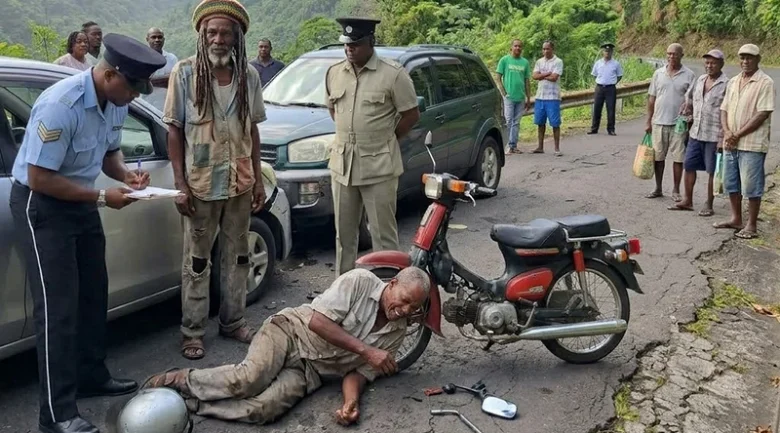
Traffic accidents pose a unique challenge in Dominica, driven by the island’s dramatic volcanic topography and a legislative framework currently undergoing a massive overhaul. Road safety has moved to the forefront of national discourse following a series of high-profile fatalities and the release of a landmark national safety report.
Driving in Dominica has always been an exercise in technical skill and heightened awareness. Known as the Nature Island, the nation’s geography features towering volcanic peaks, 365 rivers, and deep, lush ravines. While this creates a stunning landscape, it also results in a road network that is arguably among the most challenging in the Caribbean.
The Macro-Trend: 4 Decades of Vehicular Expansion
To understand the current state of traffic accidents, we must analyse the Vehicular Density Shift. In the 1980s, Dominica’s roads were largely the domain of the height of the banana industry. Transport was functional, slow, and limited. Most accidents during this period were related to mechanical failure, specifically brake fade on heavy Bedford trucks navigating the Imperial Road.
However, the late 1990s and early 2000s brought a pivotal shift: the liberalized import of Japanese reconditioned vehicles. This period saw a 400% increase in private car ownership. The infrastructure, still rooted in 19th-century bridle paths that had been roughly paved over, was never designed for the volume or the speed of modern internal combustion engines. This Infrastructure-Speed Gap led to a decade (2000–2010) during which fatalities spiked, not because the roads were worse, but because the vehicles were faster than the roads could safely accommodate.
The Legislative Backbone: The Vehicles and Road Traffic Act
The primary piece of legislation governing safety is the Vehicles and Road Traffic Act (Chapter 46:50). This act has seen numerous amendments to keep pace with modern challenges.
Licensing and Registration
Under Dominica law, driving is a privilege, not a right.
- Classes of Licenses: There are distinct classes (A, B, C) ranging from motorcycles to heavy equipment. To obtain a license in 2026, one must pass both a written theory exam and a rigorous practical test on the island’s steep hills.
- Fitness Requirements: For commercial and elderly drivers, periodic medical certificates are mandatory to ensure they are physically capable of handling the demanding terrain.
The Hard Laws: Speeding and DUI
- Speed Limits: Unlike many countries with 60-70 mph highways, Dominica’s limits are much lower, typically 20 mph in villages and 40 mph on highways. Exceeding these limits, especially in Roseau, is a major focus of traffic police.
- Drunk Driving: For decades, drinking and driving was culturally overlooked. This changed with the recent formalisation of legal blood-alcohol limits and the rollout of handheld breathalyser units for the Commonwealth of Dominica Police Force (CDPF).
Modern Safety Amendments
Mobile Phones: Handheld phone use while driving is strictly prohibited, carrying significant fines.
Seatbelts: Mandatory for drivers and front-seat passengers.
Helmets: The Motorcycle Helmet and Child Restraint Safety Act (2025/2026 enforcement) finally closed a long-standing loophole, mandating helmets for both the operator and the pillion passenger.
Charges, Prevention, and the Hidden Costs of Accidents
When an accident occurs in Dominica, the legal machinery moves into Charge Classification. Understanding these nuances is vital for insurance and liability.
The judicial system in Dominica treats traffic violations with increasing severity to deter repeat offenders.
| Offence | Typical Penalty (2026 Estimate) | Legal Consequence |
| Careless Driving | $500 – $1,500 Fine | Points on License |
| Dangerous Driving | $2,000+ Fine / Imprisonment | Mandatory Suspension |
| DUI (First Offence) | $3,000 Fine | 12-month Disqualification |
| No Insurance | $1,000 – $5,000 Fine | Vehicle Impoundment |
| Manslaughter (Traffic) | Prison Sentence | Permanent Disqualification |
The Role of the Magistrate’s Court
Most traffic offences are dealt with in the Magistrate’s Court. In 2026, the court has taken a zero tolerance stance on offences involving public service vehicles (buses and taxis), as these drivers carry the responsibility of national transport safety.
Careless vs. Dangerous Driving
Under Section 54 and 55 of the Act:
- Careless Driving: Defined as driving without due care and attention. This is the most common charge for fender benders or sliding off the road due to rain. The prevention focus here is on education and better tyre standards.
- Dangerous Driving: This carries a much higher burden of proof and significantly harsher penalties, including mandatory license disqualification. It often involves wanton disregard for others’ safety, such as overtaking at a blind corner in the Layou Valley.
Prevention through Black Spot Management
The government now uses GIS (Geographic Information Systems) to map Black Spots, areas where accidents occur with statistical regularity. By identifying these zones, such as the Antrim/Cochrane intersection or the Canefield Industrial stretch, authorities can implement Low-Cost, High-Impact interventions.
| Intervention Type | Purpose | Impact Level |
| Rumble Strips | Speed reduction in village zones | High (30% reduction) |
| Reflective Cat-Eyes | Nighttime visibility on unlit mountain passes | Critical for tourists |
| Concrete Bounding | Preventing vehicles from plunging into ravines | Life-saving |
The “Resilient Road” Engineering Strategy
Under the NRDS 2030, Dominica has moved away from asphalt-based road construction in favour of high-grade concrete. This is a deliberate safety choice. Asphalt bleeds in high heat and loses friction in heavy tropical downpours. Concrete, while more expensive to install, provides a consistent friction coefficient, which is essential for emergency braking on the island’s 20-degree inclines.
Furthermore, the introduction of standardised guardrails has been the single greatest contributor to reducing fatalities over the last five years. In the 1990s, a run-off-road event in the interior often resulted in a 200-foot drop. Today, the hardened roadsides act as a physical buffer, containing the accident to the shoulder.
Enforcement and the New Zero Tolerance Policy
Law enforcement in today’s environment has transitioned from stationary checkpoints to Intelligence-Led Patrols. The CDPF now utilises:
- Mobile Radar Units: Strategically placed on the E.O. Leblanc Highway to curb the speeding culture that emerged after the road was modernised.
- Digital Tint Meters: Enforcement of the Motor Vehicle (Tinted Windows) Regulations is strict, as excessive tinting is a primary factor in pedestrian-related accidents at dusk.
- PVI (Periodic Vehicle Inspections): Unlike the hand-waving inspections of the past, current inspections require automated brake testing and suspension analysis, recognising that a vehicle is only as safe as its ability to stop on a wet hill.
The Future: Electric Vehicles and New Risks
As Dominica pushes toward its Green Resilience goals, the influx of Electric Vehicles (EVs) presents a new safety challenge. EVs are significantly heavier than their internal combustion engine counterparts due to the weight of their batteries, and they are virtually silent.
- Pedestrian Risk: The lack of engine noise contributes to vulnerable road user accidents in high-pedestrian areas like Roseau.
- Braking Dynamics: The regenerative braking systems of EVs require a different driving style on steep declines like Horseback Ridge, necessitating updated driver education programs.


References
-
1.
Global Road Safety Facility (GRSF) Dominica Profile https://www.globalroadsafetyfacility.org/country/dominica
-
2.
WHO Road Safety 2023 Dominica Data Sheet https://cdn.who.int/media/docs/default-source/country-profiles/road-safety/road-safety-2023-dma.pdf
-
3.
National Road Safety Reports for the Commonwealth of Dominica https://dominicanewsonline.com/news/wp-content/uploads/2025/12/accident-report-pdf-1-draft-.pdf