




Electric Vehicles (EVs) in Dominica
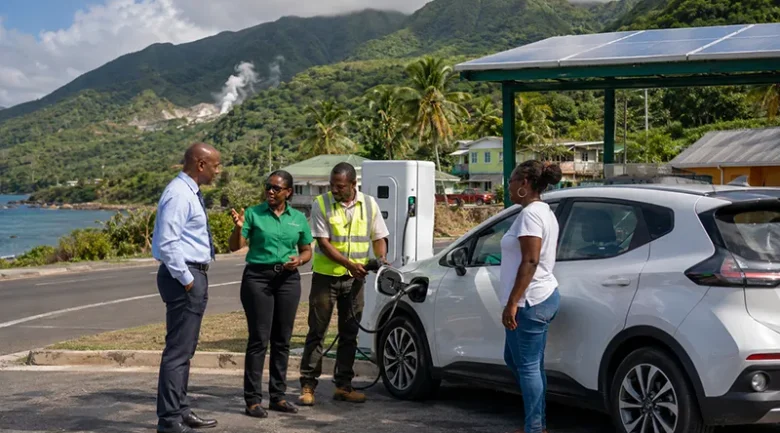
Electric Vehicles in Dominica represent a key component of the island nation’s statutory transition toward climate resilience and energy sovereignty. Strategically guided by the Climate Resilience and Recovery Plan and the country’s National Determined Contributions under the Paris Agreement, the deployment of electric vehicles (EVs) aims to systematically decarbonise the domestic transport sector. As a Small Island Developing State (SIDS) historically dependent on volatile, imported foreign petroleum products, Dominica views transport electrification not merely as an environmental choice, but as an economic safeguard to reduce its significant annual mineral fuel import bills, which totalled approximately $52.26 million USD in 2023.
The mainstream adoption of the technology is structurally tied to the simultaneous development of the island’s domestic grid utilities, moving consumption from imported diesel toward 100% home-grown renewable baseline generation. To support this transition, the government has integrated transport electrification into national investment policies, utilising targeted tax exemptions to attract private capital and encourage local adoption.
The Strategic Nexus: EVs and Geothermal Baseline
The long-term viability of electric vehicles in Dominica is uniquely linked to the development of the national electricity grid. A common critique of island-based EV adoption is that charging batteries on an isolated network simply shifts fossil fuel combustion from a vehicle’s tailpipe to a centralized diesel power station. To prevent this “diesel-charging” loop, the Government of Dominica has positioned transport electrification as the primary demand-side partner for its major utility projects in the Roseau Valley.
The cornerstone of this transition is the multi-megawatt geothermal power plant facility in Laudat. Operated in conjunction with the island’s three existing run-of-the-river hydropower installations managed by Dominica Electricity Services Limited (DOMLEC), geothermal expansion will provide an uninterrupted, zero-carbon baseline power supply. By shifting the vehicle charging load to geothermal and hydro assets, Dominica can transform every kilometre driven by an EV into a utilisation of domestic natural resources. This dynamic protects the state’s foreign exchange reserves and shields local consumers from global oil market shocks.
Historical Milestones and Corporate Proof of Concept
The operational history of electric propulsion on the island began significantly earlier than contemporary national policy frameworks:
- The 2015 Pilot: Dominica’s very first highway-legal electric car was formally introduced on November 6, 2015, by DOMLEC at its primary corporate depot in Fond Cole. The vehicle, a first-generation Nissan Leaf, was sourced from regional distribution networks in Barbados for $122,439 XCD. It was selected due to its market popularity and its safety rankings with the U.S. National Highway Traffic Safety Administration (NHTSA).
- Technical Evaluation: Equipped with an 80 kW electric motor generating 107 horsepower and powered by a 24 kWh lithium-ion battery, this initial vehicle provided DOMLEC engineers with critical local data. Testing monitored battery degradation in tropical humidity and evaluated the efficacy of regenerative braking systems during descents from steep mountain communities like Cochrane. The car’s power-saving mode yielded up to 84 miles on a full charge, demonstrating that commuter-length EV operations were fully achievable within the island’s geographic dimensions.
Fiscal Incentives and Statutory Import Frameworks
To accelerate the transition from internal combustion engine (ICE) vehicles to electric models, the Parliament of Dominica enacted aggressive fiscal adjustments within the national budget. Announced by the executive during the 2019/2020 National Budget address, effective October 1, 2019, the state reduced the import duty and Value Added Tax (VAT) on electric vehicles to zero percent.
These exemptions apply systematically across specific Harmonized System (HS) customs codes to prevent administrative ambiguity:
- HS 8702.40: Fully electric buses and multi-passenger transport vehicles.
- HS 8703.80: Fully electric cars and standard passenger vehicles.
- HS 8711.60.90: Fully electric motorcycles, scooters, and light mopeds.
These exemptions apply to standard private imports as well as high-end eco-hospitality operations, such as the luxury villa transport fleets utilised at resorts like Secret Bay. By removing the import duty and the standard 15% VAT, the state has significantly reduced the upfront cost premium typically associated with purchasing new battery-electric platforms. This policy environment has allowed regional clean-energy firms, such as Megapower Ltd, to establish distribution channels that import right-hand-drive electric models directly into the Dominican automotive market.
Topographical and Infrastructural Challenges
Despite robust fiscal support, the widespread adoption of electric mobility across Dominica faces several structural, geographic, and market-based hurdles:
- Topographical Strain and Range Estimation: Dominica’s road network features steep volcanic inclines, narrow mountain passes, and winding coastal routes. Climbing elevations like the Imperial Highway or roads traversing the central interior demand sustained high-kilowatt power draws from EV batteries. While regenerative braking helps recapture energy when driving down to coastal settlements, real-world driving ranges drop faster under these conditions than on flat urban terrain.
- Public Charging Deficits: The majority of active EV owners rely exclusively on slow, Level 2 overnight residential AC charging terminals. The establishment of a nationwide, publicly accessible DC fast-charging network remains in its infancy, requiring investments along major transit arteries like the Edward Oliver Leblanc Highway and the Dr. Nicholas Liverpool Highway to alleviate range anxiety for long-distance commuters and commercial operators.
- Technical Maintenance Gaps: The local automotive service market remains overwhelmingly optimized for legacy gasoline and diesel powertrains. Servicing advanced electric drivetrains, high-voltage battery management systems (BMS), and specialized thermal cooling loops requires diagnostic equipment and specialized technical knowledge. To bridge this gap, national educational bodies are exploring technical training collaborations to update the curriculum for local mechanics and automotive students.
Future Projections: The Fleet First Strategy
As the island moves closer to its 2030 climate goals, energy experts and policy advocates inside Dominica favour a structured “Fleet First” adoption plan. This approach acknowledges that, while private passenger car turnover takes significant time due to high vehicle acquisition costs, the quickest national economic payoff comes from targeting high-mileage, public-facing transport assets that burn the most fuel daily.
The strategy calls for prioritizing the immediate electrification of:
- Urban and rural taxi associations operating in Roseau and Portsmouth.
- Government service and ministerial fleets.
- Car rental companies catering to eco-tourists.
- Commercial delivery vehicles and public transit buses.
By transitioning high-frequency fleet operators first, the state can maximize immediate fuel import savings, lower urban air pollution, and generate the critical mass necessary to incentivize private investments in public fast-charging points and dedicated EV maintenance facilities nationwide.


References
-
1.
Government says it will allow the importation of electric vehicles into Dominica duty free from October 1, 2019 http://www.q95da.com/news/government-says-it-will-allow-the-importation-of-electric-vehicles-into-dominica-duty-free-from-october-1-2019-to-reduce-carbon-emissions-from-vehicles-using-fossil-fuel
-
2.
2021 Energy Report Card – The Commonwealth of Dominica https://cekh.ccreee.org/wp-content/uploads/2023/08/ERC_Dominica_final_002.pdf
-
3.
Low Carbon Transport Dominica https://www.greenclimate.fund/document/low-carbon-transport-dominica
-
4.
We just imported more ICE vehicles, now let’s electrify Dominica faster—not slower https://dominicanewsonline.com/news/homepage/homepage-carousel/commentary-we-just-imported-more-ice-vehicles-now-lets-electrify-dominica-faster-not-slower/
-
5.
COMMENTARY (edited version): Our love affair with EVs (electric vehicles) https://dominicanewsonline.com/news/homepage/features/commentary/commentary-our-love-affair-with-evs-electric-vehicles/
-
6.
Dominica gets first electric vehicle https://newenergyevents.com/dominica-gets-first-electric-vehicle/
-
7.
Chinese Electric Midi-Buses Coming to Dominica https://dominicanewsonline.com/news/homepage/news/chinese-electric-midi-buses-coming-to-dominica/