


Mosquitofish
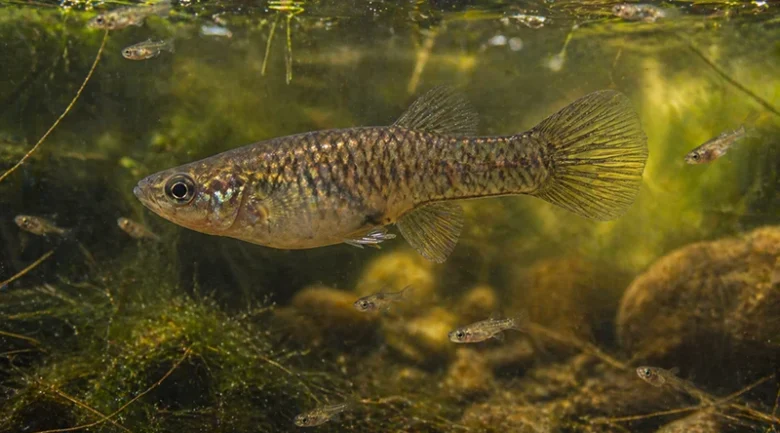
The mosquitofish (Gambusia affinis) is a resilient, freshwater fish found throughout the Commonwealth of Dominica. Known for its exceptional ability to survive in low-oxygen and stagnant environments, it was widely introduced to the island as a biological control agent. While it serves a critical administrative role in public health, it is also a fixture of local childhood nostalgia, particularly in late-20th-century urban and suburban communities.
Biological Profile and Dimensions
The mosquitofish is a member of the Poeciliidae family, making it a close relative of the common guppy. Unlike many native Dominican river fish, the mosquitofish is a live-bearer, which contributes to its high population density in isolated water bodies.
- Physical Appearance: They possess a robust, slightly compressed body with an upturned mouth specialized for surface feeding. Their coloration is a muted olive-grey or silver, providing camouflage in the silty gutters and ponds of Dominica.
- Dimensions:
- Females: Can reach lengths of up to 7 cm. They are noticeably more “pot-bellied” due to their reproductive cycle.
- Males: Smaller and more slender, typically measuring between 3 cm and 4 cm. They are distinguished by the gonopodium, a specialized anal fin used for internal fertilization.
- Breeding: They are ovoviviparous; eggs hatch internally, and the female gives birth to fully formed, free-swimming fry. A single female can produce multiple broods per year, each consisting of 40 to 100 young per cycle.
Cultural and Social History (1980s – 1990s)
During the 1980s and 1990s, the mosquitofish became a ubiquitous presence in the expanding residential areas of Dominica.
- Habitat and Prevalence: They were commonly found in the concrete gutters, drainage systems, and ornamental ponds of housing developments such as Bath Estate, Canefield, and Pottersville. In Bath Estate, the network of roadside drains provided a continuous habitat where these fish thrived in the slow-moving water.
- Childhood Pets: It was common for children during this era to catch mosquitofish from local gutters or small ponds with improvised nets or their hands.
- Makeshift Aquariums: Captured fish were often kept in repurposed glass bottles or jars filled with tap water. These makeshift aquariums served as a primary point of introduction to biology for many Dominican children. Because of their hardiness, the fish could survive in these small containers with minimal aeration, though they were often eventually returned to the gutters or kept as temporary household pets.
Role in Dengue Prevention
The primary administrative purpose of the mosquitofish in Dominica is the suppression of the Aedes aegypti mosquito, the vector for Dengue fever, Zika, and Chikungunya.
- Larvivorous Diet: The mosquitofish is highly efficient at predating on mosquito larvae (wrigglers) and pupae. A single fish can consume its own body weight in larvae daily, effectively clearing a water container of potential mosquitoes.
- Vector Control Strategy: The Environmental Health Unit historically encouraged the placement of these fish in large water storage drums, cisterns, and abandoned swimming pools. This biological method is preferred over chemical larvicides in many instances because the fish population is self-sustaining and provides year-round protection.
- Urban Sanitation: In areas like Roseau and its environs, the presence of mosquitofish in the drainage system acts as a natural first line of defense, preventing gutters from becoming mass breeding sites for disease-carrying insects.


References
-
1.
Species: Gambusia affinis, Mosquitofish, Western Mosquitofish https://biogeodb.stri.si.edu/caribbean/en/thefishes/species/3274
- 2.