

Maroon Chief Gorée Greg
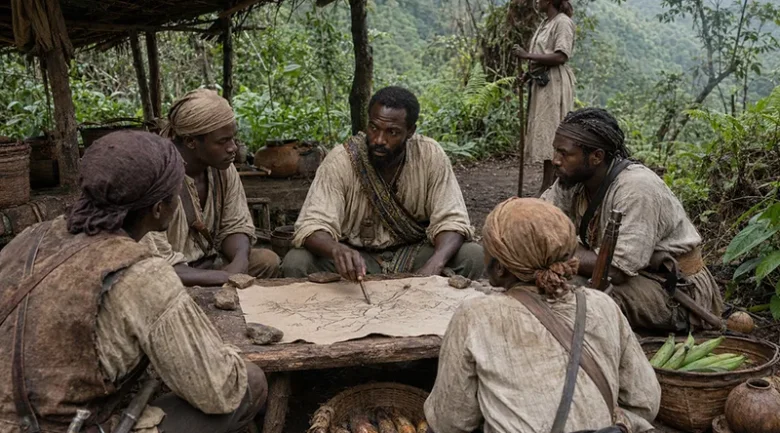
Chief Gorée Greg (often recorded in 18th-century British colonial military dispatches simply as Goree Greg or Greg) stands as a vital, highly tactical district commander of the Maroons of Dominica. Active during the continuous guerrilla campaigns that characterized the island’s interior between 1764 and 1814, Gorée Greg operated within the elite vanguard of freedom fighters who directly subverted British imperial settlement.
Working in close coordination with dominant historical chiefs such as Chief Balla, Chief Jupiter, and Chief Jacko, Gorée Greg managed key defensive sectors along the rugged mountain ranges. His legacy provides crucial historical insight into the West African ethnic identities, tactical intelligence networks, and sophisticated survival mechanics engineered by the Neg Mawon to disrupt the Caribbean plantation economy.
Ethno-Cultural Identity: The Gorée Distinction
In the historiography of early Caribbean marronage, personal identifiers carried profound political and geographical meaning. The prefix “Gorée” explicitly traces his origins or point of forced departure to Gorée Island, the notorious French and Portuguese slave-trading enclave located off the coast of Dakar, Senegal.
This specific Senegambian and coastal West African heritage influenced his leadership role in several ways:
- Maritime and Coastal Literacy: Unlike interior agricultural laborers, enslaved Africans trafficked through Gorée often possessed sophisticated understandings of coastal topography, tidal movements, and maritime piloting. Greg leveraged this background to coordinate strategic movements between the high peaks of the interior and the isolated bays of the coast.
- Pan-African Coalition Building: Having survived the trauma of coastal slave fortresses, Gorée Greg rejected internal tribal divisions. Within his mountain camps, he unified newly arrived runaways of diverse origins, including Akan, Coromantee, and Igbo individuals, under a shared philosophy of universal emancipation.
Strategic Leadership in the Maroon Federation
While supreme leaders like Chief Jacko governed highly centralised, high-altitude agricultural sanctuaries like Jacko Flats, Gorée Greg operated as a mobile, defensive frontier commander. According to colonial assembly records and military trial logs, Greg’s primary responsibility was securing the transitional forest paths that connected expanding British sugar estates to the sovereign Maroon interior.
The Intelligence and Supply Pipeline
Gorée Greg masterfully engineered an underground intelligence and economic network between the high woods and the enslaved workforce remaining on the lowlands. Under his direction, mobile Maroon columns descended from the ridgelines under the cover of night. Rather than initiating random violence, Greg’s forces prioritized targeted trades, exchanging mountain-grown provisions and gathered forest materials for British gunpowder, lead bullets, flints, and iron tools smuggled by plantation drivers.
The Defense of the Communes
Greg’s camps (maniels) were designed as secure, self-sustaining communal centers. When British regular troops or local planter militias attempted to breach the interior, Greg utilized specialized tactical protocols:
- The Sentinel Relay: Greg’s outposts deployed the kon lambi (conch shell) and rhythmic drumming patterns to flash acoustic signals across deep river gorges, mapping out the advance of imperial forces miles in advance.
- Asymmetric Traps: His forces specialized in drawing heavily armed colonial columns into vertical, rain-slicked clay ravines where conventional British military line formations became fatal liabilities.
Historical Legacy and Regional Preservation
The fierce armed resistance maintained by commanders like Gorée Greg carried severe material consequences for the British plantocracy. By converting the near-impenetrable mountainous terrain into an economically unviable combat zone, the Neg Mawon successfully halted the widespread deforestation of the island for massive, corporate sugarcane monopolies.
Today, Chief Gorée Greg’s contribution to the foundation of Caribbean freedom is preserved across regional reference frameworks:
- The National Archive Collections: Transcripts detailing the military search orders, bounty notices, and slave court trials involving Greg’s allied factions are preserved in the colonial record series as an invaluable testament to early Black sovereignty.
- The Dominica Museum Preservation: Physical artefacts from the era, including salvaged iron tools repurposed into weapons, conch shells, and defensive map reconstructions, are displayed at the Dominica Museum to educate future generations on the military sophistication of the high-woods generals.


References
-
1.
A Review of Alick Lazare's Pharcel, Runaway Slave and Kalinago Blood https://www.academia.edu/45062804/A_REVIEW_OF_ALICK_LAZARES_PHARCEL_RUNAWAY_SLAVE_AND_KALINAGO_BLOOD