
International Diplomacy of Dominica
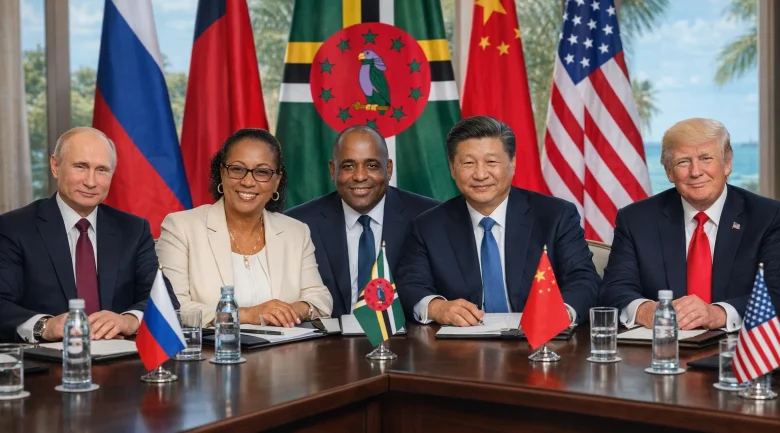
The International Diplomacy of Dominica is defined by a sophisticated “Small State Strategy” that leverages its unique vulnerabilities and environmental leadership into global influence. As a sovereign republic, the island has moved beyond post-colonial dependency to become a proactive agent of change in climate finance, regional integration, and South-South cooperation. By navigating a delicate balance between traditional Western allies and emerging partners in the Global South, the country ensures its security, economic survival, and role as a “Living Laboratory” for the world’s most pressing challenges.
Historical Foundations and the Evolution of Foreign Policy
The evolution of Dominica’s foreign policy is a narrative of transition from colonial legacy to radical self-determination. Following independence from the United Kingdom in 1978, early diplomacy was primarily defensive, focused on securing preferential trade agreements for the banana industry under the Commonwealth of Nations framework. This period was characterised by a heavy reliance on the Lomé Convention and later the Cotonou Agreement, which provided a protective umbrella for Caribbean exports to Europe.
A pivotal shift occurred in the late 1990s as the World Trade Organization (WTO) dismantled these protections, forcing the country to seek new allies and diversify its economic base. The modern diplomatic era was further refined in the wake of the 2017 climate crisis. The leadership rebranded the small nation as a global pioneer in climate adaptation, shifting the mission away from seeking “aid” toward securing “strategic investment” in green infrastructure. Today, the nation uses its voice in the United Nations to lobby for a Multidimensional Vulnerability Index (MVI), arguing that small island economies should not be judged by GDP alone, but by their exposure to external shocks.
Strategic Pillars of Global Engagement
The country maintains a multi-vector foreign policy designed to maximise development while maintaining political independence. These pillars allow the nation to punch far above its weight in global forums.
- Climate and Earth Diplomacy: As a leading member of the Alliance of Small Island States (AOSIS) and the Climate Vulnerable Forum, the island lobbies for “Loss and Damage” reparations, demanding that high-emitting industrial powers fulfil their financial obligations to vulnerable islands.
- Geopolitical Balancing: Dominica maintains an exceptionally close partnership with the People’s Republic of China while remaining a key partner in the U.S. Caribbean Basin Security Initiative (CBSI).
- Regionalism and Freedom of Movement: The nation is a cornerstone of the OECS and CARICOM, recently pioneering a “CARICOM Free Movement” pact with Barbados, Belize, and St. Vincent.
- Education and Human Resource Diplomacy: Through partnerships with Cuba, India, and China, the country has secured thousands of scholarships in medicine, engineering, and IT, effectively augmenting its human capital through international cooperation.
The Western Axis: Relations with the US, UK, and European Union
Dominica’s relationship with Western powers is a complex tapestry of security cooperation and regulatory navigation. The United States remains the nation’s primary partner for maritime security and counter-narcotics. However, Dominica must frequently defend its sovereignty against unilateral policy shifts.
A defining moment occurred in December 2025, when a U.S. presidential proclamation initially included the nation in a partial entry ban due to concerns over the Citizenship by Investment (CBI) program. Through “urgent and sophisticated sovereign dialogue,” Dominica’s leadership successfully argued that its October 14, 2025, legislative reforms, including mandatory biometric data sharing, met all international security benchmarks. The U.S. subsequently suspended the proclamation, a victory for the nation’s diplomatic corps.
Relations with the United Kingdom and the European Union are focused on visa-free mobility and development aid. While the UK imposed a visa requirement in 2023, the island is actively engaging in the EU Visa Suspension Mechanism dialogue. By aligning its tax and security standards with the OECD, the country continues to advocate for the restoration of full mobility for its citizens while benefiting from the European Development Fund for infrastructure projects.
The Global South: China, India, and Venezuela
Dominica has become a master of “South-South Cooperation,” diversifying its development partners to avoid over-dependence on any single power.
- The People’s Republic of China: Since establishing ties in 2004, China has funded the nation’s most critical infrastructure, including the Dominica China Friendship Hospital, the agricultural technical mission, and the China-Aid Project of Schools Reconstruction. In late 2025, a $37 million (XCD) “People-to-People” accord was signed, focusing on healthcare and digital transformation. This relationship is anchored in the “One China Policy” and the Belt and Road Initiative.
- India and the ITEC Program: India is a vital partner for technical capacity building. Through the ITEC program and the India-UN Development Partnership Fund, the country has received support for ICT centres and solar power projects. India also serves as a key supplier of pharmaceuticals and medical expertise.
- Venezuela and ALBA-TCP: Despite political complexities, the small island nation remains a member of ALBA. In December 2025, the country offered to serve as a mediator in the conflict between the U.S. and Venezuela, reiterating the Caribbean’s status as a “Zone of Peace.” This relationship has historically provided access to concessionary oil through the PetroCaribe Energy Cooperation Agreement.
- Cuba: The “Nursing and Medical Bridge” between the two nations has lasted for decades. Cuban medical brigades are integrated into the Dominican public health system, providing specialised care that would otherwise be inaccessible.
Middle Eastern Diplomacy: The UAE and Qatar Connection
In recent years, Dominica has looked toward the Middle East for investment and climate collaboration. The relationship with the United Arab Emirates (UAE) is powerful, focusing on renewable energy and digital governance.
At the World Government Summit, the island’s leadership praised the UAE’s digital transformation as an inspiration for the country’s own National Development Plan. The UAE-Caribbean Renewable Energy Fund has already financed solar-plus-storage projects on the island, and ongoing dialogues focus on luxury tourism investment and capacity building for the civil service. Similarly, relations with Qatar focus on disaster relief and potential energy collaborations.
Regional Leadership: The 2025 Free Movement Milestone
On October 1, 2025, Dominica, Barbados, Belize, and St. Vincent launched a Full Freedom of Movement Pact. This represents a radical leap in Caribbean integration, moving beyond the limited “skills certificates” of the wider CARICOM group.
| Feature | Impact on the Nation |
| Indefinite Stay | Citizens can live and work in any of the four countries without a visa. |
| Social Services | Families gain access to public healthcare and education across borders. |
| Economic Synergy | Addresses labour shortages by allowing a unified regional workforce. |
| CBI Appeal | Naturalised citizens now benefit from regional mobility, increasing the value of the Dominica passport. |
Blue Economy and Maritime Boundary Diplomacy
As a maritime state, Dominica has prioritised the Blue Economy and the management of its vast Exclusive Economic Zone (EEZ). Diplomacy in this area focuses on:
- Maritime Boundaries: The government has worked to finalise maritime boundary agreements with neighbouring France (Martinique and Guadeloupe) and Venezuela. These agreements are essential for preventing illegal fishing and managing potential underwater mineral resources.
- Sargassum and Marine Pollution: Collaborative diplomacy through the OECS and CARICOM aims to address transboundary threats such as the sargassum influx and plastic pollution, which affect the tourism and fishing sectors.
- Sustainable Fisheries: Through the CRFM (Caribbean Regional Fisheries Mechanism), the nation coordinates with neighbours to ensure the sustainable harvest of shared stocks like tuna and mahi-mahi.
Energy Diplomacy: The Geothermal Hub
The administration’s energy diplomacy is a central point of its international identity. The Roseau Valley Geothermal Project, set for full commissioning by early 2026, is a multi-lateral triumph involving:
- Technical Support: Collaboration with the World Bank, the Caribbean Development Bank (CDB), and Ormat Technologies.
- Climate Funding: Grants and concessional loans from the Green Climate Fund (GCF) and the United Kingdom.
- Regional Export Potential: The long-term strategy involves exporting renewable energy to Guadeloupe and Martinique via undersea cables, turning Dominica into a regional “Green Battery.”
The Commonwealth and Francophonie: Cultural Bridges
Dominica is one of the few nations to hold dual membership in both the Commonwealth of Nations and La Francophonie (OIF). This dual identity serves as a bridge between the English-speaking and French-speaking worlds.
- La Francophonie: Membership in the OIF allows the country to collaborate with the French West Indies and African francophone states on cultural preservation, youth training, and security. In 2025, the OIF has deepened its dialogue with CARICOM on stabilising the situation in Haiti, with Dominica playing a supporting role.
- The Commonwealth: This provides a platform for education and legal cooperation with 56 other nations. The country benefits from the Commonwealth Fund for Technical Co-operation, particularly in areas of judicial reform and trade negotiation.
Human Rights and Multilateralism
Despite its size, Dominica is an active participant in the Human Rights Council and other multilateral bodies. Its diplomacy in this area emphasises:
- Right to Development: Advocating for the recognition of climate change as a human rights issue.
- Social Justice: Consistent support for the self-determination of people in the Global South.
- Peace Mediation: As demonstrated by the recent offer to mediate between the U.S. and Venezuela, the nation promotes dialogue over military intervention, adhering to the principles of the Organization of American States (OAS) and the United Nations Charter.
Governance and the CBI Regulatory Framework
The CBI program is both a financial engine and a diplomatic challenge. To maintain its authority, Dominica has pioneered a “Gold Standard” of regulation within the OECS. Key reforms implemented in 2025 include:
- Mandatory Biometrics: Digital fingerprinting and verified interviews for all applicants to satisfy international security protocols.
- Fund Integrity: Ensuring all investment flows through government-monitored accounts to meet OECD and FATF standards.
- Residency Linkage: Establishing clearer legal definitions of residency to satisfy the requirements of the UK Home Office and the European Commission.
Challenges and the Future Outlook for 2030
Dominica’s diplomatic path is not without significant obstacles. The global de-risking trend in the banking sector continues to threaten the country’s financial connectivity, making it harder for local businesses to engage in international trade. Furthermore, the evolving Visa Suspension Mechanisms of Western powers require a diplomatic corps that is as skilled in technical legal negotiation as it is in traditional statecraft.
However, by positioning itself as the Innovation Hub of the Caribbean, this island has secured an influence far outstripping its geographic size. As the country advances toward its goal of becoming theworld’s first climate-resilient nation, its diplomacy remains the primary shield protecting its sovereignty and the primary engine driving its development.


