
Foreign Policy of Dominica
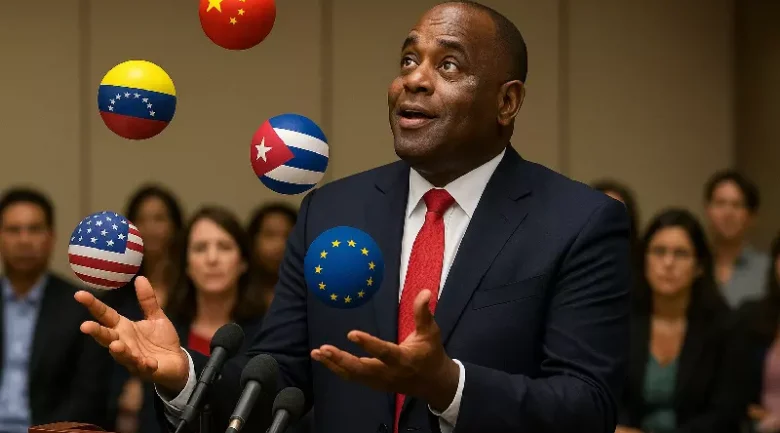
Shaped by regional vulnerabilities and global partnerships, Dominica’s foreign policy reflects the priorities of a Small Island Developing State (SIDS) operating within the Eastern Caribbean. The government’s diplomatic approach is anchored in sovereignty, development partnerships, multilateral collaboration and a commitment to international cooperation. Foreign relations focus areas have consistently sought to strike a balance between pragmatism and idealism, leveraging their unique geopolitical position, ecological value, and historical alliances to support its national development.
Dominica’s foreign affairs approach has evolved significantly, whether through historic ties with Britain, strategic partnerships with China and Venezuela, or its consistent environmental advocacy at international climate forums. This evolution has been shaped by global geopolitical shifts, changes in regional integration, domestic leadership transitions, and the pressing need to secure sustainable economic support for its vulnerable, disaster-prone population. Today, Dominica is recognised as a vocal participant in global dialogues on climate resilience, small island vulnerability, post-colonial self-determination, and reparatory justice.
Historical Foundations of Dominica’s
Dominica’s initial international engagement policy was deeply rooted in its colonial past and early post-independence aspirations. As a British colony until 1978, Dominica’s international positioning followed London’s lead in global diplomacy, trade, and military alliances. The colonial administration effectively determined foreign policy, with little room for independent manoeuvring or representation in international bodies.
After achieving independence on November 3, 1978, Dominica joined the Commonwealth of Nations and quickly began establishing sovereign diplomatic links with key allies. The first missions were established in London, Washington, D.C., and at the United Nations in New York, marking a symbolic and practical assertion of its statehood on the world stage. The post-independence Constitution enshrined Dominica’s commitment to democratic principles and non-alignment, while preserving its relationship with the Commonwealth.
Under the leadership of Prime Minister Patrick John, Dominica’s earliest foreign policy actions were cautious and traditionalist, mirroring the diplomatic conventions of other former British colonies. The country maintained strong ties to the United Kingdom, prioritised economic relations with Canada and the United States, and sought assistance from the European Economic Community (EEC), later the European Union (EU).
This conservative global affairs strategy orientation shifted somewhat during the 1980s under Prime Minister Dame Mary Eugenia Charles, whose administration aligned closely with Western democracies. Charles was a prominent supporter of the U.S.-led intervention in Grenada in 1983, famously joining President Ronald Reagan and other Caribbean leaders in justifying the action as a defence of democracy in the region. Her stance elevated Dominica’s visibility on the international stage but also polarised opinion within the Caribbean.
Charles’ government focused on strengthening relationships with democratic allies, securing aid and investment from Washington and London, and reinforcing Dominica’s alignment with liberal economic models. She established diplomatic norms that emphasised accountability, transparency, and the rule of law, tenets that would shape future diplomatic engagements.
Post-Independence Diplomatic Evolution
The late 1990s marked a turning point in Dominica’s external strategic posture. Under the leadership of Prime Minister Roosevelt “Rosie” Douglas, the country adopted a more assertive and independent approach. Douglas, a seasoned international activist and Pan-Africanist, brought a global perspective shaped by his years in Canada and his ties to liberation movements across Africa, Latin America, and the Caribbean.
Douglas championed South-South cooperation, sought deeper ties with socialist and non-aligned nations, and openly criticised the over-reliance on traditional Western partners. His administration pursued relations with Cuba, Libya, China, and Venezuela, countries that offered developmental aid without the same conditions often attached to assistance from Western financial institutions. Like other post-colonial states, he believed Dominica needed to assert its sovereignty through diversified partnerships and alternative development models.
Though Douglas passed away just eight months into his term, his brief tenure reshaped the tone of Dominican diplomacy. His legacy lived on through subsequent leaders, including Pierre Charles, who maintained many of Douglas’s initiatives while navigating delicate relations with the West. Charles emphasised pragmatism in foreign affairs, particularly regarding regional economic integration and disaster recovery support.
Prime Minister Roosevelt Skerrit, who assumed office in 2004, gave the diplomatic diversification strategy new momentum. Under his leadership, Dominica strengthened its ties with China, established significant regional partnerships through ALBA with Venezuela, and expanded its global presence by establishing embassies in Beijing, Caracas, Havana, and Abu Dhabi. This shift reflected the government’s desire to seek aid, infrastructure investment, and political recognition from countries that supported Dominica’s development vision with fewer conditionalities than traditional Western donors.
Bilateral Relations and Strategic Partnerships
Dominica’s foreign policy framework relies heavily on cultivating bilateral relationships. Its most significant is the diplomatic partnership with the People’s Republic of China. After recognising Beijing in 2004 and ending its long-standing relationship with Taiwan, Dominica received substantial Chinese support, ranging from educational scholarships and medical teams to large-scale infrastructure projects.
One flagship initiative is the China-Aid Project of Schools Reconstruction in Dominica, which helped rebuild critical educational facilities after Hurricane Maria. Other projects include the construction of the Windsor Park Sports Stadium, bridges along the West Coast, and the ongoing development of the Dominica-China Friendship Hospital. China’s financial and technical support has extended into agriculture, health, and telecommunications.
The country has also maintained robust ties with Venezuela, especially during the 2005–2015 era when the PetroCaribe Energy Cooperation Agreement provided Dominican households and institutions access to subsidised petroleum products. This cooperation enabled the construction of public housing, supported agricultural cooperatives, and enhanced the country’s energy security. Though political and economic instability in Venezuela has reduced this support, diplomatic relations remain intact.
Ties with Cuba are deeply rooted in solidarity and mutual benefit. For decades, Cuba has offered Dominica scholarships for medical training, deployed doctors and nurses via the Cuban Medical Brigade to the island, and cooperated on disaster management and climate adaptation.
Dominica continues to engage positively with France, primarily through its neighbouring territories of Guadeloupe and Martinique. Cross-border medical services, maritime security cooperation, and cultural exchanges have strengthened this relationship. Meanwhile, relations with the United States and Canada are guided by trade, investment, and diaspora ties. Dominica also collaborates with these nations on issues related to migration, financial regulation, and disaster recovery.
Dominica’s Role in Regional and Multilateral Bodies
Dominica’s foreign policy has consistently emphasised strong participation in regional and multilateral institutions. As a founding member of the Organization of Eastern Caribbean States (OECS) and a committed member of CARICOM, Dominica has worked to promote regional integration, shared governance, and economic collaboration among small island states. These institutions provide a vital framework for trade negotiations, disaster response coordination, and regional diplomacy, enabling Dominica to contribute more than its weight in global discussions.
Through CARICOM, Dominica contributes to joint Caribbean positions on international issues, including climate change, food security, regional security, and economic resilience. CARICOM also facilitates agreements on visa-free travel, common market access, and regional educational mobility. Dominica supports a unified Caribbean voice in international forums, often aligning its foreign policy statements with collective CARICOM resolutions at the United Nations and other forums.
Dominica has also played an active role in the Association of Caribbean States (ACS) and the African, Caribbean and Pacific Group of States (ACP), which promote cooperation among developing nations. These groupings allow Dominica to advocate for development financing, special trade preferences, and the rights of small island developing states in global trade negotiations.
Perhaps Dominica’s most recognized global stance is its advocacy for climate justice and environmental protection. After Hurricane Maria devastated the country in 2017, Dominica used its voice at the UN General Assembly, UNFCCC climate conferences, and the Alliance of Small Island States (AOSIS) to demand fair financing, technology transfer, and global accountability for carbon emissions. Dominica’s leadership in these forums has bolstered its reputation as a leading environmental voice in the Caribbean.
Citizenship by Investment and Economic Diplomacy
The Citizenship by Investment (CBI) programme is one of Dominica’s most distinct and controversial foreign policy tools. First introduced in 1993 and significantly restructured under Prime Minister Skerrit’s administration in the mid-2010s, the CBI initiative allows vetted foreign nationals to acquire Dominican citizenship through investment in government-approved projects.
This strategy has drawn significant foreign capital into Dominica’s economy, particularly for post-disaster reconstruction, social housing, and tourism development. Funds raised through CBI have financed the construction of hundreds of climate-resilient homes, health centres, schools, and bridges across the island. In foreign policy terms, CBI has positioned Dominica as an attractive investment destination for global elites, entrepreneurs, and diaspora families seeking mobility and security.
Embassies and consulates actively promote CBI, often hosting investment roadshows in the United Arab Emirates, China, and Africa. Dominica also collaborates with global marketing firms and due diligence agencies to manage its international image and ensure compliance with anti-money laundering standards. Despite occasional scrutiny from the European Union and United States, Dominica has maintained that the programme operates within international norms and contributes to national development.
However, critics argue that the lack of transparency in how CBI funds are allocated, the number of passports issued, and the criteria for economic citizenship undermine public trust and national identity. The government has implemented enhanced due diligence protocols, biometric security features, and third-party auditing to reassure international partners and local stakeholders.
The CBI programme remains a cornerstone of Dominica’s modern foreign policy, integrating diplomacy, economic strategy, and global engagement into a cohesive policy framework.
Foreign Policy under Roosevelt Skerrit
Under Roosevelt Skerrit’s ongoing leadership, Dominica has adopted a highly strategic and pragmatic approach to international relations. Skerrit’s foreign policy has been marked by quiet diplomacy, investment-centred outreach, and strong personal ties with heads of state in China, Venezuela, Qatar, and Cuba.
His administration emphasises results-oriented diplomacy, including attracting grants, developing infrastructure, and providing medical and technical support. Rather than engaging in ideological conflicts or bloc politics, Skerrit’s government opts for multi-alignment, maintaining constructive relationships with powers that offer economic and humanitarian support without conditional interference in domestic affairs.
Notably, under Skerrit, Dominica has taken strong stands on non-intervention, climate resilience, and South-South cooperation issues. At international forums such as COP21 and COP27, as well as UNCTAD, Dominica has joined coalitions of vulnerable states to push for climate finance, debt relief, and global awareness of the existential threat posed by rising sea levels and extreme weather events.
Prime Minister Skerrit has also led the charge in reshaping the Caribbean’s relationship with China, advocating for greater access to funding, trade opportunities, and cultural exchanges. His administration facilitated China’s diplomatic integration into regional affairs while defending Dominica’s right to develop in accordance with its unique needs.
On the regional front, Skerrit has supported moves to make CARICOM more responsive to the needs of smaller member states and has called for enhanced cooperation in tourism marketing, agriculture, and health diplomacy. His dual role as Prime Minister and Minister for Foreign Affairs has allowed him to manage Dominica’s global engagements directly, placing foreign policy at the heart of the national development strategy.
Humanitarian, Cultural, and Diaspora Engagement
Humanitarian diplomacy is another major pillar of Dominica’s foreign policy. In the wake of Tropical Storm Erika in 2015 and Hurricane Maria in 2017, Dominica mobilised the international community for support, receiving aid from countries including Cuba, China, Venezuela, France, and the United Kingdom. Diplomatic missions coordinated logistics, facilitated relief flights, and arranged for emergency medical teams, demonstrating the value of established bilateral relationships.
In addition to emergency aid, Dominica has participated in long-term recovery partnerships with the World Bank, Caribbean Development Bank, and International Monetary Fund, using these institutions to advocate for concessional funding, risk insurance mechanisms, and debt restructuring tied to climate vulnerability.
Cultural diplomacy also plays an important role. Dominica’s embassies and high commissions organise events celebrating Creole heritage, Independence Day, and the World Creole Music Festival, helping to preserve identity and strengthen ties with overseas communities. Cultural exchanges and artistic residencies have also established soft-power links with the Francophone and Hispanophone Caribbean, enhancing mutual understanding and collaboration.
Diaspora relations have been institutionalised through consular outreach programs, investment seminars, and public consultations abroad. With large Dominican populations in New York, London, Guadeloupe, and Toronto, the diaspora is both a financial resource (through remittances) and a political constituency, often influencing foreign aid decisions in host countries.
Challenges and the Future of Dominica’s Foreign Policy
Dominica’s foreign policy faces several complex and evolving challenges. The geopolitical landscape is shifting rapidly, and small states like Dominica must continually adjust to new alignments, trade regimes, and security concerns. Dominica must refine its diplomatic balancing act as China’s global presence grows and the West becomes more cautious in its financial aid.
Transparency, accountability, and inclusiveness remain key concerns. Citizens and civil society organisations have called for greater oversight over bilateral agreements and international memoranda of understanding, especially when they involve land use, citizenship sales, or public infrastructure.
Climate change remains perhaps the greatest existential threat. Dominica has positioned itself as a climate-resilient nation, but achieving this status requires continued access to technology, financing, and international solidarity. Dominica must remain a strong and consistent voice in climate negotiations, advocating for mechanisms that protect vulnerable economies from market volatility and extreme weather events.
In the future, Dominica’s foreign policy may benefit from the creation of a formal Foreign Policy White Paper that outlines objectives, guiding principles, and accountability mechanisms. Establishing a Foreign Policy Advisory Council comprising diplomats, academics, and private-sector stakeholders could further enhance strategic planning and implementation.
Dominica’s geographic location, small size, and ecological wealth provide unique diplomatic leverage. As global priorities shift toward sustainability, renewable energy, digital trade, and green financing, Dominica has an opportunity to lead from the front, championing its interests and those of the broader Caribbean and other small island states.


