


Clymene Dolphins in Dominica
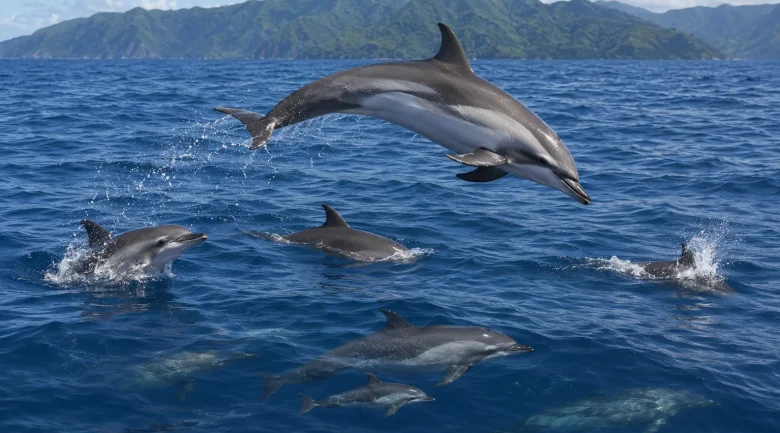
The Clymene dolphin (Stenella clymene), historically referred to as the short-snouted spinner dolphin, is a small, highly athletic cetacean endemic exclusively to the tropical, subtropical, and warm-temperate waters of the Atlantic Ocean. Within the territorial sea and Exclusive Economic Zone (EEZ) of the Commonwealth of Dominica, this pelagic species represents a specialized component of the island’s deep-sea odontocete biodiversity.
While Dominica’s marine eco-tourism sector is heavily anchored by the year-round presence of resident sperm whales (Physeter macrocephalus) in the nearshore leeward waters, populations of Stenella clymene patrol the deeper oceanic trenches surrounding the island. Because Dominica’s volcanic topography features an exceptionally narrow continental shelf that drops precipitously to depths exceeding 1,000 meters just kilometers from the shore, these typically offshore dolphins are occasionally encountered closer to the coast than in almost any other region of the Wider Caribbean.
Evolution, Taxonomy, and Physical Description
The Clymene dolphin occupies a unique place in evolutionary biology as the first and only confirmed case of homoploid hybrid speciation among marine mammals. Nuclear and mitochondrial DNA testing confirmed that Stenella clymene arose as a distinct, fertile species resulting from ancestral hybridization between the spinner dolphin (Stenella longirostris) and the striped dolphin (Stenella coeruleoalba).
Historical Classification
First described from a single skull by British zoologist John Edward Gray in 1846 under the designation Delphinus metis, the animal’s exact taxonomic position remained highly contested for well over a century. Due to its superficial physical similarities to the spinner dolphin, it was long relegated as a subspecies or regional variant of Stenella longirostris. It was not until a comprehensive morphological reassessment by cetologist William F. Perrin and colleagues in 1981 that Stenella clymene was formally validated as an independent, distinct species.
Morphological Characteristics
- Dimensions and Build: The Clymene dolphin features a robust, streamlined body that is shorter and more compact than that of the standard spinner dolphin. Adults in the Caribbean basin reach lengths between 1.8 to 2.0 meters and weigh between 75 to 90 kilograms.
- The Cranial “Mustache”: The head features a distinctively short, stocky beak (rostrum) that acts as a primary field identification marker. The upper surface of the beak is marked by a prominent, dark grey-to-black line that widens near the apex of the melon, creating a distinctive facial marking often termed a “mustache”. The lips and the tip of the snout are wrapped in a sharp black margin.
- Three-Part Pigmentation (Cetacean Neapolitan): The body possesses a distinct tricolored countershading pattern. The dorsal zone is covered by a dark grey cape that forms a unique double dip, curving downward first above the eye and second just beneath the dorsal fin. Below the cape lies a band of light grey along the lateral flanks, which gives way to a white or pale pink ventral underside.
- Dentition and Appendages: Each jaw row contains 39 to 52 pairs of small, slender, and pointed teeth. This count is lower than that of the spinner dolphin, reflecting its evolutionary inheritance from the striped dolphin. The dorsal fin is centrally positioned, moderately tall, and falcate (curved), contrasting with the more upright, triangular dorsal fins seen in Stenella longirostris.
Behavior, Social Dynamics, and Foraging Ecology
As an oceanic species, the Clymene dolphin’s life history is bound to deep pelagic ecosystems, specifically waters ranging from 250 to over 4,500 meters deep. In Dominica, they exploit the nutrient-rich sub-surface channels between Dominica and its neighboring islands, Martinique to the south and Guadeloupe to the north.
Locomotion and Aerial Acrobatics
Clymene dolphins are highly vocal, energetic surface swimmers. Like their spinner dolphin relatives, they frequently execute longitudinal spins, leaping clear of the water surface and rotating along their axis. While their aerial spins tend to involve fewer revolutions and slightly less complexity than those of Stenella longirostris, they are highly acrobatic and frequently approach vessels to ride bow waves or surf hull wakes.
Social Architecture
In the Eastern Caribbean, Clymene dolphins travel in fluid, mid-sized pods typically numbering between 40 to 80 individuals, though massive offshore aggregations exceeding several hundred have been logged globally. School structures within Dominican waters show a high degree of demographic segregation. Pods are frequently single-sex cohorts or are organized strictly by age classes, with mature adult males traveling independently of maternal nursery groups containing mothers and calves. They regularly form mixed-species traveling schools, clustering alongside pantropical spotted dolphins (Stenella attenuata) and common spinner dolphins.
Foraging Habits and Diet
Stenella clymene is a specialized mid-water carnivore that preys heavily on the complex communities of the mesopelagic zone. Their hunting strategies are optimized around the diel vertical migration of marine life, intensifying significantly at night when deep-water organisms migrate toward the surface. Their diet consists of:
- Small mesopelagic fish, dominated by lanternfish (family Myctophidae)
- Small oceanic squids and alternative cephalopods
- Deep-water pelagic shrimp and benthic invertebrates
Conservation Status and Legislative Protections
The Clymene dolphin is categorized globally as Least Concern on the IUCN Red List of Threatened Species, but its distribution within the Lesser Antilles is sparse, making local populations highly sensitive to anthropogenic (human-caused) disturbances.
International and Regional Treaties
The Commonwealth of Dominica exercises strict statutory stewardship over all cetaceans within its maritime jurisdiction, enforcing adherence to international frameworks:
- The SPAW Protocol: Under Annex II of the Specially Protected Areas and Wildlife Protocol of the Cartagena Convention (ratified by Dominica), the Clymene dolphin is a strictly protected species. This listing completely prohibits the commercial hunting, catching, killing, or trading of the animals or any derived products.
- CITES: The species is listed under Appendix II of the Convention on International Trade in Endangered Species of Wild Fauna and Flora, restricting international transport.
- Transboundary Monitoring: Dominica’s marine management practices interface directly with the Agoa Sanctuary in the neighboring French West Indies, establishing standardized data sharing within the Eastern Caribbean Islands Important Marine Mammal Area (IMMA).
National Resource Governance and Environmental Mitigations
Under the management of the Ministry of Agriculture, Fisheries, Blue and Green Economy, Dominica has instituted targeted resource guidelines to alleviate modern survival pressures on pelagic delphinids:
- Fisheries Management: While historical, small-scale cetacean artisanal harpoon fisheries occurred sporadically in parts of the wider Windward Islands, modern Dominican regulations strictly prohibit such takes. The primary modern threat is incidental entanglement (bycatch) in pelagic driftnets, gillnets, and longlines deployed near Fish Aggregating Devices (FADs). The Fisheries Division actively reviews gear restrictions to minimize underwater ghost fishing and accidental drownings.
- Acoustic Pollution and Spatial Protection: As deep-diving echolocators, Clymene dolphins are highly sensitive to underwater acoustic pollution caused by heavy international commercial shipping and high-speed inter-island ferry propulsion. Intense anthropogenic noise can cause acoustic masking, disrupting their communication, orientation, and nocturnal hunting efficiencies. The state’s marine protection laws mandate speed restrictions and specific maritime transit lanes within deep-water zones to mitigate acoustic distress and reduce the risk of lethal hull impacts.
- Eco-Tourism and Whalewatching Codes: Any opportunistic encounters with Stenella clymene during commercial whale and dolphin-watching excursions out of Portsmouth or Roseau are tightly governed by codes of conduct enforced by the Forestry, Wildlife and Parks Division. Tour vessels must approach pods using a parallel, non-threatening vector, maintain a minimum buffer distance of 50 meters, and limit observation windows to ensure pods are not subjected to behavioral displacement or forced group separation.


