




Pygmy Sperm Whale in Dominica
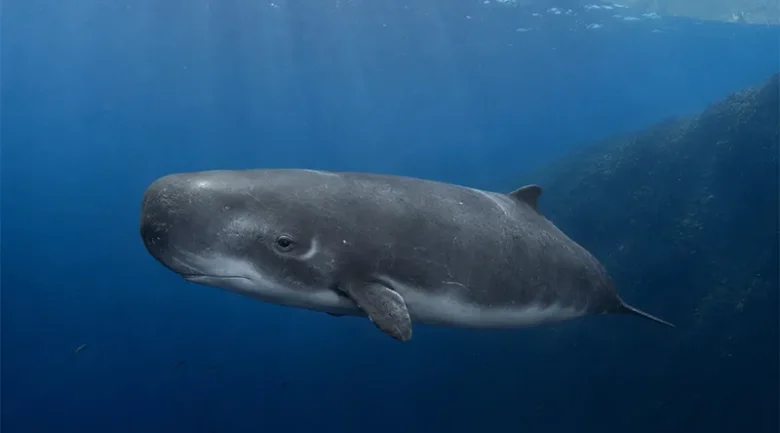
Meet the pygmy sperm whale: a compact, deep-diving cetacean navigating the open-water Exclusive Economic Zone (EEZ) of the Commonwealth of Dominica. While the island’s calm western sanctuary is famous for its photogenic population of giant sperm whales, these smaller cousins run on a totally different system. They occupy a completely separate ecological niche, diving deep for food far beyond the regular shallow coastal shelves.
Because they are incredibly timid, produce an inconspicuous surface blow, and spend the vast majority of their time foraging at extreme depths, live encounters are rare. Nonetheless, Dominica’s unique underwater topography, featuring vertical volcanic drop-offs that plunge beyond 1,000 meters just kilometers from the western coastline, offers this cryptic species an ideal environment for foraging near a coastal landmass.
Taxonomy and Physical Characteristics
The pygmy sperm whale was first taxonomically classified by French zoologist Henri Marie Ducrotay de Blainville in 1838. It shares the family Kogiidae exclusively with its slightly smaller relative, the dwarf sperm whale (Kogia sima). Distinguishing between these two cryptic species during opportunistic field sightings represents a significant challenge for marine biologists.
Morphological Distinctions
- Dimensions and Weight: At physical maturity, Kogia breviceps measures between 2.7 to 3.5 meters in length and weighs between 315 to 450 kilograms. It is noticeably larger and more robust than the dwarf sperm whale.
- Dorsal Fin Profile: The dorsal fin serves as a key visual diagnostic feature. The pygmy sperm whale features a very small, low-profile, hooked dorsal fin positioned well back on the posterior half of the body. This is distinct from the dwarf sperm whale, which boasts a taller, more prominent, falcate fin closer to the center of its back.
- Cranial Anatomy: The head is characterized by a blunt, squarish snout that projects beyond a small, narrow, underslung lower jaw. The lower jaw contains 12 to 16 pairs of long, thin, sharply curved teeth that fit into matching sockets in the toothless upper jaw.
- The “False Gill”: The body possesses a dark steel-grey to purplish-grey dorsal pigmentation that gradients into a pale cream or pinkish belly. Located behind each eye and directly ahead of the short, broad pectoral flippers is a light, crescent-shaped marking known as a “false gill,” visually reminiscent of a teleost fish’s gill slit.
Habitat Dynamics and Foraging Ecology
The bathymetric profile of western Dominica, specifically along the coastal corridors of Soufrière, Roseau, and Portsmouth, aligns precisely with the specialized biological needs of the pygmy sperm whale.
Diet and Deep Diving
Pygmy sperm whales are specialized teutophages, meaning their diet is almost exclusively composed of oceanic squid families that occupy the mesopelagic and bathypelagic zones at depths ranging from 400 to over 1,200 meters. They also consume deep-sea octopuses, crabs, and small benthic fish. To hunt in total darkness, they utilize highly directional, ultra-high-frequency echolocation clicks generated via an internal spermaceti organ and fat-filled cranial melon.
Behavior and Defense Mechanism
When resting at the surface, Kogia breviceps exhibits a behavior known as “logging,” floating completely motionless with the top of its head and small back exposed. They avoid all motorized vessels, never ride bow waves, and drop vertically beneath the surface without displaying a tail fluke when approached.
If threatened by an apex predator, such as a killer whale (Orcinus orca) or a large shark, the pygmy sperm whale utilizes a specialized intestinal sac containing up to 12 liters of viscous, dark reddish-brown liquid. When triggered, the whale expels this fluid to create a thick “ink cloud” in the water column. This acts as a sensory decoy, blinding and confusing the predator while the whale escapes into deeper water.
Protection and Management Framework
Under the environmental legislation of Dominica, the pygmy sperm whale receives full statutory protection across all national maritime boundaries.
Statutory Conservation
Although prominent conservation acts, such as the Sperm Whale Reserve Act, were originally enacted to manage the critical habitats of Physeter macrocephalus, the legislative definitions explicitly include all members of the order Cetacea. As a result, the 1,231-square-kilometer protected reserve extending along the western coast of Dominica provides a legally enforced sanctuary for the pygmy sperm whale.
Key legal provisions enforcing their safety include:
- Absolute Protection: It is strictly illegal to hunt, harass, pursue, capture, or commercially exploit any pygmy sperm whale within Dominica’s territorial sea and Exclusive Economic Zone.
- Vessel Mitigation: Commercial shipping lanes and vessel speed restrictions operate continuously within the sanctuary to minimize the occurrence of underwater acoustic disturbance and catastrophic ship strikes.
- Active Patrols: Strategic maritime enforcement is maintained by designated Sperm Whale Reserve Rangers, who monitor the sanctuary for regulatory compliance and habitat protection.
Stranding Protocols and Whale Watching
Because pygmy sperm whales are naturally prone to live strandings due to sickness, neurological parasites, or acoustic trauma, the Forestry, Wildlife and Parks Division maintains standard response guidelines for marine mammal strandings. Furthermore, due to the species’ avoidance behavior, there are no targeted commercial tours for Kogia breviceps. Under the national whale-watching code of conduct managed by the Discover Dominica Authority, operators who encounter the species opportunistically must idle their engines, maintain a substantial buffer distance, and immediately cease tracking if the animals show signs of behavioral distress.


