




Cetaceans in Dominica
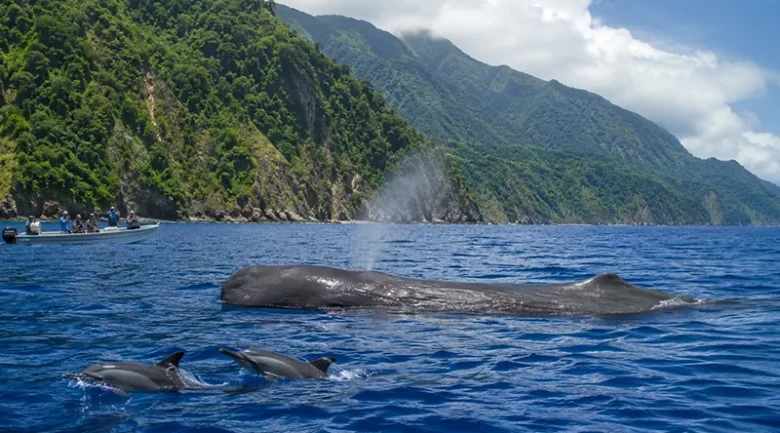
Cetaceans find a natural sanctuary in the Commonwealth of Dominica, an internationally recognized premier destination for the study of these marine mammals. Our territorial waters are characterized by extreme underwater slopes, where the ocean floor drops to abyssal depths within a few kilometers of the coastline. This unique geography provides a vital habitat for a diverse range of sea creatures, including resident and migratory populations. Scientific surveys have documented 22 species locally, representing two-thirds of those inhabiting the Caribbean Sea.
Marine Biodiversity and Key Species
Dominica’s marine ecosystem is highly productive, driven by nutrient-rich currents that support a complex food web. The deep, sheltered bays along the leeward (western) coast serve as critical nursing, feeding, and socializing grounds for several high-profile cetacean species. Over twenty distinct species of toothed whales (Odontoceti) and baleen whales (Mysticeti) have been scientifically documented in Dominican waters. These populations are categorized by their residency patterns and ecological utilization of the marine habitat.
Resident Toothed Whales (Odontoceti)
- Sperm Whale (Physeter macrocephalus): The most socio-economically and ecologically significant cetacean in Dominica. A resident population of approximately 200 individuals permanently inhabits the western coast. These whales belong to the Eastern Caribbean clan and are characterised by a highly structured matrilineal society organised into distinct social units or “pods”.
- Short-Finned Pilot Whale (Globicephala macrorhynchus): Commonly observed in large, highly social pods along the shelf edge. They feed primarily on deep-sea cephalopods.
- Pygmy Sperm Whale (Kogia breviceps) and Dwarf Sperm Whale (Kogia simus): Elusive, deep-diving species that occupy the offshore pelagic zones.
Migratory Baleen Whales (Mysticeti)
- Humpback Whale (Megaptera novaeangliae): Transient visitors that migrate through Dominica’s waters between January and April. They utilize the warmer waters of the Lesser Antilles for mating and calving before returning to cold-water northern feeding grounds.
- Bryde’s Whale (Balaenoptera edeni): Occasionally recorded in deeper offshore waters, moving seasonally in response to pelagic fish and krill availability.
Oceanic and Coastal Dolphins (Delphinidae)
Dominica hosts numerous dolphin species that form both coastal and offshore schools, frequently interacting within multi-species feeding aggregations:
- Spinner Dolphin (Stenella longirostris): Known for aerial acrobatics, often found in large schools over deep waters.
- Pantropical Spotted Dolphin (Stenella attenuata): Highly abundant along the leeward coast.
- Bottlenose Dolphin (Tursiops truncatus): Observed in smaller, coastal pods closer to shallow reefs and bays.
- Fraser’s Dolphin (Lagenodelphis hosei): A pelagic, fast-swimming species occasionally seen in massive pods travelling through the Martinique and Guadeloupe channels.
The Sperm Whale Reserve
In November 2023, the Government of Dominica established the world’s first marine protected area dedicated specifically to the protection of sperm whales. The Sperm Whale Reserve encompasses approximately 788 square kilometres of ocean along the island’s western coast.
Ecological and Conservation Objectives
The reserve was created to safeguard the Eastern Caribbean Clan of sperm whales, a population estimated to number fewer than 300 individuals. By designating this area as a sanctuary, Dominica addresses several critical conservation goals:
- Threat Mitigation: The reserve provides protection against human-induced threats, including noise pollution from commercial shipping, potential ship strikes from high-speed ferries, and entanglement in fishing gear.
- Climate Resilience: Recent scientific studies highlight the role of sperm whales in marine fertilisation. The “fecal plumes” of these whales are rich in iron and nitrogen, which stimulate phytoplankton blooms. These blooms absorb carbon dioxide, establishing a positive feedback loop between whale conservation and ocean health.
- Habitat Management: The reserve is a strictly managed zone where human activity, including vessel traffic and tourism, is regulated to ensure that whales can carry out essential life functions, such as nursing and socialising, without significant behavioural disruption.
The Sperm Whale Reserve Fund
Financially independent of the state’s central Consolidated Fund, the Sperm Whale Reserve Fund (also referred to locally as the Blue Fund) directly collects all statutory revenues. This fund is capitalized through Parliamentary appropriations, international research grants, fixed administrative penalties, and dedicated eco-tourism levies. All accumulated capital is legally restricted to funding scientific research, community grants for artisanal fishers, conservation logistics, and ranger enforcement assets.
Legislative and Administrative Framework
The management of cetaceans in Dominica is overseen by the Ministry of Agriculture, Fisheries, Blue and Green Economy, in coordination with the Forestry, Wildlife and Parks Division. The government has moved to formalise its conservation commitments through legislative action, including the Sperm Whale Reserve Act.
Regulatory Management
The Act and associated regulations provide a comprehensive framework for the oversight of human interactions with cetaceans:
- Navigation Protocols: Vessels operating within the reserve are subject to speed restrictions and designated transit routes to prevent collision and reduce acoustic disturbance.
- Whale Watching Standards: Commercial operators must adhere to a code of conduct. This includes maintaining minimum approach distances, limiting the number of vessels near a single pod, and disengaging engines or remaining in neutral when in close proximity to the animals.
- Permitting Systems: Activities such as in-water swimming with whales are strictly regulated. Permits are issued only to certified operators, with specific limits on encounter durations and group sizes to minimize harassment.
- Scientific and Media Activities: Professional research and media production involving cetaceans require specific authorization, ensuring that data collection and filming do not negatively impact the animals’ well-being.
Conservation Challenges
Despite Dominica’s leadership in marine conservation, cetaceans in the region face persistent challenges. Managing these threats requires a balance between environmental stewardship and the economic activities of coastal communities.
- Anthropogenic Noise: The Caribbean is a busy maritime corridor. Chronic underwater noise from shipping and industrial activity can mask the vocalisations cetaceans use for navigation, communication, and hunting, particularly for deep-diving species like the sperm whale.
- Climate Change and Prey Distribution: Shifts in ocean temperatures and currents can alter the distribution of the squid and forage fish that cetaceans depend on. These ecological changes may impact the reproductive success and overall health of resident pods.
- Marine Debris and Entanglement: Interactions with lost or active fishing gear, such as longlines and Fish Aggregating Devices (FADs), remain a threat to cetaceans. Continued monitoring and collaboration with the fishing community are essential to mitigate these risks.
The Blue Economy and Sustainable Tourism
Cetaceans are a cornerstone of Dominica’s “Blue Economy,” a sustainable development model that prioritizes the health of marine ecosystems to support long-term economic prosperity.
Economic Impact of Marine Tourism
Whale and dolphin watching contribute significantly to the local economy, particularly in coastal communities such as Soufrière, Scotts Head, Portsmouth, and Roseau. This industry provides vital employment for boat captains, licensed guides, and hospitality staff. By transitioning from extractive marine practices to high-value, low-impact ecotourism, Dominica has demonstrated that protecting marine biodiversity can generate consistent revenue while preserving the “Nature Island” brand.
Ecological Significance and Carbon Sequestration
Cetaceans play a foundational role in maintaining the trophic balance of Dominica’s marine ecosystems. As apex predators, sperm whales and large delphinids regulate the populations of deep-sea squid and pelagic fish species.
Furthermore, the resident sperm whale population contributes directly to climate change mitigation through a biological process known as the “whale pump”. By diving to depths exceeding 1,000 meters to hunt and subsequently returning to the surface to breathe and defecate, the whales transport limiting nutrients, primarily iron and nitrogen, from the deep sea to the photic zone. These nutrients stimulate localised blooms of phytoplankton, which absorb atmospheric carbon dioxide through photosynthesis. Scientific models estimate that the resident sperm whale population in Dominica sequesters approximately 4,200 metric tonnes of carbon annually.
Future Perspectives
The success of Dominica’s marine conservation strategy depends on the continued integration of scientific research and community participation. The ongoing partnership between the government, international research bodies, and local stakeholders ensures that the management of the Sperm Whale Reserve remains adaptive and evidence-based. As global interest in marine conservation grows, Dominica continues to serve as an international model for integrating whale protection into a national development framework.


References
-
1.
Sperm Whale Reserve Act 2025 https://www.agriculture.gov.dm/images/documents/sperm_whale_reserve_bill_2025.pdf
-
2.
Dominica Strengthens Marine Protection Framework as New Research Highlights Global Importance of Local Sperm Whale Habitat https://dominicanewsonline.com/news/governance/dominica-strengthens-marine-protection-framework-as-new-research-highlights-global-importance-of-local-sperm-whale-habitat/
-
3.
Dominica Establishes World’s First Sperm Whale Reserve, a Boost for Climate, Biodiversity and the Local Economy https://www.wcgconsultingltd.com/news-and-information/dominica-establishes-worlds-first-sperm-whale-reserve-a-boost-for-climate-biodiversity-and-the-local-economy/
-
4.
Opportunistic sightings of small cetaceans off the leeward shore of the Commonwealth of Dominica https://www.researchgate.net/publication/228992515_Opportunistic_sightings_of_small_cetaceans_off_the_leeward_shore_of_the_Commonwealth_of_Dominica
-
5.
CETI's research takes place in the Eastern Caribbean island of Dominica https://www.projectceti.org/dominica
-
6.
International Whaling Commission (IWC) Dominica Profile https://wwhandbook.iwc.int/en/country-profiles/dominica
-
7.
Dominica - Divers Alert Network (DAN) Report https://dan.org/alert-diver/article/dominica/
-
8.
Dominica - Watching Countless Whales and Dolphins! https://www.diveoclock.com/destinations/Caribbean/Dominica/Whales/
-
9.
Discover Whale Watching Dominica: The Ultimate Guide to the Best Tours https://www.waitukubulitours.com/post/discover-whale-watching-dominica-the-ultimate-guide-to-the-best-tours