




Dwarf Sperm Whale in Dominica
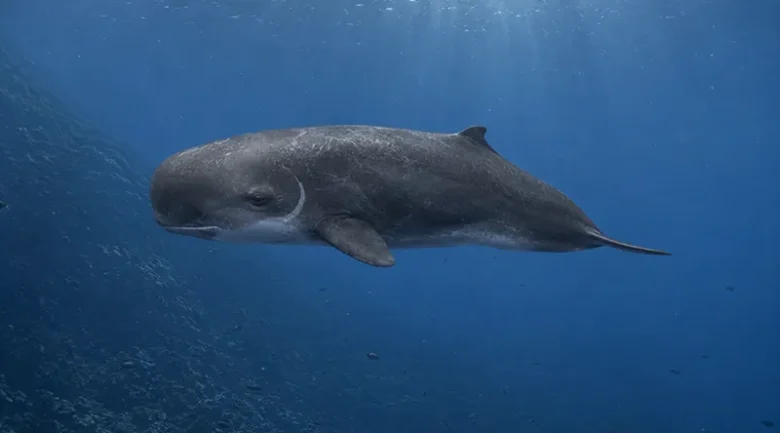
The dwarf sperm whale (Kogia sima, formerly Kogia simus) is a small, deep-diving cetacean belonging to the family Kogiidae that regularly inhabits the territorial sea and Exclusive Economic Zone (EEZ) of the Commonwealth of Dominica. While the island’s leeward marine infrastructure is globally renowned for its resident population of the larger sperm whale (Physeter macrocephalus), the dwarf sperm whale represents a distinct, cryptic ecological component of the local marine mammal community. Due to their small size, slow movements at the surface, and timid behavior, field sightings are relatively rare. However, the steep underwater shelves and submarine canyons along Dominica’s western coast provide an ideal habitat by bringing deep-water foraging zones within close proximity to the shoreline.
Taxonomy and Physical Characteristics
The dwarf sperm whale was first scientifically described by British biologist Richard Owen in 1866. For nearly a century, it was taxonomically conflated with its close relative, the pygmy sperm whale (Kogia breviceps), until morphological distinctions firmly re-established them as separate species.
Anatomy and Morphology
- Size and Weight: The species is roughly the size of a small porpoise, measuring between 2.0 to 2.7 meters in length and weighing between 135 to 270 kilograms at physical maturity.
- Dorsal Fin: A primary diagnostic feature distinguishing Kogia sima from Kogia breviceps is the dorsal fin. The dwarf sperm whale features a tall, prominent, sickle-shaped (falcate) dorsal fin located near the center of its back.
- Head and Jaw: The head structure is distinctly square with a pointed, conical snout that juts outward over a narrow, underslung lower jaw, giving it a shark-like profile. The lower jaw contains 7 to 13 pairs of sharp, curved, enamel-less teeth, while the upper jaw occasionally bears up to three pairs of small, non-functional vestigial teeth.
- Coloration and “False Gill”: The body displays a dark bluish-gray to brownish-black tint along the back, transitioning to a pale white or light pink underside. On each side of the head, located between the eye and the pectoral flipper, is a pale, crescent-shaped mark known as a “false gill” due to its visual similarity to a fish’s gill slit.
Ecological Behavior and Habitat in Dominica
The bathymetric profile of Dominica’s leeward coast, dropping sharply to depths exceeding 1,000 meters within a few kilometres of the coast, matches the preferred hunting grounds of the dwarf sperm whale.
Foraging and Diet
Dwarf sperm whales are specialized suction feeders that forage primarily in the mesopelagic and bathypelagic zones at depths up to 1,500 meters. Their diet is predominantly teutophagous, consisting of deep-sea squid, though they also consume octopuses, crustaceans, and small benthic fish species. They utilize high-frequency echolocation generated through an internal spermaceti organ and melon structure to navigate and locate prey in lightless depths.
Surface and Predator Avoidance Tactics
Unlike dolphins, dwarf sperm whales do not engage in acrobatic breaches or ride vessel bow waves. They are typically observed either alone or in small pods of fewer than ten individuals, floating motionless at the surface, a behavior known as “logging”. Their surface blow is low and virtually invisible.
When startled or threatened by apex predators such as orcas (Orcinus orca) or large pelagic sharks, the dwarf sperm whale employs a unique biological defense mechanism. It possesses a specialized sac branching off its lower intestine that holds up to 12 liters of dense, reddish-brown fluid. The whale ejects this liquid to create an expansive, dark “ink cloud” in the water column, acting as a visual decoy to mask its escape.
Statutory Protection and Conservation Status
Within the national jurisdiction of Dominica, dwarf sperm whales are fully protected under environmental and maritime safety laws.
Marine Protected Areas and Navigation Controls
The habitats of the dwarf sperm whale fall directly within the spatial protections of national marine sanctuaries, including the Soufrière Scotts Head Marine Reserve (SSMR) and the comprehensive Sperm Whale Reserve Act. Although the latter was drafted primarily around the conservation needs of Physeter macrocephalus, its statutory definitions extend protective classifications to all members of the order Cetacea found within the 1,231-square-kilometer sanctuary zone.
Consequently, commercial shipping corridors, vessel speed restrictions designed to minimize fatal vessel strikes, and acoustic noise regulations apply equally to safeguard the dwarf sperm whale population.
Regulatory Framework for Sightings and Eco-Tourism
Because the species is highly sensitive to maritime traffic and actively avoids vessels, targeted commercial tour operations focusing exclusively on dwarf sperm whales are not permitted. In the event of opportunistic encounters during standard whale-watching excursions departing from ports like Roseau or Portsmouth, operators must strictly follow the national code of conduct managed by the Forestry, Wildlife and Parks Division and the Discover Dominica Authority. These guidelines dictate mandatory approach distances, speed limits, and a strict ban on erratic tracking to prevent maternal or behavioral disruption.


