

Attempted Coups in Dominica
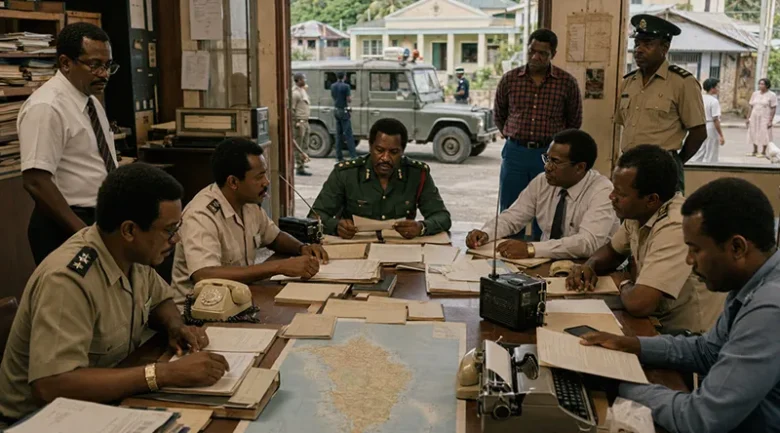
Following its independence in 1978, the historic violent attempted coups in Dominica profoundly altered national security policies in the early 1980s. Between March and December 1981, the newly established administration of Prime Minister Mary Eugenia Charles confronted multiple coordinated efforts at political destabilisation.
These conspiracies involved a volatile alliance of ousted local politicians, rogue elements of the Dominica Defence Force (DDF), and foreign right-wing mercenaries. The successful neutralisation of these plots led to a complete restructuring of national security, including the permanent disbandment of the country’s standing military.
Historical Context and Political Volatility (1979–1980)
The root causes of the 1981 coup attempts stem from the political crisis of May 29, 1979. Widespread civil unrest and a general strike forced the resignation of Dominica’s first Prime Minister, Patrick Roland John. Following an interim administration, the July 1980 general election brought Mary Eugenia Charles and the Dominica Freedom Party (DFP) to power in a landslide victory.
Seeking to regain control of the state, factions loyal to the former prime minister began actively plotting to subvert the democratic government. They exploited structural vulnerabilities within the young republic, specifically leveraging the political alignment of the Dominica Defence Force, an organization originally created by Patrick John in 1975.
The Three Primary Coup Conspiracies of 1981
The campaign to overthrow the Charles administration materialized in three distinct, interconnected operations over a ten-month period.
1. The March 1981 Internal Military Plot
In early March 1981, Prime Minister Eugenia Charles announced the discovery of an internal conspiracy organized by the leadership of the Dominica Defence Force. The plan, led by DDF Commander Major Frederick Newton, aimed to detain the Prime Minister and cabinet ministers, seize the national police headquarters, and force a transfer of executive power back to Patrick John.
- The Security Response: Acting on intelligence leaks, the civil authorities intercepted the plotters before tactical deployments began. Patrick John, Major Frederick Newton, and several high-ranking soldiers were arrested and detained under emergency security provisions.
2. The April 1981 Mercenary Plot (Operation Red Dog)
The most notorious external threat occurred in April 1981, code-named Operation Red Dog by its planners and later labelled the “Bayou of Pigs” by international media. This operation was an international filibustering plot orchestrated by American and Canadian white supremacists, neo-Nazis, and Ku Klux Klan members, led by Michael Perdue and Wolfgang Droege.
The foreign mercenaries contracted with Patrick John’s local representatives to launch an amphibious invasion of Dominica. In exchange for restoring John to the premiership, the foreign cartel was promised exclusive territorial concessions to establish logging operations, casinos, offshore banking infrastructure, and illicit transhipment hubs.
The Interception: On April 27, 1981, agents from the U.S. Bureau of Alcohol, Tobacco, and Firearms (ATF) and the FBI arrested ten armed mercenaries at a marina near New Orleans, Louisiana, as they prepared to board a charter vessel stocked with automatic weapons, dynamite, and paramilitary equipment.
3. The December 1981 Police Headquarters Assault
Despite the imprisonment of key leaders, the final and most violent coup attempt occurred on December 19, 1981. A faction of former DDF soldiers, operating alongside armed civilian allies, launched a coordinated midnight assault in Roseau.
The attackers targeted the central Police Headquarters and the main prison in an attempt to free Major Frederick Newton and Patrick John. A fierce firefight ensued between the rogue forces and loyal units of the Royal Dominica Police Force. The assault was successfully repelled, resulting in the deaths of several policemen and attackers, including the fatal shooting of a senior police officer.
Legal Outcomes and State Trials
The suppression of the coup attempts led to historic judicial proceedings within the Eastern Caribbean supreme court system.
- The Conviction of Patrick John: Following prolonged legal maneuvers and an initial acquittal that was subsequently overturned on appeal, former Prime Minister Patrick John was convicted of treason in October 1985. He was sentenced to 12 years in prison, ultimately serving five years before receiving an official presidential pardon.
- The Trial of Major Frederick Newton: Major Frederick Newton was tried, found guilty of murder and treason for his leading role in the December 1981 assault, and sentenced to death. He was executed by hanging in 1986, remaining the only person executed in Dominica since independence.
- Foreign Prosecutions: In the United States, Michael Perdue, Don Black, and other mercenary plotters were convicted of violating the U.S. Neutrality Act and received three-year federal prison sentences.
Long-Term Institutional and Geopolitical Impact
The existential threats of 1981 forced fundamental changes in how Dominica managed its internal security and regional foreign policy.
| Area of Impact | Institutional Realignment | Long-Term Outcome |
| Military Infrastructure | Permanent dissolution of the Dominica Defence Force (DDF) in April 1981. | Dominica became one of the few global states without a standing army. |
| Civilian Law Enforcement | Centralization of tactical defense within the Royal Dominica Police Force. | Creation of the specialized, paramilitary Special Service Unit (SSU) and Coast Guard. |
| Regional Geopolitics | Active spearheading of the Regional Security System (RSS) treaty in 1982. | Established a mutual-defense framework among Eastern Caribbean states to counter coups. |
The immediate structural fallout demonstrated that small island democracies were highly vulnerable to unconventional, non-state security threats during the Cold War era. By dismantling the compromised military and relying on a unified, civilian-led police apparatus backed by regional defense treaties, Dominica stabilized its constitutional governance, ensuring that no further coup attempts materialized in the decades that followed.


