



Smuggling in Dominica
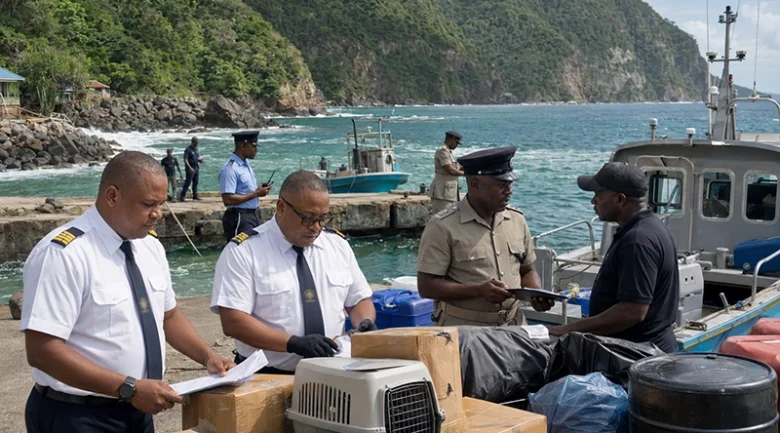
The underlying structures, transport methods, and statutory rules governing smuggling in Dominica remain tied to the island’s location in the Eastern Caribbean. Nestled directly between the French territories of Guadeloupe to the north and Martinique to the south, Dominica displays a rocky, 148-kilometre coastline. This jagged edge offers clear entry points for open-water trafficking networks. Border smuggling takes distinct forms, operating as highly organised channels that transport illegal firearms, dangerous drugs, banned commercial products, protected natural species, and irregular border-crossing migrants.
To suppress these border infractions, the island operates a combined national security apparatus led by the Customs and Excise Division and the Commonwealth of Dominica Police Force (CDPF). These border protection agencies enforce strict statutory frameworks derived from national trade, conservation, and criminal legislation. Their collective mandate focuses on protecting state fiscal revenues, countering transnational syndicates, preserving fragile ecological biomes, and maintaining public safety across all local ports of entry and territorial waters.
Statutory Framework and Jurisdictional Penalties
The suppression of contraband and unauthorized cross-border trade operates under a robust statutory framework designed to give state border agents broad enforcement, search, and seizure powers.
The Customs (Control and Management) Act (Act 20 of 2010)
The primary legal instrument utilized by the Magistrate’s and High Courts to prosecute border infractions is the Customs (Control and Management) Act. This modernized legislation grants the Comptroller of Customs and designated customs officers extensive executive authorities:
- The Right of Unrestricted Boarding: The statutory power to board and search any vessel, aircraft, or vehicle within the contiguous zone or territorial limits of Dominica without a prior judicial warrant if smuggling is reasonably suspected.
- Power of Mandatory Entry: The authority to enter and inspect commercial warehouses, duty-free outlets, and retail premises to audit cargo manifests and verify the presence of formal import documentation.
- Administrative Seizure: The legal right to instantly secure and hold “prohibited or restricted goods” that bypass declared customs stations.
Statutory Penalties for Evasion and Contraband Trafficking
Under Section 111 and related provisions of the Act, individuals convicted of smuggling, altering cargo manifests, or intentionally evading customs duties face severe summary and indictable penalties:
- Financial Sanctions: A statutory fine of $100,000 XCD or an amount equivalent to three times the total assessed market value of the smuggled goods, whichever sum is greater.
- Custodial Terms: Sentence terms of up to five years of imprisonment for standard commercial smuggling infractions.
- Automatic Asset Forfeiture: Section 196 mandates the absolute forfeiture of the smuggled contraband (“tainted articles”), alongside any vehicle, marine vessel, aircraft, container, or animal utilized to facilitate the transport, concealment, or distribution of the goods.
Core Typologies of Illicit Trafficking
Smuggling activities intercepted within Dominican jurisdiction are systematically categorised into five distinct operational lines, each demanding a specific interdiction methodology.
I. Illegal Firearms and Ammunition
The smuggling of unlicensed firearms and components into Dominica has emerged as a critical national security priority. Driven by multi-agency investigations, the state has established a specialised Firearms Investigative Unit (FIU), which pools resources from the police force, Customs, and the Financial Intelligence Unit.
National Security reports indicate that from 2023 through mid-2026, law enforcement agencies successfully recovered 161 illegal firearms and 3,929 rounds of ammunition, resulting in the direct arrest of 121 individuals.
The operational mechanics of arms trafficking primarily involve “straw purchases” originating from retail markets in North America. These weapons are disassembled into component parts, wrapped in specialised shielding material, and hidden inside consolidated commercial shipping barrels, household freight boxes, or vehicular engines that arrive at the Deep Water Harbour in Roseau or the Longhouse Port in Portsmouth.
To counter this method, the Ministry of National Security has invested over $2.7 million XCD to install advanced high-resolution container scanners at key ports. Under the Firearms Act, individuals convicted of smuggling military-grade hardware, such as semi-automatic AR-15 rifles, face maximum sentences of up to 25 years of imprisonment or fines reaching $700,000 XCD.
II. Illicit Drugs and Narcotics
Dominica acts primarily as a high-speed transit corridor and temporary storage point for the maritime trans-shipment of illicit narcotics. Because domestic consumer demand remains low, international drug syndicates utilize the country’s geographic position to move high-volume shipments of South American cocaine northward.
Trafficking networks employ high-velocity go-fast boats equipped with multiple outboard engines. These vessels skim through the deep-water channels separating Dominica from Martinique and Guadeloupe, often transferring cargo at sea to local fishing skiffs during the night.
Conversely, domestic cannabis cultivation occurs primarily within remote, mountainous interior sectors, such as the dense forest reserves of Saint George, Saint Andrew, and Saint David. While localised cultivation supplies the domestic market, small-scale maritime smuggling networks frequently export compressed cannabis blocks to neighbouring islands where market prices are higher.
III. Consumer Goods, Tobacco, and Alcohol
The smuggling of commercial consumer goods is driven primarily by the desire to evade high national tariff walls, value-added taxes (VAT), and excise duties. This form of evasion commonly targets high-duty items such as commercial alcohol, bulk tobacco, cigarettes, and specialised building materials.
Smuggling operations utilize two primary methods:
- Border Bypassing: Utilizing small wooden sloops to land commercial goods directly onto unpatrolled beaches along the northern and eastern coasts (such as Marigot, Calibishie, and Wesley) under the cover of night, completely avoiding customs inspection.
- Commercial Invoice Fraud: Under-declaring the true transaction value, misclassifying cargo under incorrect Harmonized System (HS) codes, or presenting falsified supplier invoices within the customs clearance process to lower the calculated duty obligations.
IV. Human Smuggling and Trafficking in Persons
While distinct from goods trafficking, the irregular movement of people through Dominica’s territorial waters represents a growing challenge monitored closely by the United Nations Office on Drugs and Crime (UNODC). Dominica’s status as an English-speaking republic bordered by two European Union territories (Guadeloupe and Martinique) makes it a preferred stepping stone for irregular migrants seeking entry into the French social welfare system.
Migrant smuggling operations typically utilize small, overloaded open fishing boats (pirogues) to navigate the rough ocean channels. These journeys present significant safety risks, with passengers frequently lacking basic life-saving equipment.
Furthermore, data from the U.S. State Department’s Trafficking in Persons Report underscores the vulnerability of transit populations. Unscrupulous smuggling rings occasionally transition into human trafficking, exploiting irregular migrants through forced labor or debt bondage within hidden agricultural or commercial sectors before their planned onward journey.
V. Endangered Wildlife and Flora (CITIES Infractions)
The smuggling of wild flora and fauna strikes directly at Dominica’s identity as the “Nature Island of the Caribbean.” This illicit trade is governed by the Convention on International Trade in Endangered Species of Wild Fauna and Flora (CITES), to which Dominica is a signatory state.
Illegal wildlife extraction focuses heavily on endemic and highly prized species:
- The Sisserou Parrot (Amazona imperialis): Dominica’s national bird is highly protected. Illegal poaching networks target nests in the high-altitude rainforests around Morne Diablotins to supply the international exotic pet trade, where collectors pay premium prices on the black market.
- The Jaco Parrot (Amazona arausiaca): Similarly targeted for illicit export via unmonitored coastal points.
- Exotic Orchids and Rare Timber: The unauthorized extraction and export of specialized forest flora, which circumvents mandatory phytosanitary inspections and state environmental export permits.
Structural Comparison of Smuggling Streams
The diverse nature of smuggling operations in Dominica requires distinct organizational structures, profiles, and transport methods across the different types of contraband:
| Trafficking Typology | Primary Transport Mechanism | Primary Source Regions | Domestic Distribution / Destination Hubs |
| Firearms & Ammunition | Commercial cargo containers, hidden barrel shipments, postal couriers. | North America (primarily southern United States ports). | Urban distribution nodes in Roseau, Portsmouth, and localized criminal elements. |
| Narcotics (Cocaine) | High-speed go-fast vessels, offshore open-water ship-to-ship transfers. | South American mainland via traditional maritime transit lanes. | Re-exported immediately north toward Puerto Rico, the US, and mainland Europe. |
| Excisable Goods | Small coastal sloops, regional inter-island trading boats. | Neighboring regional free-ports and low-tax distribution islands. | Secondary rural retail shops and unauthorized commercial networks. |
| Migrant Smuggling | Overloaded open fishing skiffs, clandestine maritime border crossings. | Caribbean nations (Haiti, Cuba) and specific extra-regional points. | Clandestine transit corridors leading directly to Guadeloupe and Martinique. |
| Wildlife & Flora | Concealed personal luggage, specialized maritime smuggling craft. | Interior rainforest reserves (Morne Diablotins, Morne Trois Pitons). | International collectors’ markets across Western Europe and North America. |
Enforcement, Border Protection, and Systemic Infrastructure
The task of detecting, intercepting, and dismantling transnational smuggling networks is distributed across several specialized state agencies and regional enforcement frameworks.
The Dominica Customs and Excise Division
The Customs and Excise Division operates as the frontline defense against commercial fraud and contraband insertion. The division manages import control through specialized internal tracking branches:
- The Risk Management and Intelligence Unit: Collects, collates, and analyzes shipping data to build high-risk profiles within the ASYCUDA automated customs platform. This system automatically flags anomalous cargo weights, suspicious origins, or unverified supply chains, isolating high-risk shipments for mandatory physical de-stuffing and scanning before they enter the country.
- The Cargo Examination Unit (Red Lane): Conducts thorough, manual examinations of flagged commercial containers and consolidated household barrels within secure port enclosures to detect hidden compartments.
- Post Clearance Audit (PCA) Services: Conducts extensive external business audits and inspections of commercial premises to verify that duties have been fully paid on imported inventory.
The Commonwealth of Dominica Police Force Marine Unit
Because smuggling operations rely heavily on maritime transit, the CDPF Marine Unit (Dominica Coast Guard) bears primary responsibility for intercepting contraband at sea. Operating a fleet of fast interceptor craft from its base in Fond Cole, the Coast Guard conducts regular patrols of territorial waters.
The Marine Unit focuses its operational presence on the northern Dominica Channel (facing Guadeloupe) and the southern Martinique Channel. These areas are high-probability zones for intercepting go-fast vessels running without navigation lights during new-moon cycles.
The Financial Intelligence Unit (FIU)
The FIU targets the financial foundations of smuggling operations. Recognising that trafficking networks rely on cash economies, the FIU monitors local banks, credit unions, and remittance agencies for suspicious transaction patterns.
By enforcing strict anti-money laundering (AML) protocols, the FIU traces the domestic profits generated by illicit smuggling. These financial investigations feed directly into the state’s Asset Forfeiture Fund, allowing the government to seize criminal assets and reinvest those resources into advanced border security hardware, such as port scanners and coastal surveillance technology.
Regional Security Integration and Treaties
Because smuggling operations span multiple international boundaries, Dominica cannot effectively protect its borders in isolation. The state integrates its local enforcement efforts with several regional and international security frameworks.
The Regional Security System (RSS)
The Commonwealth of Dominica is a full member state of the Regional Security System, an international treaty organization focused on defense and security across the Eastern Caribbean. The RSS provides Dominica with critical operational support:
- Joint Maritime Patrols: Deploying multi-national naval assets and aerial reconnaissance flights to track suspicious vessels within Dominica’s Exclusive Economic Zone (EEZ).
- Tactical Training Deployments: Providing specialized training to the CDPF Special Service Unit (SSU) and Coast Guard personnel in advanced boarding and search procedures for non-compliant vessels.
The Caribbean Firearms Roadmap
In April 2026, Dominica achieved a major national security milestone by becoming the 14th Caribbean State to draft a specialized National Action Plan (NAP) under the Caribbean Firearms Roadmap (CFRM). This interinstitutional initiative was developed during a three-day roundtable meeting hosted in collaboration with the United Nations Regional Centre for Peace, Disarmament and Development in Latin America and the Caribbean (UNLIREC) and CARICOM IMPACS.
The roadmap focuses on four primary national objectives:
- Reinforcing Regulatory Frameworks: Strengthening domestic laws governing the licensing, storage, and movement of firearms and ammunition.
- Mitigating Illicit Trafficking: Enhancing operational screening capabilities at all maritime and aviation points of entry to intercept weapon components.
- Enhancing Data Collection: Implementing standardized tracking procedures to trace the origins of seized firearms through international ballistics databases.
- Strengthening Joint Port Tasks: Establishing permanent, cross-departmental task forces that link Customs, Port Authorities, and Police investigators to quickly dismantle domestic smuggling rings.


References
-
1.
Dominica joins 13 Caribbean states in drafting plan to combat illicit firearms and ammunition trafficking https://www.unlirec.org/en/dominica-joins-13-caribbean-states-in-drafting-plan-to-combat-illicit-firearms-and-ammunition-trafficking/
-
2.
Criminality in Dominica Profile 2021 on the Organized Crime Index https://ocindex.net/assets/downloads/2021/english/ocindex_profile_dominica_2021.pdf
-
3.
DOMINCA: Evaluation Report on Drug Policies: Measures to Control and Counter the Illicit Cultivation, Production, Trafficking, and Distribution of Drugs, and to Address their Causes and Consequences https://www.oas.org/ext/DesktopModules/MVC/OASDnnModules/Views/Item/Download.aspx?type=1&id=610&lang=1
-
4.
Dominica Police Investigate Case of Alleged Illegal Migration https://dominicanewsonline.com/news/homepage/homepage-carousel/dominica-police-investigate-case-of-alleged-illegal-migration-with-video/
-
5.
Prohibited and Restricted Items on Dominica Customs https://customs.gov.dm/trade/prohibited-and-restricted-items