


Customs Act 2010 of Dominica
The Customs Act 2010 of Dominica is a modern legislative framework that governs customs operations, the regulation of imports and exports, and the enforcement of trade rules at the nation’s borders. Enacted in 2010, the Act replaced earlier customs legislation, including the long-standing Customs (Control and Management) Act, with the goal of modernising customs administration in line with international best practices. The Act empowers the Customs and Excise Division to collect duties and taxes, facilitate lawful trade, and safeguard Dominica’s fiscal and security interests.
Legislative history and modernisation of customs law
Dominica’s customs legislation has evolved alongside its economic development. The earlier Customs (Control and Management) Act, part of the Revised Laws of Dominica, provided a foundation for customs control but was increasingly outdated in addressing the complexities of globalised trade. The 2010 Act was therefore enacted to harmonize local customs laws with the standards of the World Customs Organization (WCO), the World Trade Organization (WTO), and CARICOM frameworks. It streamlined procedures, introduced electronic documentation, and gave customs officials expanded enforcement powers.
The modernisation was essential not only for revenue collection but also for compliance with Dominica’s regional and international obligations, particularly as the country pursued deeper integration into global supply chains.
Objectives and scope of the Act
The Customs Act of Dominica sets out clear objectives that shape customs management and enforcement. Its scope includes:
- Collection of duties and taxes – Establishing tariffs, excise duties, and other charges on goods entering or leaving Dominica.
- Control of imports and exports – Ensuring that goods crossing the border comply with health, safety, and trade regulations.
- Prevention of smuggling – Providing customs officers with authority to search, seize, and detain goods suspected of being illegally imported or exported.
- Trade facilitation – Promoting efficient customs processes that balance enforcement with the need for legitimate trade flows.
- Integration with international obligations – Aligning Dominica’s customs practices with CARICOM trade agreements, WTO commitments, and international anti-smuggling standards.
Structure and key provisions of the Act
It contains a wide range of provisions that regulate every stage of customs activity, from the arrival of goods to final clearance. Major areas include:
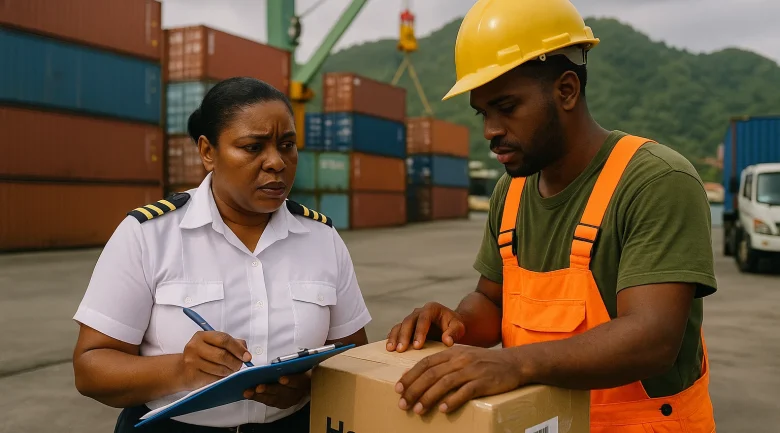
- Powers of customs officers – Customs officials are authorised to board vessels, inspect cargo, examine documentation, and seize goods believed to be in violation of customs rules.
- Customs declarations and documentation – All goods entering Dominica must be declared through manifests, invoices, and standardised forms, with penalties for false or incomplete declarations.
- Warehousing and bonded storage – The Act allows for bonded warehouses where goods may be stored under customs supervision pending payment of duties.
- Prohibited and restricted goods – Narcotics, unlicensed firearms, counterfeit products, and certain hazardous items are explicitly banned, while restricted goods require special permits.
- Valuation of goods – Provisions establish how goods are valued for duty purposes, consistent with the WTO Customs Valuation Agreement, preventing under-invoicing and fraud.
- Smuggling and offenses – Strict penalties are imposed for smuggling, fraudulent declarations, or interference with customs operations, including fines and imprisonment.
- Appeals and redress – Traders have the right to appeal customs decisions through administrative and judicial processes.
Relationship with other legislation
The Customs Act functions within Dominica’s broader legal ecosystem for financial regulation and crime prevention. It complements the Proceeds of Crime Act, which enables the confiscation of assets derived from smuggling and customs fraud. The Drugs (Prevention of Misuse) Act grants customs powers where narcotics trafficking is intercepted at ports. The Money Laundering Prevention Act ensures that illicit funds generated from customs-related offenses are traceable and punishable. International enforcement is further supported by the Mutual Assistance in Criminal Matters Act and the Extradition Act, which allow Dominica to cooperate with other jurisdictions in prosecuting offenders who operate across borders.
Role of the Customs and Excise Division
The Customs and Excise Division is the primary agency responsible for implementing the Customs Act. It collects duties, monitors goods at entry points, and enforces restrictions on prohibited items. The Division also collaborates with the Commonwealth of Dominica Police Force, the Financial Intelligence Unit (FIU), and the Financial Services Unit (FSU), particularly in cases involving smuggling, drug trafficking, and trade-based money laundering.
The Customs Division has also played a critical role in Dominica’s economic governance, as customs duties account for a significant share of government revenue. By modernising operations under the 2010 Act, the Division has reduced inefficiencies, introduced risk-based inspections, and supported the use of electronic filing systems to speed up trade.
The Act is vital to Dominica’s financial stability. Customs duties and excise taxes are among the main sources of non-grant government revenue. By ensuring proper collection, the Act supports the national budget and public services.
From an enforcement perspective, the Act equips authorities to tackle narcotics smuggling and arms trafficking, both of which are regional security concerns.
International cooperation and trade facilitation
Dominica’s Customs Act aligns its practices with international standards. As a member of the World Customs Organization and the World Trade Organization, Dominica is obligated to maintain transparent, non-discriminatory customs procedures. The Act incorporates these principles, fostering investor confidence and ensuring that Dominica remains an attractive destination for trade and business.
Within CARICOM, the Act supports the Caribbean Single Market and Economy (CSME) by standardising customs procedures, reducing barriers to trade, and promoting intra-regional trade. It also plays a role in global efforts to counter illicit trade, ensuring that Dominica participates actively in cooperative enforcement operations across the Caribbean.
Contemporary challenges and outlook
Despite modernisation, Dominica continues to face challenges in implementing the Act. Limited resources for maritime patrols, the high cost of scanning and inspection technology, and pressure from rising trade volumes all strain enforcement capacity. Smuggling networks continue to adapt, using advanced concealment techniques and exploiting weak points in the chain of control.
Looking ahead, further digitisation of customs procedures, enhanced training for customs officers, and deeper international cooperation will be critical for maintaining the effectiveness of the Act. For Dominica, customs law will remain a central pillar of both economic management and national security.


