


Rasta
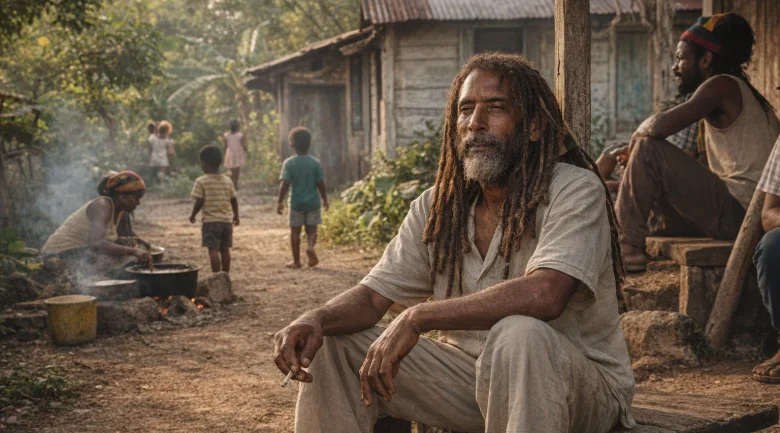
The term Rasta within the Commonwealth of Dominica points to a particular sociopolitical role shaped by the pressures of the 1970s. Whereas “Rastafari” names the global movement and “Rastafarian” serves as a formal title, Rasta represents a local commitment to resistance.
Rasta life in Dominica developed as both a spiritual path and a social stance, shaped by African consciousness, resistance to inherited authority, and a search for moral order in a society marked by inequality and control. The movement’s presence has left a lasting mark on politics, law, culture, and national self-understanding.
The Identity Hierarchy: Rasta vs. Rastafari vs. Dread
The nuance of these terms in Dominica is rooted in the “Reasonings” of the 1970s, where language was used as a tool of liberation.
- Rastafari: This is the sacred name of the livity itself, emphasising the spiritual connection to Emperor Haile Selassie I. In the local context, identifying as “Rastafari” meant claiming a spiritual and theological status that transcended politics. It focused on the Nyabinghi traditions and the “I-and-I” philosophy.
- Rasta: This became the common social and cultural descriptor. In the 1970s, “Rasta” was often used to describe the lifestyle, diet (Ital), music, and communal agricultural practices. It was the label of the living man who rejected the Babylonian system of the urban centres like Roseau.
- Rastafarian: This term was frequently viewed with suspicion by those within the movement. In Dominica, Rastafarianism was seen as an “ism” or a “schism”, a Western academic label that attempted to categorise a spiritual livity as a mere political ideology or “religion.” Many practitioners preferred to omit the “ian” to avoid being classified by the state.
- Dread: This was the most politically charged term. While many Dreads were Rasta, not all Rasta identified with the Dread militancy. The Dread was the radicalised youth who used the Rastafarian aesthetic as a badge of war against the Patrick John administration.
Origins and early influences
Rastafari ideas reached Dominica during the mid-20th century through returning migrants, sailors, religious texts, and Caribbean radio. Early adherents were influenced by Ethiopianism, Pan-African thought, and the coronation of Haile Selassie I, whose role in African history resonated deeply with Black communities across the Caribbean.
In Dominica, early Rasta believers often encountered resistance from churches, employers, and authorities. The movement questioned colonial Christianity, rejected European cultural norms, and promoted African identity, self-reliance, and spiritual discipline. These ideas found particular traction among youth who felt excluded from political and economic opportunity during the final years of British administration.
Social setting and early communities
By the late 1960s, small Rasta circles existed in Roseau and surrounding districts, often meeting informally for reasoning sessions, prayer, and discussion. These gatherings were modest in size but intense in purpose. Members adopted natural hair, new names, and a disciplined lifestyle that challenged dominant standards of respectability.
Rasta communities emphasised communal support, veganism, and moral conduct. The use of drums, chanting, and scriptural interpretation drew from African and Caribbean traditions, creating a spiritual culture distinct from mainstream religious life. These practices, while peaceful, were often misrepresented by officials and media as signs of disorder.
Rasta and Black Power consciousness
Rasta identity in Dominica became closely linked with Black Power ideas during the late 1960s and early 1970s. The movement’s critique of colonial authority, land inequality, and cultural alienation overlapped with radical political thought circulating at the time. Many Rasta youth participated in study groups, public discussions, and publishing efforts that questioned the legitimacy of inherited power structures.
This convergence produced what became locally known as “Dread” consciousness, a form of Rastafari expression that was overtly political. It rejected incremental reform and argued for deep social transformation. Language, dress, and music functioned as statements of refusal and self-definition.
State reaction and policing
As Rasta visibility increased, the state response hardened. Authorities associated Rastafari identity with political agitation, vagrancy, and threats to public order. Police harassment, arbitrary arrests, and workplace discrimination became common experiences for Rasta men and women.
Tensions escalated under the government of Patrick John, who publicly framed Dreads as a danger to national stability. Surveillance intensified, and confrontations between police and Rasta youth became more frequent. The movement’s spiritual practices were increasingly treated as political provocation.
The Dread Act and repression
The most severe episode of repression occurred in 1974 with the passage of the Prohibited and Unlawful Societies and Associations Act, commonly known as the Dread Act. The law criminalised Rastafari identity, authorised extreme policing powers, and penalised citizens who sheltered or assisted suspected Dreads.
The Act had immediate and lasting consequences. Rasta communities were forced into hiding, families were displaced, and fear spread well outside activist circles. The legislation also exposed deep divisions within Dominican society, prompting debates about civil rights, constitutional limits, and the use of law as a tool of political control.
Desmond Trotter and symbolic struggle
No figure became more closely associated with the Rasta experience in Dominica than Desmond Trotter, later known as Ras Kabinda Habre Selassie. His arrest, conviction, and death sentence in 1974 transformed him into an international symbol of repression and resistance.
For many Rastas, Trotter’s case confirmed that the state was prepared to use the legal system to silence dissent. His subsequent pardon and acquittal following the political upheaval of 1979 reinforced the belief that justice had been subordinated to political expediency. His later repatriation to Shashamane further cemented his status as a figure linking Dominican Rasta identity to the global movement.
Cultural expression and music
Despite repression, Rasta culture continued to influence Dominican life. Nyabinghi drumming, chanting, and communal gatherings persisted quietly, sustaining spiritual practice during periods of hostility. Language, proverbs, and ritual reinforced collective identity and moral discipline.
Rasta thought also shaped artistic expression. Musicians, poets, and visual artists drew on themes of African pride, resistance, and spiritual renewal. While reggae did not dominate Dominican music as it did in Jamaica, its presence contributed to a broader Caribbean exchange of ideas and aesthetics.
The 1979 uprising and shifting attitudes
The collapse of the Patrick John administration in 1979 marked a turning point. The release and pardon of imprisoned activists signalled a retreat from overt repression. While suspicion toward Rastas did not vanish, public hostility softened, and space opened for cultural reassessment.
The years following independence saw the gradual reintegration of Rasta individuals into public life. Some became farmers, craftsmen, musicians, or community organisers. Others migrated, maintaining ties with diaspora networks in the United Kingdom, North America, and Africa.
Repatriation and global connections
For many Dominican Rastas, repatriation to Africa represented a spiritual objective rather than a mass migration. A small number relocated to Ethiopia, particularly Shashamane, joining an international Rastafari community. These connections reinforced a sense of belonging to a wider African world and kept Dominican Rasta identity linked to global currents.
Those who remained on the island maintained transnational ties through visits, correspondence, and cultural exchange. These relationships influenced local understandings of identity, spirituality, and history.
Contemporary presence and perception
In contemporary Dominica, Rasta identity is more visible and less openly criminalised than during the 1970s. While discrimination has not disappeared, Rastafari are now recognised as part of the nation’s cultural mosaic. Their contributions to agriculture, music, herbal knowledge, and community life are increasingly acknowledged.
Public memory of repression has also deepened. The Dread Act period is now widely discussed as a cautionary episode in the use of state power. Rasta experience is frequently cited in debates about civil liberties, policing, and constitutional governance.
Historical weight and legacy
Rasta in Dominica represents a sustained challenge to imposed norms of authority, culture, and identity. From marginalisation and legal repression to cultural persistence and gradual recognition, the movement’s trajectory reflects broader struggles within Caribbean post-colonial societies.
Its legacy lies not only in visible practices or famous figures, but in the questions it forced society to confront: who defines respectability, whose culture counts, and how power is exercised. These questions continue to shape Dominican public life.


References
-
1.
The Dread Act · History of The Rastafarians – DomFari https://domfari.omeka.net/exhibits/show/rastahistory/the-dread-act
-
2.
Human Rights and Development: 1978 Report https://www.icj.org/wp-content/uploads/1978/01/Caribbean-human-rights-and-their-promotion-report-1978-eng.pdf
-
3.
Dread Rastafari and Ethiopia: A Landmark Account – Emonews https://emonewsdm.com/dread-rastafari-and-ethiopia-a-landmark-historical-account-of-the-rastafari-movement-in-dominica/