




Oath of Allegiance in Dominica
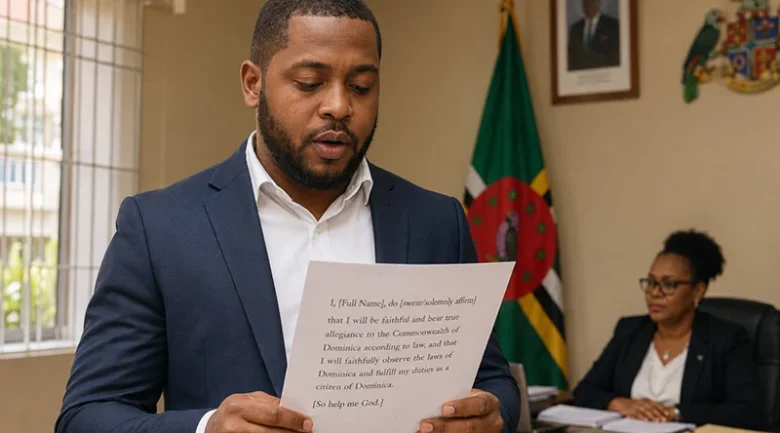
The Oath of Allegiance is the final, solemn legal requirement for any individual seeking to become a citizen of the Commonwealth of Dominica. While it is a standard part of naturalization globally, in Dominica, it carries specific weight within the Citizenship by Investment (CBI) program and is governed by strict constitutional and regulatory protocols.
The Official Wording
The oath can be taken either as a religious Oath or a secular Affirmation. The text is standardised as follows:
“I, [Full Name], do [swear/solemnly affirm] that I will be faithful and bear true allegiance to the Commonwealth of Dominica according to law, and that I will faithfully observe the laws of Dominica and fulfill my duties as a citizen of Dominica. [So help me God.]”
Legal Framework (2026 Updates)
The Oath is not merely a symbolic gesture; it is a statutory requirement under Section 101 of the Constitution of Dominica and the Citizenship by Investment Act.
The 2025–2026 Regulatory Shift
As of January 2026, the process is governed by the Citizenship by Investment (Amendment) Regulations, 2025 (S.R.O. 46 of 2025) and overseen by the newly established Eastern Caribbean Citizenship by Investment Regulatory Authority (ECCIRA). Key changes affecting the oath include:
- Mandatory Virtual Interview: Before the Oath can be administered, all applicants aged 16 and over must pass a mandatory virtual identity and security interview.
- Remote Execution: In 2026, the government formally allows the Oath to be signed remotely (abroad), provided it is witnessed by an authorized official in the applicant’s jurisdiction.
- Name Change Restrictions: Once the Oath is taken and citizenship is granted, new citizens are strictly prohibited from changing their names for five years, a measure introduced to prevent identity fraud.
Execution Procedure
The Oath is the final step in the Naturalisation phase. It only occurs after the Approval in Principle is granted, and the financial investment (minimum $200,000 as of 2026) has been confirmed by the government.
The Witnessing Requirement
The document cannot be signed in private. It must be executed in the presence of an authorised official who gives public faith to the signature. Authorised witnesses include:
- Notary Public (Most common for international applicants).
- Justice of the Peace (JP).
- Commissioner of Oaths.
- Dominican Diplomatic Official (at an embassy or consulate).
The Signing Process
- Verification: The witness verifies the applicant’s identity using their current valid passport.
- Administration: The applicant recites the wording aloud.
- Endorsement: The applicant signs the form, and the official affixes their seal or stamp.
- Submission: The original signed and sealed Oath is couriered to the Citizenship by Investment Unit (CBIU) in Roseau.
Requirements for Dependents
The rules for the Oath vary depending on the age and status of the family members included in an application:
| Category | Requirement |
| Main Applicant | Must sign individually. |
| Spouse | Must sign individually. |
| Children (16–30) | Must sign individually (after passing the mandatory interview). |
| Children (Under 16) | Both parents must sign the Oath on the child’s behalf. If one parent has sole custody, legal proof is required. |
| Parents/Grandparents (65+) | Must sign individually. |
Why the Oath Matters
The moment the signed Oath is accepted by the CBIU, the Certificate of Naturalisation is issued. This certificate is the source document for the Dominican Passport.
Taking the Oath grants the applicant the same irrevocable rights as a natural-born Dominican, including:
- The right to live and work in Dominica indefinitely.
- The right to pass citizenship down to future generations (hereditary status).
- Consular protection from the Commonwealth of Dominica worldwide.
Practical Tip for 2026-30: If you are executing the Oath outside of Dominica, ensure your Notary’s commission is active and their seal is clearly legible. In some jurisdictions, the CBIU may require the Notary’s signature to be further authenticated by an Apostille or at a Dominican Consulate to meet the enhanced 2026 due diligence standards.


