



Certificate of Naturalization in Dominica
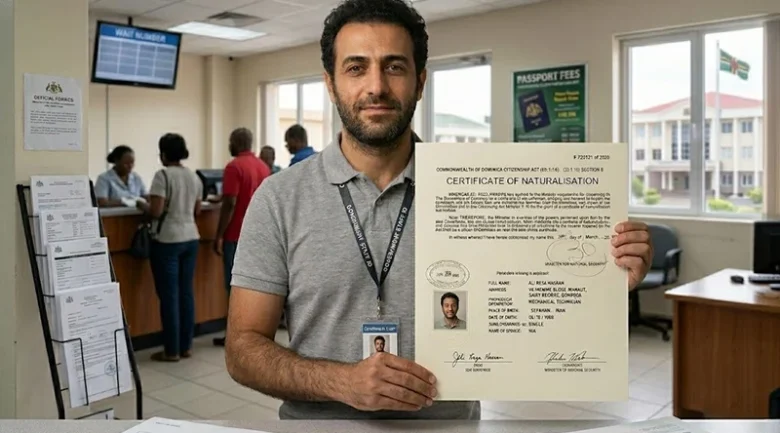
The Certificate of Naturalization is the ultimate legal document issued by the Government of the Commonwealth of Dominica, serving as conclusive proof that a non-national has been granted full citizenship. While a passport is a travel document that can expire or be revoked, the Certificate of Naturalization is the source document, the permanent record of the holder’s legal status as a Dominican.
Today, this document has evolved into a high-security instrument, integrated with regional oversight and digital verification systems to maintain the integrity of the Dominican state.
Legal Foundation and Authority
The issuance of this certificate is grounded in Chapter VII of the Constitution of Dominica and the Citizenship Act (Cap. 1:10). It is the formal instrument by which the Minister responsible for Citizenship (currently under the Ministry of National Security and Legal Affairs) exercises the power to grant nationality.
For those pursuing citizenship through the Citizenship by Investment (CBI) program, the certificate is the final deliverable of a multi-stage process governed by the Citizenship by Investment Regulations. In 2026, the Eastern Caribbean Citizenship by Investment Regulatory Authority (ECCIRA) provides an additional layer of regional audit to ensure that every certificate issued meets the highest international due diligence standards.
The Journey to Issuance
A Certificate of Naturalization is not simply bought; it is earned through a rigorous legal sequence. The certificate is only generated once the following conditions are met:
- Final Approval: The applicant has received Approval in Principle from the CBIU.
- Financial Settlement: The required investment (starting at $200,000 USD in 2026) or real estate payment has been verified.
- The Oath of Allegiance: The applicant must sign the Oath. The Certificate is dated and issued only after the signed Oath is received and processed by the Registry Division in Roseau.
Security Features and Design
To combat identity theft and document forgery, the latest version of the Certificate of Naturalization includes several sophisticated security layers:
- Watermarked Security Paper: The document is printed on specialized heavy-bond security paper with embedded security fibers and multi-tonal watermarks that are highly resistant to replication.
- The Great Seal: Every document features a crisp, embossed (raised) impression of the official Public Seal of the Commonwealth of Dominica, applied physically upon registration.
- Secure Archival Registration: Each certificate carries a unique, hand-signed registration number that corresponds directly with the permanent, physical master logs maintained securely at the High Court Registry in Roseau.
The “Source Document” for Passports
The most critical practical use of the Certificate of Naturalization is as the primary supporting document for a Dominica Passport application.
When a new citizen applies for their first passport at the Immigration Department on Bath Road, they must present the original Certificate of Naturalization. Because the passport is an identity derivative, any error on the certificate (such as a misspelt name or incorrect date of birth) will be carried over to the passport. This is why new regulations strictly require applicants to report any clerical errors on the certificate within 1 month of receipt.
Rights Granted by the Certificate
Once the certificate is in your possession, you are legally indistinguishable from a natural-born Dominican in terms of rights and responsibilities. These include:
- Hereditary Transmission: The right to pass Dominican citizenship down to future generations (subject to specific registration rules for children born abroad).
- Right of Abode: The absolute right to live, work, and own land in Dominica without a Work Permit or Alien Landholding License.
- CARICOM Benefits: As a Dominican citizen, the certificate-holder is also a CARICOM national, granting specific rights of movement and trade within the Caribbean Community.
- Voting Rights: After meeting the residency requirements (typically 12 months of living in a constituency), naturalized citizens have the right to vote in general elections.
Lost or Damaged Certificates
The Certificate of Naturalization is arguably the most important document a new citizen will ever own. It should be treated with the same care as a deed to a house.
The Replacement Process (2026)
If a certificate is lost, stolen, or destroyed, obtaining a replacement is a complex administrative task:
- Police Report: A formal report must be filed in the jurisdiction where the loss occurred.
- Affidavit of Loss: The citizen must swear an affidavit before a Justice of the Peace or Notary Public explaining the circumstances.
- Application for Duplicate: An application must be submitted to the Ministry of National Security, accompanied by a replacement fee (which increased in 2026 to deter negligence).
- Verification: The Ministry cross-references the request against the digital database and the original Registry entries before issuing a Certified Duplicate.
Naturalization vs. Registration
The operational boundaries between naturalization and registration are explicitly defined under the Dominica Citizenship Act (Chapter 1:10). This legislation creates separate administrative pathways to manage the island’s geopolitical relationships and historical Commonwealth ties.
┌───────────────────────────┐ │ DOMINICA CITIZENSHIP ACT │ │ (Chapter 1:10) │ └─────────────┬─────────────┘ │ ┌───────────────────────┴───────────────────────┐ ▼ ▼ ┌───────────────────────────┐ ┌───────────────────────────┐ │ NATURALIZATION │ │ REGISTRATION │ │ (Section 8) │ │ (Sections 5, 6, & 7) │ └────────────┬──────────────┘ └────────────┬──────────────┘ │ │ • Target: Non-Commonwealth Citizens • Target: Commonwealth Citizens, • CBI Program Applicants │ Spouses, & Children by Descent • Requires Oath of Allegiance • Verifies familial/geopolitical ties- The Naturalization Pathway (Section 8): This process applies strictly to applicants who have no ancestral ties to Dominica and hold passports from non-Commonwealth countries. Because the Citizenship by Investment (CBI) program caters primarily to international investors from outside the Commonwealth, it functions almost exclusively through this naturalisation framework.
- The Registration Pathway (Sections 5, 6, and 7): This track simplifies the acquisition of citizenship for individuals with established connections to the state. Under Section 5, citizens from other Commonwealth nations enjoy a streamlined registration process based on long-term residency. Section 6 governs matrimonial applications, allowing spouses of Dominican nationals to register, while Section 7 permits children born overseas to register their inherent citizenship by descent.
Regardless of the initial administrative track, both pathways lead to identical legal statuses. Once a certificate is stamped and registered at the Registry in Roseau, both citizens receive identical constitutional protections, passport privileges, and voting rights.


References
-
1.
How Do I Apply for Citizenship of the Commonwealth of Dominica? https://dominica.gov.dm/services/citizenship/how-do-i-apply-for-citizenship-of-the-commonwealth-of-dominica
-
2.
Dominica Citizenship by Investment Unit (CBIU) Official Homepage https://www.cbiu.gov.dm/dominica-citizenship/
-
3.
Henley & Partners Dominica Regulatory Profile https://www.henleyglobal.com/citizenship-investment/dominica
-
4.
Official E-Passport Application Instruction Sheet https://www.dominica.gov.dm/images/docs/services/dominica_epp_and_sid_application_instructions_v1_30Mar2021.pdf
-
5.
Dominica Citizenship by Naturalization https://dominicaconsulateinvietnam.org/services/citizenship-by-naturalization/
-
6.
Dominican Consulate Passport Renewal https://dominicaconsulategreece.com/dominica-passport-renewal-requirements/